وسائط ذات صلة
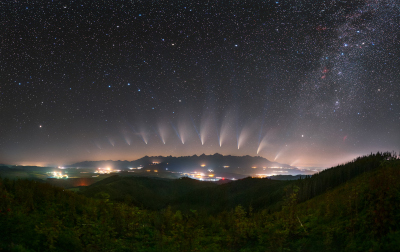
Neowise's metamorphosis, by Tomáš Slovinský and Petr Horálek, Slovakia
الشرح: First place in the 2021 IAU OAE Astrophotography Contest, category Comets.
This image uses the chronophotography technique to capture the evolution of the comet C/2020 F3 (Neowise) over time, as it became visible in the northern skies in July 2020. Orbits of comets are extremely elliptical, which means that during part of their orbit they get close to the Sun. As a comet approaches the Sun, it gets heated, releases gas and dust creating an envelope or coma around the nucleus. The solar wind and photons (particles of electromagnetic radiation) interact with the coma producing the cometary tail, which can be seen clearly in this image. The tail of a comet always points away from the Sun, and extends as much as tens of millions of kilometres. This tail has two parts: the relatively straight bluish gas (ion or plasma) tail, which is made up of charged particles interacting with the magnetic fields of the solar wind; and the whitish dust tail compose of very small dust particles that are pushed by the radiation pressure from the Sun into a curve due to their slower speeds. Two regions in the Solar System are often associated with being “storehouses” of comets: the Kuiper Belt and the Oort Cloud. Comets with periods up to about two hundred years come from the Kuiper belt, a reservoir of cometary nuclei material with a disk-like shape located beyond Neptune. Longer period comets come from the Oort cloud, another huge reservoir of icy objects, with a spherical shape surrounding the Solar System. The outer limit of the Oort Cloud is not known as yet, but it could be as much as 10 thousand times the Sun-Earth distance, or even more. Due to gravitational disturbances, some of these cometary nuclei might be ejected towards the inner regions of the Solar System, sometimes approaching the Earth, offering some of the most spectacular views of a celestial body. The image also shows some prominent constellations and asterisms like the Big and Little Dippers, and also the North (Pole) Star – Polaris.
المصدر: Tomáš Slovinský and Petr Horálek/IAU OAE
License: CC-BY-4.0 المشاع الإبداعي نَسب المُصنَّف 4.0 دولي (CC BY 4.0) أيقونات
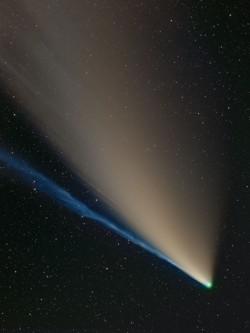
Comet C/2020F3 (Neowise) with separate dust and ion gas tails and a green glowing coma, by Dietmar Gutermuth, Germany
الشرح: Second place in the 2021 IAU OAE Astrophotography Contest, category Comets.
Comets have a very interesting structure comprising of four main parts: the nucleus, composed of rock, dust and frozen gases, typically spanning a few kilometres, although bigger ones have been observed; a small atmosphere of gas surrounding the nucleus (only present when the comet approaches its closest point to the Sun), called coma; and the two distinctive cometary tails (there is at times third tail). The green colour of the coma is due to carbon and nitrogen present in the coma reacting with the Sun’s ultraviolet radiation. The tail that we are mostly used to observing – dust tail and is composed of micron sized dust particles, the second tail composed of charged particles – ion or gas tail. The tails are released only when the comet approaches the Sun at a distance where the heat and radiation emanating from our star is intense enough to vaporize the frozen gases. The dust tail is curved, while the gas tail is straight and always points away from the Sun as this is carried by the solar wind - flow of charged particles emitted by the Sun. As comets are formed by leftover material, they carry with them important information about the early stages of the Solar System’s formation. This beautiful image shows the comet C/2020 F3 (Neowise), as seen from Germany in July 2020, with three of the four structures clearly visible – coma, gas, and dust tail.
المصدر: Dietmar Gutermuth/IAU OAE
License: CC-BY-4.0 المشاع الإبداعي نَسب المُصنَّف 4.0 دولي (CC BY 4.0) أيقونات
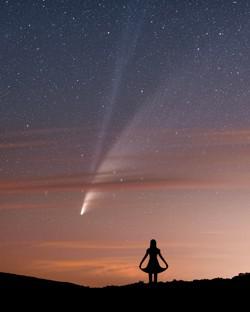
صورة بعنوان مرحباً ايها المذنب ، هل نرقص؟ بعدسة روبرت بارسا ، سلوفاكيا
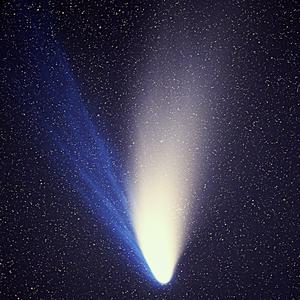
المذنب هال بوب
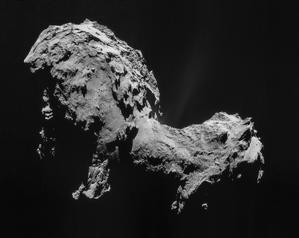
المذنب 67 بي/تشوريوموف جيراسيمنكو
الأنشطة المرتبطة
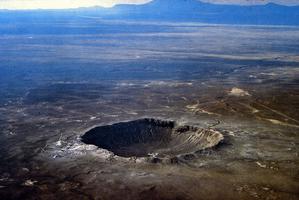
Meteoroids, Meteors and Meteorites
astroEDU educational activity (links to astroEDU website) Description: Unveiling the mystery of "shooting stars": meteors, meteorites and meteroids
License: CC-BY-4.0 المشاع الإبداعي نَسب المُصنَّف 4.0 دولي (CC BY 4.0) أيقونات
وسوم:
Geology
الفئات العمرية:
6-8
, 8-10
, 10-12
, 12-14
المرحلة التعليمية:
المرحلة المتوسطة
, المرحلة الابتدائية
مجالات التعلم:
محاضرة تفاعلية
التكاليف:
تكلفة منخفضة
المدة:
ساعة ونصف
حجم المجموعة:
جماعي
المهارات:
تحليل البيانات وتفسيرها
, طرح الأسئلة
, توصيل المعلومات
, بناء حجج استنادًا إلى الأدلة
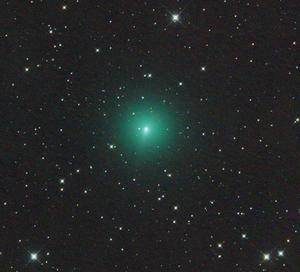
Measuring the average speed of a comet
astroEDU educational activity (links to astroEDU website) Description: Using telescope images of comet C/2019 Y4 we calculate its average speed and understand what a physical quantity is
License: CC-BY-4.0 المشاع الإبداعي نَسب المُصنَّف 4.0 دولي (CC BY 4.0) أيقونات
وسوم:
Software
, average speed
الفئات العمرية:
12-14
, 14-16
, 16-19
, 19+
المرحلة التعليمية:
المرحلة الثانوية
التكاليف:
مجاني
المدة:
ساعة ونصف
حجم المجموعة:
جماعي
المهارات:
تحليل البيانات وتفسيرها
, تطوير النماذج واستخدامها
, بناء حجج استنادًا إلى الأدلة