بلغات أخرى
- الألمانيّة: Zodiakallicht
- الإنجليزيّة: Zodiacal Light
- الإسبانيّة: Luz zodiacal
- الفارسيّة: نور منطقة البروجی
- الفرنسيّة: Lumière zodiacale
- الإيطاليّة: Luce zodiacale
- اليابانيّة: 黄道光 (رابط خارجي)
- البرتغاليّة البرازيليّة: Luz Zodiacal
- الصينيّة المبسطة: 黄道光
- الصينيّة التقليدية: 黃道光
وسائط ذات صلة
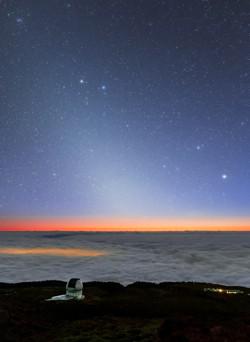
Zodiacal Light over GTC Observatory
الشرح: Winner in the 2022 IAU OAE Astrophotography Contest, category Still images of celestial patterns.
Taken from La Palma, Canary Islands, in May 2022, this image captures the Zodiacal light, three prominent constellations (Gemini, Cancer and Auriga), and the Beehive Cluster, which appears as a small nebulosity to the unaided eye under dark skies. The Zodiacal light is a triangular white glow stretching along the ecliptic that is visible here at the western horizon shortly after sunset.The Canary Islands were considered the westernmost land of the inhabited world by the ancient Greeks. The dim shimmer in the Zodiac might have inspired the Greek philosopher Plato to think that the Sun leaves a trace of sunny glitter in its wake, and that the current path of the Sun, the ecliptic, has not always been its path. Plato believed that the Milky Way was a former path of the Sun and that its bright clouds are sparks of the Sun’s glory left behind. Today, we know that these two phenomena in the sky have different causes; while the Zodiacal light is really caused by reflection of sunlight from very tiny dust particles in the plane of the ecliptic, the Milky Way consists of billions of stars. The Zodiacal light is a smooth cone of light from the horizon upwards, while the Milky Way crosses the whole sky and also includes dark clouds.
The Zodiac is described by Indigenous Australians as the Dreaming Road, and the Zodiacal light is a celestial rope connecting Venus to the Sun. The two bright stars in the top-left of the image are Castor (the bluish star) and Pollux (the whitish star), which are part of the constellation Gemini, the Twins. The two bright stars towards the bottom-right of the image are Menkalinan (the dimmer one) and Capella (the brighter one), which are part of the constellation Auriga, the Charioteer.
The Wergaia people of Western Victoria in Australia see Castor and Pollux as brothers who hunt the kangaroo Purra in their stories. This has coincidental similarities to the Babylonian story, where they are considered two strong gods of the Netherworld, depicted with weapons. The Greco-Roman myth of the twins describes them as two brothers who accompanied the first ocean sailor, Jason, on voyages with the The Ship, Argo. A similar myth exists in the Blackfoot traditions of the First Nations people of Canada and the USA, where they are considered the two brothers Ashes Chief and Struck-behind.
المصدر: Amirreza Kamkar/IAU OAE
License: CC-BY-4.0 المشاع الإبداعي نَسب المُصنَّف 4.0 دولي (CC BY 4.0) أيقونات