Terme du glossaire : Lumière zodiacale
Description : Dans le système solaire, les planètes et les autres corps orbitent principalement dans le plan de l'écliptique. La poussière interplanétaire présente dans notre voisinage cosmique est également concentrée près de ce plan. Une partie de la lumière du Soleil est réfléchie par ces grains de poussière interplanétaire dans l'écliptique en direction de la Terre. En principe, cela produit un léger ruban lumineux dans le ciel nocturne, le long du zodiaque - la région du ciel nocturne proche de l'écliptique. En pratique, cette lueur n'est visible à l'œil nu qu'à l'est, peu avant le lever du soleil, ou à l'ouest, peu après le coucher du soleil, uniquement à proximité de l'horizon et à partir d'un lieu d'observation naturellement sombre. Cette partie visible de la lueur est la lumière zodiacale : une région lumineuse diffuse ayant la forme d'un triangle arrondi et allongé qui s'étend depuis l'horizon sur une courte distance le long de l'écliptique.
Termes associés :
Voir ce terme dans d'autres langues
Statut du terme et de sa définition : La définition initiale de ce terme en anglais a été aprouvée par un·e spécialiste de la recherche en astronomie et un·e spécialiste de l’éducation La traduction de ce terme et de sa définition n'ont pas encore été aprouvées
Le glossaire multilangue de l'OAE est un projet du Bureau de l'IAU de l'Astronomie pour l'Education (OAE) en collaboration avec le Bureau de l'IAU de diffusion de l'Astronomie (OAO). Les termes et définitions ont été choisis, écrits et relues grâce à un effort collectif de l'OAE, les Centres et les Noeuds de l'OAE, les Coordinateurs Nationaux de l'Astronomie pour l'Education de l'OAE(NAECs) et d'autres volontaires. La liste complète des crédits pour ce projet est disponible ici . Tous les termes du glossaire et leur définition sont déposés sous licence Creative Commons CC BY-4.0 et doivent être créditées au nom de "IAU OAE".
Si vous constatez une erreur dans ce terme ou sa définition, veuillez nous contacter .
Dans d'autres langues
- Arabe: الضوء البروجي
- Allemand: Zodiakallicht
- Anglais: Zodiacal Light
- Espagnol: Luz zodiacal
- Perse: نور منطقة البروجی
- Italien: Luce zodiacale
- Japonais: 黄道光 (Liens externes)
- Portugais brésilien: Luz Zodiacal
- Chinois simplifié: 黄道光
- Chinois traditionnel: 黃道光
Media associé
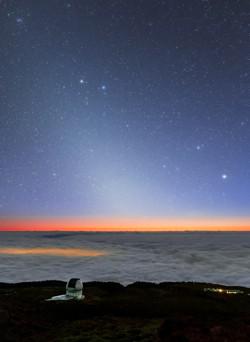
Zodiacal Light over GTC Observatory
Légende : Winner in the 2022 IAU OAE Astrophotography Contest, category Still images of celestial patterns.
Taken from La Palma, Canary Islands, in May 2022, this image captures the Zodiacal light, three prominent constellations (Gemini, Cancer and Auriga), and the Beehive Cluster, which appears as a small nebulosity to the unaided eye under dark skies. The Zodiacal light is a triangular white glow stretching along the ecliptic that is visible here at the western horizon shortly after sunset.The Canary Islands were considered the westernmost land of the inhabited world by the ancient Greeks. The dim shimmer in the Zodiac might have inspired the Greek philosopher Plato to think that the Sun leaves a trace of sunny glitter in its wake, and that the current path of the Sun, the ecliptic, has not always been its path. Plato believed that the Milky Way was a former path of the Sun and that its bright clouds are sparks of the Sun’s glory left behind. Today, we know that these two phenomena in the sky have different causes; while the Zodiacal light is really caused by reflection of sunlight from very tiny dust particles in the plane of the ecliptic, the Milky Way consists of billions of stars. The Zodiacal light is a smooth cone of light from the horizon upwards, while the Milky Way crosses the whole sky and also includes dark clouds.
The Zodiac is described by Indigenous Australians as the Dreaming Road, and the Zodiacal light is a celestial rope connecting Venus to the Sun. The two bright stars in the top-left of the image are Castor (the bluish star) and Pollux (the whitish star), which are part of the constellation Gemini, the Twins. The two bright stars towards the bottom-right of the image are Menkalinan (the dimmer one) and Capella (the brighter one), which are part of the constellation Auriga, the Charioteer.
The Wergaia people of Western Victoria in Australia see Castor and Pollux as brothers who hunt the kangaroo Purra in their stories. This has coincidental similarities to the Babylonian story, where they are considered two strong gods of the Netherworld, depicted with weapons. The Greco-Roman myth of the twins describes them as two brothers who accompanied the first ocean sailor, Jason, on voyages with the The Ship, Argo. A similar myth exists in the Blackfoot traditions of the First Nations people of Canada and the USA, where they are considered the two brothers Ashes Chief and Struck-behind.
Crédit : Amirreza Kamkar/IAU OAE
License: CC-BY-4.0 Creative Commons (CC) Attribution 4.0 International (CC BY 4.0) Icônes
Ceci pourrait vous intéresser également







- Ressources
- Moteur de recherche des ressources pédagogiques
- Parcourir les ressources pédagogiques par Sujet
- Parcourir les images
- AstroEdu - Activités en classe
- Grandes Idées - Littéracie en astronomie
- Glossaire
- Rapports de l'OAE
- L'astronomie pour l'Education à travers le monde
- Sélection de ressources externes