Término del glosario: Luz zodiacal
Descripción: Dentro del Sistema Solar, los planetas y otros cuerpos celestes orbitan en su mayoría dentro del plano de la eclíptica. El polvo interplanetario de nuestro entorno cósmico también se concentra cerca de ese plano. Parte de la luz solar es reflejada por esos granos de polvo interplanetario que se encuentran en la eclíptica hacia la Tierra. En principio, esto produce una tenue franja luminosa que atraviesa el cielo nocturno, a lo largo del zodíaco —la región del cielo nocturno cercana a la eclíptica—. En la práctica, ese resplandor solo es visible a simple vista hacia el este poco antes del amanecer o hacia el oeste poco después del atardecer, únicamente cerca del horizonte y solo desde un lugar de observación naturalmente oscuro. Esa parte visible del resplandor es la luz zodiacal: una región difusa y brillante con forma de triángulo redondeado y alargado que se extiende desde el horizonte a lo largo de un pequeño tramo de la eclíptica.
Términos relacionados:
Ver este término en otros idiomas
Estado del término y la definición: La definición original de este término en inglés ha sido aprobada por unastrónomo o astrónoma investigadora y un docente La traducción de este término y su definición aún están pendientes de aprobación
El Glosario multilingüe de la OAE es un proyecto de la Oficina de Astronomía para la Educación de la UAI (OAE) en colaboración con la Oficina de Divulgación de Astronomía de la UAI (OAO). Los términos y definiciones fueron seleccionados, redactados y revisados gracias al esfuerzo colectivo de la OAE, los Centros y Nodos de la OAE, los Coordinadores Nacionales de Educación Astronómica (NAECs) y otros voluntarios. Puedes encontrar una lista completa de créditos aquí. Todos los términos del glosario y sus definiciones se publican bajo la licencia Creative Commons CC BY-4.0 y deben atribuirse a la "IAU OAE".
Si detectas algún error de contenido o de traducción en este término del glosario o en ladefinición, ponte en contacto con nosotros.
En otros idiomas
- Árabe: الضوء البروجي
- Alemán: Zodiakallicht
- Inglés: Zodiacal Light
- Persa: نور منطقة البروجی
- Francés: Lumière zodiacale
- Italiano: Luce zodiacale
- Japonés: 黄道光 (enlace externo)
- Portugués de Brasil: Luz Zodiacal
- Chino simplificado: 黄道光
- Chino tradicional: 黃道光
Contenidos relacionados
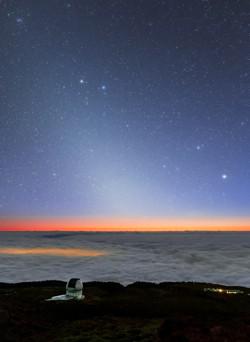
Zodiacal Light over GTC Observatory
Pie de foto: Winner in the 2022 IAU OAE Astrophotography Contest, category Still images of celestial patterns.
Taken from La Palma, Canary Islands, in May 2022, this image captures the Zodiacal light, three prominent constellations (Gemini, Cancer and Auriga), and the Beehive Cluster, which appears as a small nebulosity to the unaided eye under dark skies. The Zodiacal light is a triangular white glow stretching along the ecliptic that is visible here at the western horizon shortly after sunset.The Canary Islands were considered the westernmost land of the inhabited world by the ancient Greeks. The dim shimmer in the Zodiac might have inspired the Greek philosopher Plato to think that the Sun leaves a trace of sunny glitter in its wake, and that the current path of the Sun, the ecliptic, has not always been its path. Plato believed that the Milky Way was a former path of the Sun and that its bright clouds are sparks of the Sun’s glory left behind. Today, we know that these two phenomena in the sky have different causes; while the Zodiacal light is really caused by reflection of sunlight from very tiny dust particles in the plane of the ecliptic, the Milky Way consists of billions of stars. The Zodiacal light is a smooth cone of light from the horizon upwards, while the Milky Way crosses the whole sky and also includes dark clouds.
The Zodiac is described by Indigenous Australians as the Dreaming Road, and the Zodiacal light is a celestial rope connecting Venus to the Sun. The two bright stars in the top-left of the image are Castor (the bluish star) and Pollux (the whitish star), which are part of the constellation Gemini, the Twins. The two bright stars towards the bottom-right of the image are Menkalinan (the dimmer one) and Capella (the brighter one), which are part of the constellation Auriga, the Charioteer.
The Wergaia people of Western Victoria in Australia see Castor and Pollux as brothers who hunt the kangaroo Purra in their stories. This has coincidental similarities to the Babylonian story, where they are considered two strong gods of the Netherworld, depicted with weapons. The Greco-Roman myth of the twins describes them as two brothers who accompanied the first ocean sailor, Jason, on voyages with the The Ship, Argo. A similar myth exists in the Blackfoot traditions of the First Nations people of Canada and the USA, where they are considered the two brothers Ashes Chief and Struck-behind.
Crédito: Amirreza Kamkar/IAU OAE
License: CC-BY-4.0 Creative Commons Reconocimiento 4.0 Internacional (CC BY 4.0) íconos