وسائط ذات صلة

Zodiacal Light over GTC Observatory
الشرح: Winner in the 2022 IAU OAE Astrophotography Contest, category Still images of celestial patterns.
Taken from La Palma, Canary Islands, in May 2022, this image captures the Zodiacal light, three prominent constellations (Gemini, Cancer and Auriga), and the Beehive Cluster, which appears as a small nebulosity to the unaided eye under dark skies. The Zodiacal light is a triangular white glow stretching along the ecliptic that is visible here at the western horizon shortly after sunset.The Canary Islands were considered the westernmost land of the inhabited world by the ancient Greeks. The dim shimmer in the Zodiac might have inspired the Greek philosopher Plato to think that the Sun leaves a trace of sunny glitter in its wake, and that the current path of the Sun, the ecliptic, has not always been its path. Plato believed that the Milky Way was a former path of the Sun and that its bright clouds are sparks of the Sun’s glory left behind. Today, we know that these two phenomena in the sky have different causes; while the Zodiacal light is really caused by reflection of sunlight from very tiny dust particles in the plane of the ecliptic, the Milky Way consists of billions of stars. The Zodiacal light is a smooth cone of light from the horizon upwards, while the Milky Way crosses the whole sky and also includes dark clouds.
The Zodiac is described by Indigenous Australians as the Dreaming Road, and the Zodiacal light is a celestial rope connecting Venus to the Sun. The two bright stars in the top-left of the image are Castor (the bluish star) and Pollux (the whitish star), which are part of the constellation Gemini, the Twins. The two bright stars towards the bottom-right of the image are Menkalinan (the dimmer one) and Capella (the brighter one), which are part of the constellation Auriga, the Charioteer.
The Wergaia people of Western Victoria in Australia see Castor and Pollux as brothers who hunt the kangaroo Purra in their stories. This has coincidental similarities to the Babylonian story, where they are considered two strong gods of the Netherworld, depicted with weapons. The Greco-Roman myth of the twins describes them as two brothers who accompanied the first ocean sailor, Jason, on voyages with the The Ship, Argo. A similar myth exists in the Blackfoot traditions of the First Nations people of Canada and the USA, where they are considered the two brothers Ashes Chief and Struck-behind.
المصدر: Amirreza Kamkar/IAU OAE
License: CC-BY-4.0 المشاع الإبداعي نَسب المُصنَّف 4.0 دولي (CC BY 4.0) أيقونات
قوس درب التبانة فوق حديقة أمبوسيلي الوطنية
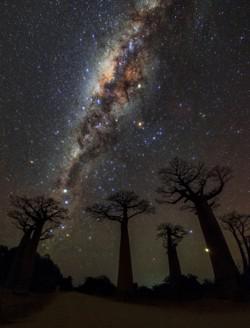
Milky Way over Avenue of Baobabs
الشرح: Winner in the 2022 IAU OAE Astrophotography Contest, category Still images of celestial patterns.
This image, taken from the Avenue of Baobabs, Morondava, Madagascar, in July 2017, shows the majestic band of the Milky Way, our home galaxy, together with a rich collection of constellations and asterisms: Crux, Centaurus, Scorpius, Sagittarius and the Teapot asterism. Towards the bottom left of the image we can see the Southern Cross and the pointer stars Alpha (the brighter of the two) and Beta Centauri, which help to distinguish it from similar-looking configurations. Some cultures in Africa associate the Southern Cross with a giraffe, while others associate the constellations with a pride of lions or even with the Tree of Life.
Antares, the brightest star in the constellation Scorpius, is the orange-red star straight up from the middle baobab tree.
To the Pokomo people from southwestern Kenya, Africa, the Milky Way is associated with the smoke emanating from a campfire lit by ancient people. The various people in South Africa, in contrast, have different star tales; the Khoikhoi from the region around Cape Town explained the colours of the red and white stars as red and white roots that were roasted on a fire and thrown towards the sky together with the ashes of the fire. The Xhosa from further east consider the Milky Way the raised bristle of a huge angry dog, while the Zulu from near Johannesburg interpret it as a stream of spears of their strongest warriors.
Polynesian people, who were adept seafarers and navigators, see the constellation Scorpius as a fish hook, and refer to it as the demigod Maui’s Fish Hook. For the Djab Wurrung and the Jardwadjali people, the Southern Cross is part of a Dreamtime Story involving Tchingal, the Bram-bram-bult brothers (the pointer stars), their mother Druk (Delta Crux), and Bunya, the hunter who gets changed into a possum (Gacrux, red star at the top of the Southern Cross).
In this image, the planets Saturn (the bright point above Antares) and Jupiter (the bright point at the bottom-right of the image close to the trunk of the baobab tree) are visible. Indigenous cultures have various stories associated with the planets, for example Kamilaroi and Wailan people associate Saturn with wunygal, a small bird. The Boorong people of Western Victoria associate Jupiter with Ginabongbearp, the chief of the old spirits (Nurrumbunguttias), who takes the totemic form of the sulphur-crested white cockatoo.
المصدر: Amirreza Kamkar/IAU OAE
License: CC-BY-4.0 المشاع الإبداعي نَسب المُصنَّف 4.0 دولي (CC BY 4.0) أيقونات

Drive
الشرح: Honourable mention in the 2022 IAU OAE Astrophotography Contest, category Still images of celestial patterns.
This image shows the Milky Way crossing the sky above the historical Bixby Bridge in Big Sur, a mountainous region in California, USA, in May 2021.
The star directly above the shore is Antares, a red supergiant in the heart of the Scorpion. To its left, the clouds of the Milky Way seem to emerge from the same point of the horizon as the rocky landmass. Above the land, below the Milky Way in the left quarter of the image, is another bright star, Altair, the bright star in Aquila, the Eagle.
The scorpion is considered a dangerous animal, so scorpion-men (human-scorpion hybrids) guarded the gate to the Netherworld in ancient Babylonian stories, as reported in the Gilgamesh saga. The Eagle, in contrast, appears in the Babylonian saga of King Etana who was taken to the sky by an Eagle and describes the world that he sees below him with increasing distance. Both heroes, Gilgamesh and Etana, are searching for the “herb of life” but one of them by going down, the other by travelling upwards. Gilgamesh aims to get back his dead friend Enkidu and to become immortal himself, while Etana is seeking the herb to help his wife become pregnant. The scorpion and the eagle are the animals supporting these heroes in their search, that ultimately remained unsuccessful. Gilgamesh finally learned that humans can only become immortal by their good deeds for humanity. The Eagle was also recognised in Greek culture, but it was only in Roman times that it became a messenger of a dead soul, carrying it towards the eternal stars. This was when Ptolemy created a constellation to represent the soul of Antinuous below the classical Eagle. This young friend and consultant of the Roman emperor Hadrian drowned in the Nile only seven years before the completion of the Almagest, and the whole Roman empire observed a state of national mourning.
The Milky Way is seen as a “pathway of souls” by many cultures, but in the Babylonian culture, this is not the case. Still, in Greco-Roman philosophy, the bright white parts of it between Antares and Altair, at the intersection of the Milky Way and the Zodiac do have a meaning: Plato, Macrobius and other philosophers refer to it as “the X in the sky”, and the second Celestial Gate was probably considered to be here (the first one being the gate formed by the Hyades and Pleiades).
These celestial pathways and gates, depicted above a gigantic bridge in the landscape and a site where the realms of land and ocean meet, make for an incredibly charged photograph. Additionally, the dark clouds in the Milky Way directly above the land form one of the two large dark constellations of the crocodiles, as interpreted by some people in southern Australia.
المصدر: Marcin Zajac/IAU OAE
License: CC-BY-4.0 المشاع الإبداعي نَسب المُصنَّف 4.0 دولي (CC BY 4.0) أيقونات
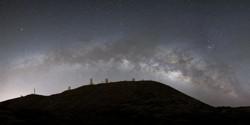
Teide Observatory
الشرح: Honourable mention in the 2022 IAU OAE Astrophotography Contest, category Still images of celestial patterns.
Taken in May 2022 in Teide National Park in Tenerife, Spain, this image shows the arc of the Milky Way galaxy crossing the sky, accompanied by prominent constellations over the professional telescopes located on the mountains of that island. While the telescopes and the people working with them may ignore the constellations, the photographer managed to catch the Milky Way in such a way that it almost matches the shape of the mountain.
The bright star in the top-left side of the image is Vega, one of the brightest stars in the night sky and located in the small constellation Lyra. Being a white star, it is the standard star astrophysicists use to define the colour scale. As it is also a relatively close star, only about 25 light-years away, with a relatively simple name, it frequently appears in modern science fiction, for example in Carl Sagan’s famous novel “Contact”, which was filmed in 1997 with Jodie Foster starring as a radio astronomer.
The bright star seen below the galaxy and on the left half of the image is Altair, also one of the brightest stars in the night sky and located in the constellation Aquila. Together with Deneb — a star in the constellation Cygnus (the Swan) that is not visible in this image — Altair and Vega form the Summer Triangle, a characteristic asterism of popular astronomy in the northern hemisphere, where these telescopes are located.
On the right side of the image we can see the constellation Scorpius. This is easily identified by its brightest star, Antares, the reddish star in the Scorpion’s heart. Below it, the whole body and tail of the Scorpion can be found and above it the celestial Scorpion's head is represented by three bright bluish stars. Below the tail and above the horizon, the constellation of Ara, the Altar, is half-visible, but like all the stars of Sagittarius in the Milky Way and the much fainter ones in Hercules and Ophiuchus above it, these constellations are more difficult to pinpoint in this photograph full of stars. The head of Ophiuchus is the relatively bright star in the middle between Vega and Antares. In addition to the huge size of this constellation, it is also important because it is the thirteenth one of the Zodiac, and the Sun spends roughly three weeks in Ophiuchus, after only five days in Scorpius. Furthermore, Ophiuchus represents the model for the mythological best doctor in the world, called Asklepios in Greek mythology, and Aesculab in Latin. His constellation praises all people working in medical professions, including nurses, pharmacists and doctors.
المصدر: Curd-Christian Tengeler/IAU OAE
License: CC-BY-4.0 المشاع الإبداعي نَسب المُصنَّف 4.0 دولي (CC BY 4.0) أيقونات