بلغات أخرى
- الألمانيّة: Kreuz des Südens
- الإنجليزيّة: Southern Cross
- الإسبانيّة: Cruz del Sur
- الفرنسيّة: Croix du Sud
- الإيطاليّة: Croce del Sud
- الكوريّة: 남십자성
- البرتغاليّة البرازيليّة: Cruzeiro do Sul
- الصينيّة المبسطة: 南十字星
- الصينيّة التقليدية: 南十字星
وسائط ذات صلة
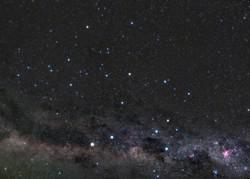
Cen-Lup-Cru-Panorama: Centaurus Carrying the Beast and Riding Along the Milky Way
الشرح: Winner in the 2022 IAU OAE Astrophotography Contest, category Still images of celestial patterns.
This image was taken in February 2020 in the Coquimbo Region along the northern coast of Chile. It is one of the best places on Earth for astronomical observations, thanks to its clear skies, lack of light pollution and lack of precipitation, as it is close to the Atacama desert, one of the driest places on our planet. It is no coincidence that many of the most modern professional observatories are located here. The picture shows prominent patterns visible in the southern latitudes, containing rich cultural significance for various Indigenous groups of the southern world. In the bottom of the image towards the right, the Southern Cross is prominent. The orange star at the top of the Southern Cross is called Gacrux (gamma crux). The people in Chile celebrate the beginning of winter at the beginning of May when the constellation Crux is high up in the sky; for them it is a symbol of the start of the cold season. For the festival of the Cruz de Mayo (the Great Cross), they put candles next to crosses in their villages when the constellation Crux is high. As in Christianity, the four endpoints (stars) of the cross symbolise the cardinal virtues. For some indigenous Chileans, they represent the fundamental cultural principles: force, reciprocity, wisdom, and spirituality.
Unlike modern constellations that are arrangements of several stars, Indigenous peoples sometimes associate stories with individual stars. In the case of the Southern Cross for example, the Boorong, Djab Wurrung and Jardwadjali peoples of Australia refer to the star Gacrux as Bunya (the ring-tailed possum). From the Southern Cross to the left of the image are two bright stars, these are called the pointer stars (as they point to the Southern Cross). The Djab Wurrung and Jardwadjali people refer to the pointer stars as the Bram-bram-bult brothers, who hunted and killed the giant Emu Tchingal. Alpha Centauri, which is the brighter and whiter of the two pointer stars, is the closest star to the Sun that we can see with our eyes, located just over four light-years away. To the bottom left of the Southern Cross is a dark nebula, which the Indigenous Australians see as the head of the Emu Tchnigal (the Coalsack Nebula). The pointers are located on the neck of the Emu. The image also shows two other IAU constellations, Centaurus (The Centaur) and Lupus (The Wolf), and HII regions of the Eta Carina Nebula (seen in pink).
المصدر: Uwe Reichert/IAU OAE
License: CC-BY-4.0 المشاع الإبداعي نَسب المُصنَّف 4.0 دولي (CC BY 4.0) أيقونات
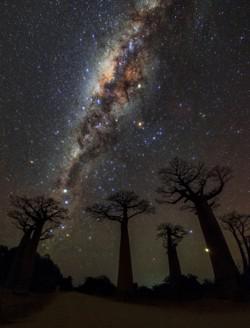
Milky Way over Avenue of Baobabs
الشرح: Winner in the 2022 IAU OAE Astrophotography Contest, category Still images of celestial patterns.
This image, taken from the Avenue of Baobabs, Morondava, Madagascar, in July 2017, shows the majestic band of the Milky Way, our home galaxy, together with a rich collection of constellations and asterisms: Crux, Centaurus, Scorpius, Sagittarius and the Teapot asterism. Towards the bottom left of the image we can see the Southern Cross and the pointer stars Alpha (the brighter of the two) and Beta Centauri, which help to distinguish it from similar-looking configurations. Some cultures in Africa associate the Southern Cross with a giraffe, while others associate the constellations with a pride of lions or even with the Tree of Life.
Antares, the brightest star in the constellation Scorpius, is the orange-red star straight up from the middle baobab tree.
To the Pokomo people from southwestern Kenya, Africa, the Milky Way is associated with the smoke emanating from a campfire lit by ancient people. The various people in South Africa, in contrast, have different star tales; the Khoikhoi from the region around Cape Town explained the colours of the red and white stars as red and white roots that were roasted on a fire and thrown towards the sky together with the ashes of the fire. The Xhosa from further east consider the Milky Way the raised bristle of a huge angry dog, while the Zulu from near Johannesburg interpret it as a stream of spears of their strongest warriors.
Polynesian people, who were adept seafarers and navigators, see the constellation Scorpius as a fish hook, and refer to it as the demigod Maui’s Fish Hook. For the Djab Wurrung and the Jardwadjali people, the Southern Cross is part of a Dreamtime Story involving Tchingal, the Bram-bram-bult brothers (the pointer stars), their mother Druk (Delta Crux), and Bunya, the hunter who gets changed into a possum (Gacrux, red star at the top of the Southern Cross).
In this image, the planets Saturn (the bright point above Antares) and Jupiter (the bright point at the bottom-right of the image close to the trunk of the baobab tree) are visible. Indigenous cultures have various stories associated with the planets, for example Kamilaroi and Wailan people associate Saturn with wunygal, a small bird. The Boorong people of Western Victoria associate Jupiter with Ginabongbearp, the chief of the old spirits (Nurrumbunguttias), who takes the totemic form of the sulphur-crested white cockatoo.
المصدر: Amirreza Kamkar/IAU OAE
License: CC-BY-4.0 المشاع الإبداعي نَسب المُصنَّف 4.0 دولي (CC BY 4.0) أيقونات
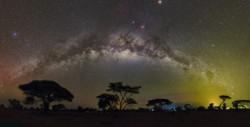
قوس درب التبانة فوق حديقة أمبوسيلي الوطنية
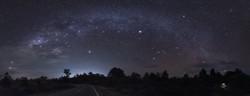
Most Brightest Stars of the Sky
الشرح: Honourable mention in the 2022 IAU OAE Astrophotography Contest, category Still images of celestial patterns.
Taken in March 2016 in Bromo-Tengger-Semeru National Park, Java Island, Indonesia, this image shows the arch of the Milky Way and many prominent constellations, including many of the brightest stars in the night sky.
In the lower-left corner, we see Rigil Kentaurus and Hadar, the first one lower and the other higher up, both located in the large constellation Centaurus. As pointers they point towards Crux, the Southern Cross, whose long axis points towards the southern pole, which is located roughly at the horizon because the Island of Java is almost at the equator. Crux is almost entirely obscured by clouds, with only the four bright stars visible in the photograph. Confusingly, the asterism of the False Cross (consisting of stars in Argo, The Ship) is clearly prominent a bit further up the Milky Way.
The pinkish spot between the true and the False Cross is the Carina Nebula, located about 8500 light-years from Earth, in the constellation Carina, and invisible to the unaided eye. In Carina we can also find Canopus, the second-brightest star in the night sky, seen just below the Galaxy and above the road on the ground.
Even brighter is Sirius, the brightest star in the night sky. Sirius lies in the constellation Canis Major, The Great Dog, one of the dogs that follow Orion, the Hunter, who is depicted in the right half of this image, just above the clouds at the horizon. Orion’s Belt of three bright stars points to Sirius in the upper left and to Aldebaran in the lower right, just above the horizon.
Orion contains some of the brightest stars in the sky, making it the most colourful constellation as it hosts Rigel, the bright bluish star below the Galaxy toward the right, and Betelgeuse, the reddish bright star higher up and to the right of Rigel. Between them we find the three stars that comprise the belt of Orion, a famous asterism. Just next to the belt we find the Great Orion Nebula, a star-forming region whose bright centre is visible to the unaided eye and also in this image.
Above Betelgeuse but on the opposite side of the Galaxy, we see the bright star Procyon, whose name means literally “Before the Dog”. It is mythologically often considered a tiny one-star dog asterism accompanying Orion, and transformed into the modern constellation of Canis Minor.
In the upper-right corner, the Beehive Star Cluster in the constellation Cancer is easily recognisable. Below it, we find the constellation Gemini with the stars Pollux and Castor, which are not prominent in this image. In contrast, the bright white star Capella in the constellation Auriga, the Charioteer, shines through the clouds at the middle-right edge of the image.
Some light pollution is visible along the road.
المصدر: Giorgia Hofer/IAU OAE
License: CC-BY-4.0 المشاع الإبداعي نَسب المُصنَّف 4.0 دولي (CC BY 4.0) أيقونات
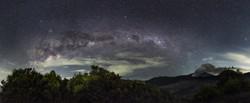
Equatorial Milky Way
الشرح: Honourable mention in the 2022 IAU OAE Astrophotography Contest, category Still images of celestial patterns: Equatorial Milky Way
Taken in Bromo-Tengger-Semeru National Park, Java Island, Indonesia, in March 2016, this image captures regions of the southern Milky Way and, at its left edge, the two planets Mars and Saturn. Mars appears orange and is similar in colour to the star Antares, whose Greek name — anti Ares — references this. Saturn is a little bit fainter than Mars, but clearly visible among the stars of Ophiuchus, above the Pipe Nebula and forming an isosceles triangle with Mars and Antares.
Mars is on the top and Saturn is vertically below. Visible to the naked eye, both planets have significance in many cultures around the world. In Roman mythology Mars is the god of war and fertility, and Saturn the god of sowing and agriculture. Its Greek equivalent, the god Kronos, is also considered the regent of completion. Indigenous Australians, including the Kamilaroi and Wailan people, associate Saturn with “wunygal”, a small bird. Mars is called Iherm-penh (something burnt in flames) by the Anmatyerre people of the Central Desert, while the Kokatha people of the Western Desert associate Mars and the star Anatres with the red-tailed black cockatoo (Kogolongo).
In the middle of this photograph, the most famous southern constellations are clearly recognisable: the Southern Cross (Crux), the pointer stars, Alpha and Beta Centauri, the dark Coalsack Nebula and the red Eta Carina Nebula, which is not visible to the unaided eye but is prominent in modern photographs. In the 19th century, the star eta Carinae had been the second-brightest star in the sky for some time, but since it varies irregularly, it has hardly been recognisable in recent decades, and its future visibility is unpredictable.
Triangulum Australe is visible between the pointer stars and the Scorpion, and in the constellation of Centaurus, the bright globular star cluster Omega Centauri is clearly displayed. It was considered a “nebulous star” since antiquity and, thus, was listed in star catalogues for at least 2000 years. Only within the last century did astronomers discover that globular star clusters are in the halo of our galaxy and that this one consists of roughly 10 million stars.
The dark regions in the Milky Way, which are cool, dense clouds of dust and gas, form the head and body of the Celestial Emu Tchingal. Together with the Southern Cross and the pointer stars, they appear in the Dreamtime stories of many Indigenous Australians. One story associated with the Djab Wurrung and the Jardwadjali people is part of a Dreamtime Story involving Tchingal, the Bram-bram-bult brothers (the pointer stars), their mother Druk (Delta Crux), and Bunya the hunter, who gets transformed into a possum (Gacrux, the red star at the top of the Southern Cross).
المصدر: Giorgia Hofer/IAU OAE
License: CC-BY-4.0 المشاع الإبداعي نَسب المُصنَّف 4.0 دولي (CC BY 4.0) أيقونات
الرسوم التوضيحية المرتبطة
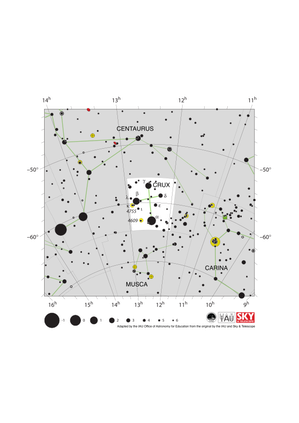
Crux Constellation Map
الشرح: The constellation Crux (commonly known as the Southern Cross or Crux Australis) showing its bright stars and surrounding constellations. The Southern Cross is surrounding by (going clockwise from the top) Centaurus, Carina and Musca. The brightest star is alpha Crucis which appears at the bottom of the constellation's famous kite shape. The Southern Cross is visible from southern and equatorial regions of the world. In more southerly parts of the world it is circumpolar so is always above the horizon. In other parts of the southern hemisphere and in equatorial regions it is most visible in the evenings in the southern hemisphere autumn.
The yellow circles show the locations of two open clusters, NGC 4755 (known as the Jewel Box) and NGC 4609.
The line joining gamma and alpha Crucis (the third and first brightest stars in the Southern Cross) points in the approximate direction of the South Celestial Pole. This has led to the Southern Cross playing an important role in celestial navigation, allowing navigators from different astronomical traditions to find their bearings.
The y-axis of this diagram is in degrees of declination with north as up and the x-axis is in hours of right ascension with east to the left. The sizes of the stars marked here relate to the star's apparent magnitude, a measure of its apparent brightness. The larger dots represent brighter stars. The Greek letters mark the brightest stars in the constellation. These are ranked by brightness with the brightest star being labeled alpha, the second brightest beta, etc., although this ordering is not always followed exactly. The dotted boundary lines mark the IAU's boundaries of the constellations and the solid green lines mark one of the common forms used to represent the figures of the constellations. Neither the constellation boundaries, nor the lines joining the stars appear on the sky.
المصدر: Adapted by the IAU Office of Astronomy for Education from the original by IAU/Sky & Telescope.
License: CC-BY-4.0 المشاع الإبداعي نَسب المُصنَّف 4.0 دولي (CC BY 4.0) أيقونات
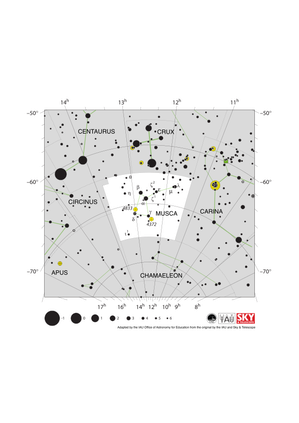
Musca Constellation Map
الشرح: The constellation Musca with its bright stars and surrounding constellations. Musca is surrounded by (going clockwise from the top): Crux, Centaurus, Carina, Chamaeleon, Apus and Circinus.
Musca is a southern constellation and thus the whole constellation is visible at some point in the year throughout the southern hemisphere. The whole constellation is visible to a thin strip of the northern hemisphere near the equator with parts of the constellation visible to other northern equatorial regions. Musca is circumpolar in temperate and antarctic regions of the southern hemisphere. Musca is best viewed in the evening in the northern hemisphere late spring and southern hemisphere late autumn.
The globular clusters NGC 4372 and NGC 4833 lie in Musca and are marked here with yellow circles with plus signs superimposed on them.
The y-axis of this diagram is in degrees of declination with north as up and the x-axis is in hours of right ascension with east to the left. The sizes of the stars marked here relate to the star's apparent magnitude, a measure of its apparent brightness. The larger dots represent brighter stars. The Greek letters mark the brightest stars in the constellation. These are ranked by brightness with the brightest star being labeled alpha, the second brightest beta, etc., although this ordering is not always followed exactly. The dotted boundary lines mark the IAU's boundaries of the constellations and the solid green lines mark one of the common forms used to represent the figures of the constellations. Neither the constellation boundaries, nor the lines joining the stars appear on the sky.
المصدر: Adapted by the IAU Office of Astronomy for Education from the original by the IAU and Sky & Telescope
License: CC-BY-4.0 المشاع الإبداعي نَسب المُصنَّف 4.0 دولي (CC BY 4.0) أيقونات