词条 褐矮星
描述: 褐矮星是一种既非恒星也非行星的天体,它的质量相较于恒星来说太小,但相较于行星来说又太大。恒星的能量来源是核心中的氢聚变。褐矮星的内部温度太低,无法维持氢聚变。不过,褐矮星在其生命早期能够短暂地进行氘聚变,氘是氢的一种较重形式。这种氘聚变被用来区分褐矮星和行星,但很难观测到。褐矮星的质量通常在太阳质量的1.2%到8%之间(大约是木星质量的12到80倍),尺寸与木星大致相同。年轻褐矮星外部区域的温度(有效温度)与小质量恒星(红矮星)相近,但由于缺乏内部热源,它们会随着年龄的增长而冷却,有些会冷却到几百摄氏度。
相关词条
用其他语言查看该词条
词条和定义状态: 该术语的英文原始定义已通过天文研究人员和教师的审核 该术语及其定义的译文仍待审核
OAE多语言词汇表是由国际天文学联合会(IAU) 天文教育办公室(OAE) 和 国际天文学联合会(IAU) 天文推广办公室(OAO)合作的项目。. 术语和定义由 OAE中心, OAE 国家天文教育协调员(NAECs) 以及其他志愿者共同选择、撰写和审阅。您可以在 找到完整的致谢列表。所有词汇表术语及其定义均根据 Creative Commons CC BY-4.0许可证发布 且版权归属于 “IAU OAE”。
如果您发现此词汇术语或定义中的事实或翻译错误, 请向 发邮件 联系.
其他语言版本
- 阿拉伯语: القزم البني
- 德语: Brauner Zwerg
- 英语: Brown Dwarf
- 西班牙语: Enana marrón
- 法语: Naine brune
- 意大利语: Nana bruna
- 日语: 褐色矮星 (外部链接)
- 韩语: 갈색왜성
- 巴西葡萄牙语: Anã marrom
- 繁体中文: 褐矮星
相关媒体

A binary brown dwarf system revealed
图注: This image presents a nearby system of brown dwarfs, objects that fall between planets and stars in mass and do not sustain long-term nuclear fusion in their cores. Located about 6.5 light-years from Earth, this system (known as Luhman 16) is the third closest system to the Solar System after the Alpha Centauri system and Barnard's Star. It was initially observed as what seemed to be a single faint source of infrared light. Brown dwarfs are often difficult to study because of their low brightness, especially in visible light. However they shine brighter in infrared light due to their cooler effective temperatures.
The comparison highlights the importance of observational resolution. The image at the center, taken by NASA’s Wide-field Infrared Survey Explorer (WISE), shows the system as a single blurred object due to its lower resolution (WISE has a resolution of roughly 6 arcseconds). A highlighted zoomed-in view from the Gemini South Observatory in Chile reveals that this “single” source is actually a binary system of two brown dwarfs. The improved angular resolution (roughly 0.6 arcseconds) allows astronomers to separate the two objects clearly, demonstrating how higher-resolution observations uncover hidden structures in the universe. While the Gemini telescope is situated on the Earth and thus is affected by the blurring effects of the Earth's atmosphere, it has a substantially larger mirror than the WISE telescope (8m wide vs. 40cm wide) meaning it can achieve much higher resolutions.
来源: NASA/JPL/Gemini Observatory/AURA/NSF
来源链接
License: PD 公共领域 图标
相关图表
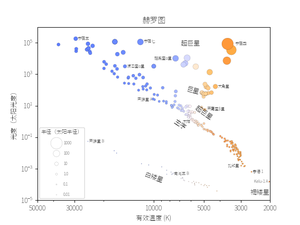
赫罗图
图注: 这张图展示了不同恒星温度和亮度。每个点的大小代表恒星的半径,颜色代表人眼所看到的颜色。恒星的颜色从淡蓝色到淡橙红色不等,没有恒星具有像红、绿或蓝这样的纯颜色,因为恒星的光谱包含了许多不同颜色的光。然而,最红的恒星通常被称为红恒星,最蓝的恒星被称为蓝恒星。为了展示不同类型的恒星,制作这个图表的恒星样本选择上并没有反映出每种类型恒星的实际数量比例。
从左上到右下是一条长长的恒星带,这些恒星在其核心燃烧氢气,这被称为主序。在这条线上,我们可以看到参宿三(Mintaka)、波江座α星(Achernar)、天狼星A(Sirius A)、太阳和比邻星(Proxima Centauri)等恒星。在主序线右下方的比邻星周围的天体被称为红矮星。在红矮星的右下方是Teide 1和Kelu-1 A。这两个天体是褐矮星,它们的质量太低,核心没有足够的热量来持续地进行氢融合。由于它们不燃烧氢,褐矮星不被认为是主序星。"褐矮星"这个名字与它们的颜色无关。
在主序星的上方,我们发现次巨星、巨星和超巨星。这些是已经完成了核心的氢燃烧并演化成更大天体的恒星。恒星的亮度取决于其温度和大小,因此巨星比具有较小半径但相同温度的恒星更亮。随着时间的推移,这些天体将走向生命的尽头,经历行星状星云阶段或变成超新星。以行星状星云阶段结束生命的恒星会形成一种叫做白矮星的恒星残骸。这种天体比相同温度的恒星小得多,因此更暗淡,并且位于主序星带的显著下方。以超新星结束生命的恒星会成为黑洞或中子星。这些在这个图表上没有显示。
来源: IAU OAE/Niall Deacon
相关活动

The Brown Dwarf builder's guide
astroEDU educational activity (links to astroEDU website) Description: Make your own model of a failed star!
License: CC-BY-4.0 知识共享许可协议 署名 4.0 国际 (CC BY 4.0) 图标
年龄段:
14-16
受教育等级:
中学
学习领域:
美术为主
, 以观察为主
, 项目式学习
费用:
低成本
时间跨度:
3 小时
技能:
分析和解读数据
, 传达信息
, 开发和使用模型