Termo do glossário: Anã marrom
Descrição: Uma anã marrom é um objeto com massa muito baixa para ser uma estrela, mas com massa muito alta para ser um planeta. As estrelas são alimentadas pela fusão de hidrogênio em seus núcleos. As anãs marrons têm temperaturas internas muito baixas para sustentar a fusão de hidrogênio. No entanto, no início de suas vidas, as anãs marrons são capazes de fundir brevemente o deutério, uma forma mais pesada de hidrogênio. Essa fusão de deutério é usada para distinguir as anãs marrons dos planetas, mas é difícil de ser observada. As anãs marrons normalmente têm massas entre 1,2% e 8% da massa do Sol (cerca de 12 a 80 vezes a massa de Júpiter) e têm aproximadamente o mesmo tamanho físico de Júpiter. As anãs marrons jovens têm temperaturas em suas regiões externas (temperatura efetiva) semelhantes às das estrelas de baixa massa (anãs vermelhas) mas, por não terem fontes internas de calor, esfriam à medida que envelhecem, sendo que algumas esfriam até algumas centenas de graus Celsius.
Termos relacionados:
- Hidrogênio
- Fusão de hidrogênio
- Júpiter
- Massa
- Planeta
- Anã Vermelha
- Temperatura efetiva
- Atividade estelar
Ver este termo em outros idiomas
Status do termo e da definição: A definição original deste termo em inglês foi aprovada por um astrônomo(a) pesquisador(a) e um(a) professor(a) A tradução deste termo e de sua definição ainda aguarda aprovação
O Glossário Multilíngue da OAE é um projeto do Escritório da IAU de Astronomia para a Educação (OAE) em colaboração com o Escritório da IAU para Divulgação da Astronomia (OAO). Os termos e definições foram selecionados, escritos e revisados por meio de um esforço coletivo da OAE, dos Centros e Nós da OAE, dos Coordenadores Nacionais de Educação em Astronomia (NAECs) da OAE e de outros voluntários. Você pode encontrar uma lista completa dos créditos aqui. Todos os termos do glossário e suas definições são disponibilizados sob uma licença Creative Commons CC BY-4.0 e devem ser creditados à "IAU OAE".
Se você notar algum erro factual ou de tradução neste termo do glossário ou em sua definição, por favor entre em contato.
Em outros idiomas
- Árabe: القزم البني
- Alemão: Brauner Zwerg
- Inglês: Brown Dwarf
- Espanhol: Enana marrón
- Francês: Naine brune
- Italiano: Nana bruna
- Japonês: 褐色矮星 (link externo)
- Coreano: 갈색왜성
- Chinês Simplificado: 褐矮星
- Chinês Tradicional: 褐矮星
Mídia relacionada

A binary brown dwarf system revealed
Legenda: This image presents a nearby system of brown dwarfs, objects that fall between planets and stars in mass and do not sustain long-term nuclear fusion in their cores. Located about 6.5 light-years from Earth, this system (known as Luhman 16) is the third closest system to the Solar System after the Alpha Centauri system and Barnard's Star. It was initially observed as what seemed to be a single faint source of infrared light. Brown dwarfs are often difficult to study because of their low brightness, especially in visible light. However they shine brighter in infrared light due to their cooler effective temperatures.
The comparison highlights the importance of observational resolution. The image at the center, taken by NASA’s Wide-field Infrared Survey Explorer (WISE), shows the system as a single blurred object due to its lower resolution (WISE has a resolution of roughly 6 arcseconds). A highlighted zoomed-in view from the Gemini South Observatory in Chile reveals that this “single” source is actually a binary system of two brown dwarfs. The improved angular resolution (roughly 0.6 arcseconds) allows astronomers to separate the two objects clearly, demonstrating how higher-resolution observations uncover hidden structures in the universe. While the Gemini telescope is situated on the Earth and thus is affected by the blurring effects of the Earth's atmosphere, it has a substantially larger mirror than the WISE telescope (8m wide vs. 40cm wide) meaning it can achieve much higher resolutions.
Crédito: NASA/JPL/Gemini Observatory/AURA/NSF
link do crédito
License: PD Domínio Público ícones
Diagramas relacionados
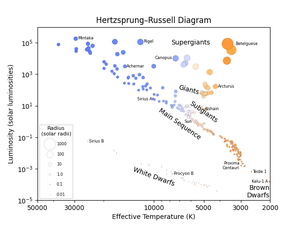
Hertzsprung-Russell diagram
Legenda: This diagram shows the temperature and luminosity of different stars. The size of each point represents the star’s radius and its colour is the colour the human eye would see. The stars range in colour from a washed-out blue to a washed-out reddish-orange. No star has a pure colour like red, green or blue as stars’ spectra include light from lots of different colours. However the reddest stars are commonly referred to as red and the bluest stars as blue. The sample of stars used to make this diagram was chosen to show a wide range of stars of different types so the relative number of each type of star is not representative of how commonly each type is found.
From the top left to bottom right there is a long line of stars burning hydrogen in their cores. This is called the main sequence. On this line, one sees the stars Mintaka, Achernar, Sirius A, the Sun and Proxima Centauri. The objects around Proxima Centauri at the lower right end of the main sequence are known as red dwarfs. To the lower right of the red dwarfs are Teide 1 and Kelu-1 A. These two objects are brown dwarfs, objects too low in mass to have cores hot enough to fuse hydrogen for a sustained period of time. As they do not burn hydrogen, brown dwarfs are not considered main sequence stars. The name brown dwarf is unrelated to their colour.
Above the main sequence, we find subgiants, giants and supergiants. These are stars that have finished burning hydrogen in their core and have evolved into larger objects. A star’s brightness depends on its temperature and size so giant stars are brighter than stars with a smaller radius but the same temperature. In time these objects will move towards the end of their lives and undergo either a planetary nebula phase or become supernovae. Stars which end their lives with a planetary nebula phase become a type of stellar remnant called a white dwarf. Such objects are much smaller than stars of the same temperature and thus are fainter and are found significantly below the main sequence. Stars which end their lives as supernovae become either black holes or neutron stars. These are not shown on this plot.
Crédito: IAU OAE/Niall Deacon
License: CC-BY-4.0 Creative Commons Attribution 4.0 International (CC BY 4.0) ícones
Atividades relacionadas

The Brown Dwarf builder's guide
astroEDU educational activity (links to astroEDU website) Description: Make your own model of a failed star!
License: CC-BY-4.0 Creative Commons Attribution 4.0 International (CC BY 4.0) ícones
Faixas etárias:
14-16
Nível de ensino:
Médio
Áreas de aprendizagem:
Com foco em belas-artes
, Baseado em observação
, Aprendizagem baseada em projetos
Custos:
Baixo custo
Duração:
3 hours
Habilidades:
Analisar e interpretar dados
, Comunicar informações
, Desenvolver e usar modelos