Termo do glossário: Sol
Descrição: O Sol é a estrela que está mais próxima da Terra. Para os astrônomos, é uma estrela do tipo "G2V". Isso significa que o Sol é uma estrela de sequência principal com uma temperatura típica ("temperatura efetiva") de 5800 kelvins (K). As estrelas de sequência principal são estáveis, com a energia liberada pela fusão de hidrogênio em seu núcleo equilibrando a força interna em decorrência da gravidade. O Sol parece branco ao olho humano, pois emite muita luz em todo o espectro visível. Quando está em uma posição mais baixa no céu, o aumento da extinção atmosférica pode fazer com que o Sol pareça amarelo ou laranja, daí sua representação comum como amarelo. As estrelas variam de mais de 1.000 vezes mais brilhantes do que o Sol a cerca de 1.000 vezes mais fracas, mas as mais brilhantes são relativamente raras: o Sol é mais brilhante (e mais pesado) do que a maioria (talvez cerca de 85%) das estrelas da Galáxia.
Para os astrônomos, o Sol é interessante devido à sua proximidade, o que significa que a superfície pode ser resolvida com mais detalhes, permitindo o estudo de estruturas e fenômenos. Por exemplo, os estudos detalhados da atividade solar, que está relacionada aos campos magnéticos do Sol, podem incluir: manchas solares (áreas mais frias), erupções (flashes brilhantes de curta duração) e até mesmo ejeções de massa coronal (partículas eletricamente carregadas lançadas para longe do Sol). Os físicos também detectaram partículas elementares conhecidas como neutrinos do núcleo do Sol; essa é uma evidência direta de processos de fusão nuclear. O elemento hélio foi detectado pela primeira vez no espectro solar, daí o nome Hélio, que vem de Helios (na mitologia grega, o deus Sol).
Termos relacionados:
- Sequência Principal
- Fusão nuclear
- Erupção solar
- Estrela
- Mancha solar
- Temperatura efetiva
- Campo magnético
- Neutrino
- Ejeção de massa coronal (CME)
Ver este termo em outros idiomas
Status do termo e da definição: A definição original deste termo em inglês foi aprovada por um astrônomo(a) pesquisador(a) e um(a) professor(a) A tradução deste termo e de sua definição ainda aguarda aprovação
O Glossário Multilíngue da OAE é um projeto do Escritório da IAU de Astronomia para a Educação(OAE) em colaboração com o Escritório da IAU para Divulgação da Astronomia (OAO). Os termos e definições foram selecionados, escritos e revisados por meio de um esforço coletivo da OAE, dos Centros e Nós da OAE, dos Coordenadores Nacionais de Educação em Astronomia (NAECs) da OAE e de outros voluntários. Você pode encontrar uma lista completa dos créditos aqui. Todos os termos do glossário e suas definições são disponibilizados sob uma licença Creative Commons CC BY-4.0 e devem ser creditados à "IAU OAE".
Se você notar algum erro factual ou de tradução neste termo do glossário ou em sua definição, por favor entre em contato.
Mídia relacionada
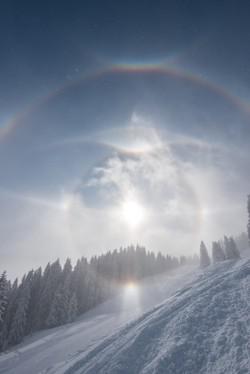
Winter Haloes, by Thomas Gigl, Germany
Legenda: Second place in the 2021 IAU OAE Astrophotography Contest, category Sun/Moon haloes.
Captured in Jochberg located in the famous Austrian ski-region of Tirol, this image shows multiple features related to ice halos, which are a more common appearance around the sun, due to its brightness, than the moon. External and internal reflection of sun rays from ice crystal faces and within different types of ice crystals lead to these halo related phenomena. The 22° halo encircles the sun, with two bright spots at the edge called Sundogs, Parhelia or Mock Suns observed to the left and right at the same height as the sun. The horizontal white band called the parhelic circle, named after the sun god Helios, passes through the sun and the Sundogs at the same angular elevation. An Upper tangent arc, a suncave parry arc and a lower tangent arc are also seen touching the top and bottom of the 22° halo. An upside down rainbow like arc or the circumzenithal arc is seen touching the bright supralateral arc, both of which are less frequently observed.
Crédito: Thomas Gigl/IAU OAE
License: CC-BY-4.0 Creative Commons Attribution 4.0 International (CC BY 4.0) ícones
Manchas solares
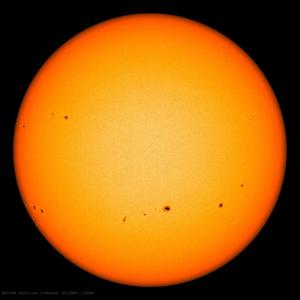
Legenda: Nesta imagem, o Sol aparece pontilhado por grupos de manchas solares ao longo de quase nove dias entre julho e agosto de 2012. As manchas solares vistas nesta imagem foram fontes de erupções solares e ejeções de massa coronal (CME). Nesta imagem em particular, o Sol está se aproximando do máximo de atividade de seu ciclo (ciclo solar), período em que observamos muitas manchas se formando ao longo do equador solar. Essas manchas solares e essa atividade são observadas no hemisfério sul do Sol; antes disso, a maior parte da atividade estava concentrada no hemisfério norte.
Crédito: NASA/SDO/HMI
link do crédito
License: PD Domínio Público ícones
Erupção solar
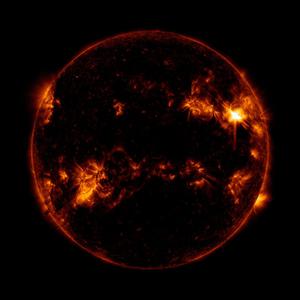
Legenda: Esta imagem mostra uma erupção solar de intensidade média observada em março de 2022 pelo Solar Dynamics Observatory (SDO). O SDO monitora a atividade solar, por isso mostra as regiões do Sol onde há essa atividade ocorre. Uma erupção solar é um breve aumento de brilho na superfície do Sol; esta erupção em particular é da classe M, o que significa que tem um décimo da intensidade das erupções mais intensas, ou seja, as erupções de classe X. As erupções solares são quase invisíveis a olho nu, daí a necessidade do SDO. A imagem foi registrada em luz ultravioleta extrema e colorida de vermelho pelo SDO; a erupção aparece na parte superior do disco solar.
Crédito: NASA/SDO
link do crédito
License: PD Domínio Público ícones

Imagem H-alfa da cromosfera do Sol
Legenda: Esta imagem em cor falsa foi capturada com um telescópio de 10 cm no Big Bear Solar Observatory (BBSO), nos Estados Unidos, em julho de 2002. Ela mostra o disco solar completo utilizando a linha de emissão H-alfa do hidrogênio. Quando observada nessa linha espectral, a cromosfera do Sol aparece particularmente proeminente devido aos átomos de hidrogênio que emitem luz nesse comprimento de onda específico. Essa emissão produz uma coloração vermelha característica, tornando bem visíveis características como as espículas (jatos de plasma que parecem fios de cabelo) e as placas (regiões brilhantes na cromosfera). Várias proeminências solares pequenas podem ser vistas projetando-se da borda do disco solar. Quando as proeminências (também conhecidas como filamentos) cruzam o disco do Sol, aparecem como fios escuros causados pelo material mais frio na proeminência que absorve a luz. A cromosfera também pode ser observada na região violeta do espectro solar devido ao cálcio ionizado, devido às emissões nesses comprimentos de onda.
Crédito: Observatório Solar de Big Bear (BBSO)/Instituto de Tecnologia de Nova Jersey (NJIT)
link do crédito
License: PD Domínio Público ícones

Close-up view of a sunspot
Legenda: This image of a sunspot was taken by the Daniel K Inouye Solar Telescope (DKIST), operated by the U.S. National Science Foundation. It was taken only in light with a wavelength of 530 nanometers, within the greenish-yellow part of the visible spectrum.
The picture reveals the detail of the spot's structure and the Sun’s photosphere. The dark central region, known as the umbra, is surrounded by a lighter area called the penumbra with radially elongated features stretching towards the umbra. Note that the umbra and penumbra here are not the same as the umbra and penumbra that occur during an eclipse.
The sunspot measures approximately 5000 kilometres in diameter, roughly equivalent to the east-west span of China. While the umbra appears black, it is actually hot and bright. It only appears dark because it is a few thousand kelvin cooler than the surrounding solar photosphere. Surrounding the sunspot, granulation patterns of plasma are visible on the photospheric surface of the Sun.
Crédito: NSO/NSF/AURA
link do crédito
License: CC-BY-4.0 Creative Commons Attribution 4.0 International (CC BY 4.0) ícones
Diagramas relacionados

Total Solar Eclipse
Legenda: This not to scale diagram shows what happens during a total solar eclipse. The Moon orbits the Earth, but its orbit is slightly tilted with respect to the Earth’s orbit around the Sun. During the new moon lunar phase, the Moon lies between the Earth and the Sun, but due to the Moon’s tilted orbit around the Earth, the Moon normally lies above or below the Sun at this point. However twice a year the Moon’s orbit lines up in such a way that the Moon can lie in a direct line between the Earth and Sun. During each of these periods (each of which last roughly a month) solar (and lunar) eclipses can occur. The Moon is about 400 times smaller than the Sun, but is 400 times closer to the Earth than the Sun. Hence the Sun and Moon have approximately the same angular size when viewed from the Earth. This means that it is possible for the Moon to completely cover the Sun when viewed from Earth. This is known as a total solar eclipse.
Here we see a schematic of such and eclipse. The Moon casts a shadow on the Earth known as the umbra. This is a roughly circular shadow a few hundred kilometres across although its shape can be severely distorted when the eclipse is at the edge of the illuminated part of the Earth. Any region within the umbra will see the Moon completely cover the Sun and thus will experience a total solar eclipse. Outside of the umbra there are regions where the Moon will cover part of the Sun. This partial shadow is known as the penumbra. Regions in the penumbra will experience a partial solar eclipse.
An eclipse is a dynamic event with the Moon moving in its orbit and the Earth rotating. Hence the umbra and penumbra move across the Earth’s surface together. The path the umbra takes across the Earth is known as the path of totality. Let’s consider one particular region that lies in the path of totality: except in rare cases where an eclipse begins at sunrise, a region that experiences totality will first see the Moon cover part of the Sun and gradually move across Sun until it is totally covered. From outside the Earth this would appear as the penumbra moving over this particular region followed by the umbra moving over this region. Once the Moon moves so that it no longer completely covers the Sun, totality ends and the umbra moves away from this particular region. The Moon will continue to uncover the Sun until (unless the Sun sets before the end of the eclipse) the Sun is completely uncovered. From outside the Earth this would appear as the umbra moving away from our particular region and the edge of the penumbra approaching and eventually passing over the region.
Outside of the path or totality there is a much broader region that will lie in the penumbra but will be missed by the umbra. Such regions will not experience a total solar eclipse during this event, only a partial solar eclipse.
Crédito: Aneta Margraf/IAU OAE
License: CC-BY-4.0 Creative Commons Attribution 4.0 International (CC BY 4.0) ícones
Atividades relacionadas
Measure the Solar Diameter
astroEDU educational activity (links to astroEDU website) Description: Hands-on activity to measure the Sun by using household materials.
License: CC-BY-4.0 Creative Commons Attribution 4.0 International (CC BY 4.0) ícones
Tags:
Hands-on
, Scales
, Observing
, Measurement
Faixas etárias:
12-14
, 14-16
, 16-19
, 19+
Nível de ensino:
Ensino fundamental
Áreas de aprendizagem:
Aprendizagem por investigação estruturada
Custos:
Baixo custo
Tamanho do grupo:
Grupo
Habilidades:
Comunicar informações
, Construir explicações
, Usar matemática e pensamento computacional
Counting Sunspots
astroEDU educational activity (links to astroEDU website) Description: Counting the Sunspots using real solar images and data.
License: CC-BY-4.0 Creative Commons Attribution 4.0 International (CC BY 4.0) ícones
Tags:
Hands-on
, Sunspots
, Data analysis
Faixas etárias:
16-19
Áreas de aprendizagem:
Baseado em observação
Custos:
Baixo custo
Duração:
1 hour
Tamanho do grupo:
Grupo
Habilidades:
Analisar e interpretar dados
, Construir explicações
, Usar matemática e pensamento computacional
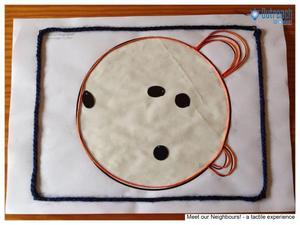
Meet Our Neighbours: Sun
astroEDU educational activity (links to astroEDU website) Description: Explore the tactile version of our star; the Sun with household materials.
License: CC-BY-4.0 Creative Commons Attribution 4.0 International (CC BY 4.0) ícones
Tags:
Hands-on
, Model
, Sunspots
, Visually Impaired
, Tactile
Faixas etárias:
6-8
, 8-10
, 10-12
Nível de ensino:
Ensino fundamental
, Básico
, Médio
Áreas de aprendizagem:
Aula interativa
, Modelagem
Custos:
Baixo custo
Duração:
1 hour
Tamanho do grupo:
Grupo
Habilidades:
Analisar e interpretar dados
, Desenvolver e usar modelos
Build a Safe Sun Viewer
astroEDU educational activity (links to astroEDU website) Description: Build a safe Sun viewer using cheap household items and learn why it is dangerous to look directly at the Sun, even briefly.
License: CC-BY-4.0 Creative Commons Attribution 4.0 International (CC BY 4.0) ícones
Tags:
Hands-on
, Safety
Faixas etárias:
6-8
, 8-10
, 10-12
Nível de ensino:
Básico
, Médio
Áreas de aprendizagem:
Modelagem
, Baseado em observação
Custos:
Baixo custo
Tamanho do grupo:
Grupo
Habilidades:
Planejar e realizar pesquisas
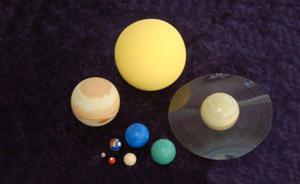
Solar System Model
astroEDU educational activity (links to astroEDU website) Description: Make a model of the Solar System planets using household materials.
License: CC-BY-4.0 Creative Commons Attribution 4.0 International (CC BY 4.0) ícones
Tags:
Hands-on
, Model
, Planets
Faixas etárias:
4-6
, 6-8
, 8-10
Nível de ensino:
Pré-escola
, Básico
Áreas de aprendizagem:
Modelagem
Custos:
Baixo custo
Duração:
30 mins
Tamanho do grupo:
Grupo
Habilidades:
Analisar e interpretar dados
, Fazer perguntas
, Comunicar informações
, Desenvolver e usar modelos