Termo do glossário: Estrela cadente
Descrição: Uma estrela cadente (ou meteoro) é um fragmento de um asteróide ou cometa, ou um pedaço de detrito espacial, que entra na atmosfera da Terra ou de outro corpo celeste e se incendeia devido ao calor gerado pelo atrito com a atmosfera. Esse calor gerado pelo atrito é semelhante à maneira como aquecemos as mãos esfregando-as uma na outra quando estamos com frio. As estrelas cadentes costumam ser muito pequenas, variando de alguns milímetros a alguns centímetros. Os astrônomos as chamam de meteoros. Sua direção, a época do ano em que as observamos e sua cor nos permitem saber mais sobre sua origem e de que são feitas.
Os meteoros mais brilhantes são chamados de bólidos e podem ser vistos com frequência no céu, às vezes até mesmo durante o dia. Ocasionalmente, observadores chegam a relatar ter ouvido sons enquanto eles queimam e atravessam a atmosfera. As estrelas cadentes também causam a ionização da atmosfera, o que, no caso da Terra, pode ser observado por meio de radar.
Na Terra, as estrelas cadentes são visíveis durante todo o ano, mas, ocasionalmente, muitas delas ocorrem em curtos períodos de tempo, como na mesma noite. Muitas dessas chuvas de meteoros se repetem em padrões anuais previsíveis e receberam nomes com base na constelação da qual os meteoros parecem se originar (ou irradiar). Entre as chuvas de meteoros famosas estão as Perseidas e as Leônidas.
Termos relacionados:
Ver este termo em outros idiomas
Status do termo e da definição: A definição original deste termo em inglês foi aprovada por um astrônomo(a) pesquisador(a) e um(a) professor(a) A tradução deste termo e de sua definição ainda aguarda aprovação
O Glossário Multilíngue da OAE é um projeto do Escritório da IAU de Astronomia para a Educação(OAE) em colaboração com o Escritório da IAU para Divulgação da Astronomia (OAO). Os termos e definições foram selecionados, escritos e revisados por meio de um esforço coletivo da OAE, dos Centros e Nós da OAE, dos Coordenadores Nacionais de Educação em Astronomia (NAECs) da OAE e de outros voluntários. Você pode encontrar uma lista completa dos créditos aqui. Todos os termos do glossário e suas definições são disponibilizados sob uma licença Creative Commons CC BY-4.0 e devem ser creditados à "IAU OAE".
Se você notar algum erro factual ou de tradução neste termo do glossário ou em sua definição, por favor entre em contato.
Em outros idiomas
- Árabe: الشهاب
- Alemão: Sternschnuppe
- Inglês: Shooting Star
- Espanhol: Estrella fugaz
- Francês: Étoile filante
- Italiano: Stella cadente
- Japonês: 流星 (link externo)
- Chinês Simplificado: 流星
- Chinês Tradicional: 流星
Mídia relacionada
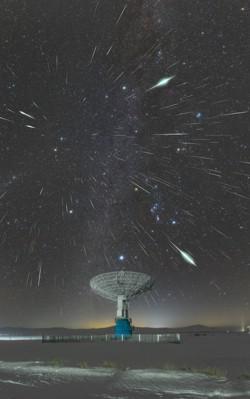
Gemini meteor shower, by Hao Yin, China
Legenda: Third place in the 2021 IAU OAE Astrophotography Contest, category Meteor showers.
As the Earth travels around the Sun, it may cross the path of debris left behind by a comet or, more rarely, by an asteroid. These debris enter the atmosphere at high speed, producing beautiful tracks as they burn in the sky due to friction with the atmosphere. The image captures the Geminid meteor shower, named because the radiant point is located on the sky in the constellation Gemini. The particles composing the meteor shower travel at similar speed and in parallel trajectories, which causes a perspective effect like if the stream radiates from one single point in the sky, which is known as the radiant point. This image, taken in December 2020 in China, clearly shows this perspective. This is a very prolific shower, in such a way that over one hundred meteorites could be seen per hour in recent appearances. This meteor shower is one of the few associated not with a comet, but with an asteroid – 3200 Phaeton, which might be a comet that lost all its volatile material. This image shows the large number of meteors that can be observed in this shower, which always happens in December every year. The image also shows one of the most prominent constellations in the night sky, Orion, easily seen by the three stars in a diagonal making up Orion’s Belt, and the red-orange star Betelgeuse. Right above the dish is a bright point and that is the Sirius, the brightest star in the night sky and part of the constellation Canis Major. The fuzzy bluish smudge at around 2 ‘o’ clock is the Pleiades star cluster.
Crédito: Hao Yin/IAU OAE
License: CC-BY-4.0 Creative Commons Attribution 4.0 International (CC BY 4.0) ícones
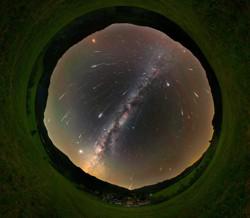
Perseids 2020 over Dark Sky Park Poloniny, by Tomáš Slovinský, Slovakia
Legenda: Second place in the 2021 IAU OAE Astrophotography Contest, category Meteor showers.
A meteor shower occurs when the debris originated from comets or, on rare occasions, from asteroids enter the Earth’s atmosphere at high speed, leaving behind beautiful tracks in the sky due to friction with the atmosphere. This all-sky image taken in Slovakia in 2020 shows the Perseid meteor shower in a vivid way so one can really see the Perseids appearing all over the sky. This meteor shower is named so because the radiant point (the point on the sky where the meteors misleadingly seem to originate from) of the Perseid meteor shower is located in the constellation Perseus. This is a very prolific meteor shower, and a very popular phenomenon that can be observed from mid-July until mid-August, when the peak of activity happens. This is associated with the comet 109P/Swift–Tuttle, as Earth's orbit around the Sun crosses the debris left behind by this comet. This kind of image is very useful for full dome projections in planetariums, beautifully showing the Milky Way, our home Galaxy.
Crédito: Tomáš Slovinský/IAU OAE
License: CC-BY-4.0 Creative Commons Attribution 4.0 International (CC BY 4.0) ícones
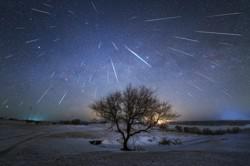
Geminid Meteor Shower from China, by Dai Jianfeng, China
Legenda: First place in the 2021 IAU OAE Astrophotography Contest, category Meteor showers.
A meteor shower occurs when the Earth in its orbit around the Sun, passes through a debris trail left previously by a comet on its approach around the Sun. As the Earth enters this debris (small sand grain sized), they enter the atmosphere at high speeds and on parallel trajectories, burning completely leaving beautiful tracks (streaks) in the sky. These streaks can appear and disappear in the blink of an eye, or last much longer. On rare occasions the debris originates from asteroids, as in the case of the Geminid meteor shower, shown in this image, picturing many streaks of debris captured in the sky of China in 2017. Due to relative motions and perspective, the shower appears to come from one single point, known as the radiant point, beautifully pictured in this image. This is similar to driving in a car on a rainy day without any wind, looking out the front window it seems that the rain is coming directly towards the window, when in fact the rain is falling vertically downwards.
Crédito: Dai Jianfeng/IAU OAE
License: CC-BY-4.0 Creative Commons Attribution 4.0 International (CC BY 4.0) ícones
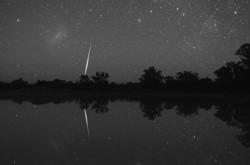
Between Two Skies
Legenda: Honourable mention in the 2022 IAU OAE Astrophotography Contest, category Still images of celestial patterns.
Taken from Narrabri, Australia, in April 2014, this photograph shows a meteor next to the Large Magellanic Cloud and the reflection of all this in the water.
The Magellanic Clouds are named after the Portuguese explorer Ferdinand Magellan, who made the first maps of the southern part of South America in the early 16th century but did not survive his expedition voyage. His shipmates called the two nebulae after him, and it was only in the 20th century that astronomy research discovered that they are in fact dwarf galaxies accompanying our own.
In the 18th century, the French mathematician J-N. Lacaille, who lived in South Africa for some years in order to draw maps of the sky and the land, invented some new constellations. He measured the positions of some faint stars and listed them in his star catalogue, but did not try to overlay beautiful drawings of real-world objects on the star patterns, so he could name them however he wanted. He was based in the trade station that is now the city of Cape Town and, from this bay, Table Mountain is visible. Lacaille learned from the navigators that they used the clouds around this mountain to predict whether or not the wind would blow in the correct direction and allow for sailing. Normally, there is a huge white cloud at the top of Table Mountain, so Lacaille considered the larger one of the two dwarf galaxies not a “Magellanic Cloud”, but the cloud at Table Mountain. Consequently, he invented the constellation “Mensa”, Table Mountain, in the small area of faint stars directly attached to this dwarf galaxy.
Crédito: Fabrizio Melandri/IAU OAE
License: CC-BY-4.0 Creative Commons Attribution 4.0 International (CC BY 4.0) ícones
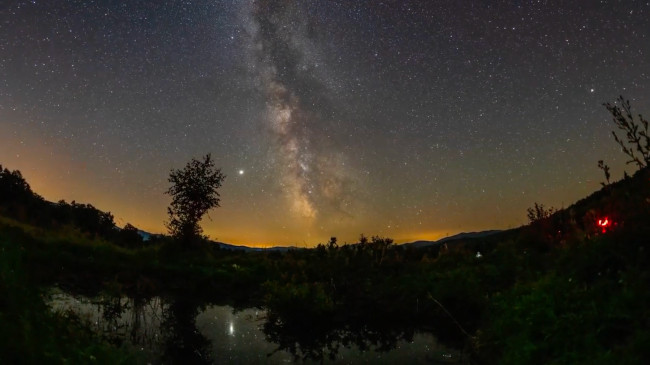
Flowing Night Sky
Legenda: Honourable mention in the 2022 IAU OAE Astrophotography Contest, category Time lapses of celestial patterns.
This time-lapse was shot from Slovakia in August 2020. By fixing the relative movement of the sky to Earth's rotation in some of the frames, we can experience a different perspective as a viewer.
The Milky Way, our home galaxy, is visible throughout the whole video. The bright objects near the Milky Way are Jupiter and Saturn, close together, Jupiter being the brighter one.
This video also shows the interaction of amateur astronomers observing the Perseids meteor shower with their telescopes pointed towards the sky. An unfortunate aspect of the art of astronomical observing, clouds can suddenly cover the whole sky. The fog occurs mostly because of the higher humidity after the rain.
Most of the light trails in the sky are made by satellites, but some of them, appearing just very briefly and not very noticeably, are meteors, as the video was shot around the peak of Perseids meteor shower.
Crédito: Robert Barsa/IAU OAE
License: CC-BY-4.0 Creative Commons Attribution 4.0 International (CC BY 4.0) ícones
Atividades relacionadas
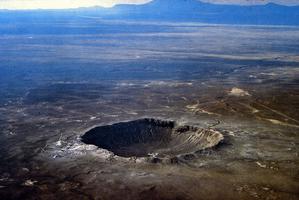
Meteoroids, Meteors and Meteorites
astroEDU educational activity (links to astroEDU website) Description: Unveiling the mystery of "shooting stars": meteors, meteorites and meteroids
License: CC-BY-4.0 Creative Commons Attribution 4.0 International (CC BY 4.0) ícones
Tags:
Geology
Faixas etárias:
6-8
, 8-10
, 10-12
, 12-14
Nível de ensino:
Ensino fundamental
, Básico
Áreas de aprendizagem:
Aula interativa
Custos:
Baixo custo
Duração:
1 hour 30 mins
Tamanho do grupo:
Grupo
Habilidades:
Analisar e interpretar dados
, Fazer perguntas
, Comunicar informações
, Engajar-se em argumentação com base em evidências
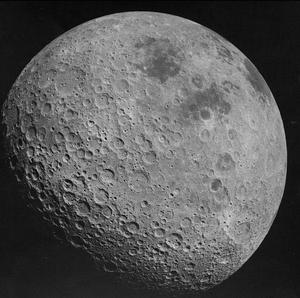
Impact Craters
astroEDU educational activity (links to astroEDU website) Description: A literal Earth-Shattering experiment
License: CC-BY-4.0 Creative Commons Attribution 4.0 International (CC BY 4.0) ícones
Tags:
History
, Impact
, Experiment
Faixas etárias:
10-12
, 12-14
, 14-16
Nível de ensino:
Ensino fundamental
, Básico
, Médio
Áreas de aprendizagem:
Aprendizagem por descoberta guiada
, Modelagem
, Experimento científico tradicional
Custos:
Baixo custo
Duração:
1 hour
Tamanho do grupo:
Grupo
Habilidades:
Analisar e interpretar dados
, Fazer perguntas
, Construir explicações
, Engajar-se em argumentação com base em evidências
, Usar matemática e pensamento computacional