Termo do glossário: Estrela tipo K
Descrição: Uma estrela com tipo espectral “K”. Os astrônomos identificam as estrelas do tipo K pela presença de linhas de hidrogênio muito fracas, mas linhas fortes de átomos de ferro e manganês em seus espectros. Elas têm temperaturas típicas (efetivas) entre cerca de 3700 kelvins (K) e 5200 K. Em comparação com outras estrelas, elas parecem laranja-esbranquiçadas ao olho humano, a menos que o avermelhamento interestelar ou atmosférico seja significativo. Exemplos de estrelas do tipo K são Aldebaran, em Touro, e Pollux, em Gêmeos.
Termos relacionados:
Ver este termo em outros idiomas
Status do termo e da definição: A definição original deste termo em inglês foi aprovada por um astrônomo(a) pesquisador(a) e um(a) professor(a) A tradução deste termo e de sua definição ainda aguarda aprovação
O Glossário Multilíngue da OAE é um projeto do Escritório da IAU de Astronomia para a Educação (OAE) em colaboração com o Escritório da IAU para Divulgação da Astronomia (OAO). Os termos e definições foram selecionados, escritos e revisados por meio de um esforço coletivo da OAE, dos Centros e Nós da OAE, dos Coordenadores Nacionais de Educação em Astronomia (NAECs) da OAE e de outros voluntários. Você pode encontrar uma lista completa dos créditos aqui. Todos os termos do glossário e suas definições são disponibilizados sob uma licença Creative Commons CC BY-4.0 e devem ser creditados à "IAU OAE".
Se você notar algum erro factual ou de tradução neste termo do glossário ou em sua definição, por favor entre em contato.
Em outros idiomas
- Árabe: النجم من النوع الطيفي K
- Alemão: K-Stern
- Inglês: K-type Star
- Espanhol: Estrella de tipo K
- Francês: Étoile de type K
- Italiano: Stella di tipo K
- Japonês: K型星 (link externo)
- Chinês Simplificado: K 型星
- Chinês Tradicional: K 型星
Diagramas relacionados
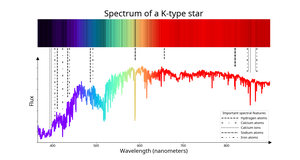
Spectrum of a K-type star
Legenda: The spectrum of the K-type star 2MASS J19554455+4754531. The colour of the line between 400 nm and 700 nm roughly corresponds to the colour the human eye would see light of that wavelength. Below 400 nm and above 700 nm, where the human eye can see little to no light, the lines are coloured blue and red respectively.
The black lines show spectral absorption lines caused by atoms and ions of different elements in the star’s atmosphere. These atoms and ions absorb at specific wavelengths, causing sharp, dark lines in the spectra. How strong these lines are depends on the temperature of the star’s atmosphere. Two stars made from the same mix of elements could have spectra with vastly different sets of lines in their spectra if they have different temperatures in their atmospheres. The spectra of K-type stars are dominated by metal atoms such as iron, sodium and calcium atoms. There are so many lines from metal atoms, far too many to mark individually, that the spectrum has a choppy, ragged appearance. The lines of hydrogen atoms and calcium ions are much weaker than in the hotter G-type stars.
Crédito: IAU OAE/SDSS/Niall Deacon
License: CC-BY-4.0 Creative Commons Attribution 4.0 International (CC BY 4.0) ícones