Termo do glossário: Eclipse Solar
Descrição: Um eclipse solar ocorre quando a Terra, a Lua e o Sol estão alinhados em uma linha reta, com a Lua entre a Terra e o Sol. Quando observado da superfície da Terra, o disco da Lua cobre o disco do Sol no céu; do espaço, podemos ver a sombra da Lua se movendo pelo lado iluminado da Terra.
Existem diferentes tipos de eclipses solares. O eclipse total, quando o disco da Lua cobre completamente o Sol; o parcial, quando apenas uma fração do disco solar é coberta, mesmo no momento de máximo do eclipse; e o anular, quando a Lua está mais distante do que o normal e, por isso, parece menor do que de costume, permitindo que um anel do disco solar permaneça visível mesmo no momento de máximo do eclipse, o chamado "anel de fogo".
Durante um eclipse solar total, o ponto mais escuro da sombra da Lua na Terra é chamado de “umbra”, e a borda da sombra é chamada de “penumbra”. Os observadores na umbra veem um eclipse total, enquanto os observadores na penumbra veem um eclipse parcial.
Termos relacionados:
Ver este termo em outros idiomas
Status do termo e da definição: A definição original deste termo em inglês foi aprovada por um astrônomo(a) pesquisador(a) e um(a) professor(a) A tradução deste termo e de sua definição ainda aguarda aprovação
O Glossário Multilíngue da OAE é um projeto do Escritório da IAU de Astronomia para a Educação (OAE) em colaboração com o Escritório da IAU para Divulgação da Astronomia (OAO). Os termos e definições foram selecionados, escritos e revisados por meio de um esforço coletivo da OAE, dos Centros e Nós da OAE, dos Coordenadores Nacionais de Educação em Astronomia (NAECs) da OAE e de outros voluntários. Você pode encontrar uma lista completa dos créditos aqui. Todos os termos do glossário e suas definições são disponibilizados sob uma licença Creative Commons CC BY-4.0 e devem ser creditados à "IAU OAE".
Se você notar algum erro factual ou de tradução neste termo do glossário ou em sua definição, por favor entre em contato.
Em outros idiomas
- Árabe: الكسوف الشمسي
- Alemão: Sonnenfinsternis
- Inglês: Solar Eclipse
- Espanhol: Eclipse solar
- Francês: Eclipse solaire
- Italiano: Eclissi solare
- Japonês: 日食 (link externo)
- Chinês Simplificado: 日食
- Chinês Tradicional: 日食
Mídia relacionada
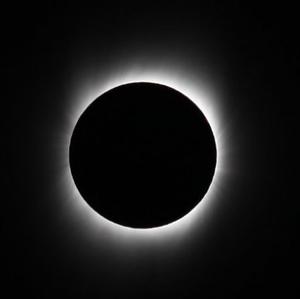
Eclipse total do Sol
Legenda: Esta imagem representa o eclipse solar total observado a partir de Kurigram, em Bangladesh. Os eclipses solares ocorrem quando a Lua, vista da Terra, passa na frente do Sol. A lua é muito menor que o Sol, mas está suficientemente mais próxima de nós de modo que os diâmetros angulares do Sol e da lua são quase iguais (aproximadamente a largura de meio dedo na ponta do braço). Portanto, a Lua pode cobrir o disco solar quando passa diretamente entre o Sol e a Terra. O anel de luz ao redor do círculo preto é chamado de coroa.
Crédito: Lutfar Rahman Nirjhar
link do crédito
License: CC-BY-3.0 Creative Commons Attribution 3.0 Unported ícones

Trânsito de Fobos por Marte
Legenda: Este vídeo mostra o Sol visto de Marte, enquanto Fobos, a lua de Marte, transita pelo disco solar. Este vídeo é composto por imagens captadas da superfície marciana no dia 30 de setembro de 2024 pela câmera Mastcam-Z do rover Perseverance da NASA. Enquanto nossa Lua tem o tamanho perfeito para eclipsar o Sol quando vista da superfície da Terra, o tamanho e a órbita de Fobos fazem com que ele não consiga cobrir o disco solar completamente. Isso significa que este evento é um trânsito e não um eclipse.
Este vídeo é em tempo real, com o trânsito inteiro durando apenas 32 segundos. Isso contrasta com as várias horas que um eclipse solar na Terra pode durar, desde o momento em que a Lua começa a encobrir parte do Sol até que o Sol volte a ficar completamente visível. Isso se deve ao período orbital muito mais curto de Fobos, de pouco mais de sete horas e meia, em comparação com o período orbital da Lua, de 27 dias, bem como ao fato de o disco solar parecer ligeiramente menor visto de Marte do que da Terra. Observe a forma não esférica de Fobos enquanto cruza o disco solar.
Crédito: NASA/JPL-Caltech/ASU/MSSS
link do crédito
License: PD Domínio Público ícones

Eclipse solar total sobre o Observatório La Silla, Chile
Legenda: Um vídeo em tempo real mostrando o eclipse solar total em 2 de julho de 2019 sobre o Observatório La Silla, no Chile. Este vídeo cobre os momentos antes da totalidade, pouco menos de dois minutos de totalidade e os momentos após a totalidade. Note que, no início do vídeo, o Sol já estava quase completamente obscurecido pela Lua, mas é idifícil de perceber devido ao brilho do Sol e à exposição da câmera. Na verdade, a Lua começou a eclipsar parcialmente o Sol cerca de uma hora antes do início desta gravação e continuaria a encobri-lo parcialmente por aproximadamente o mesmo tempo depois. No momento da totalidade, é possível ver o brilho tênue das regiões externas difusas do Sol e, no horizonte, também é possível ver o brilho das partes das áreas ao redor da Terra que não estão passando pela totalidade.
Crédito: ESO/A. Santerne
link do crédito
License: CC-BY-4.0 Creative Commons Attribution 4.0 International (CC BY 4.0) ícones

Eclipse solar total de 2024 visto do espaço
Legenda: O Deep Space Climate Observatory da NASA (DSCOVR) registrou o eclipse solar total sobre a América do Norte em 8 de abril de 2024 a partir do espaço, usando sua Câmera de Imagem Policromática da Terra (EPIC). Este vídeo mostra imagens da Terra tiradas ao longo de quatro horas e meia. A sombra da Lua sobre a Terra pode ser vista enquanto se move do sudoeste para o nordeste. Embora a sombra pareça cobrir uma grande parte do continente, apenas uma faixa de até 185 km de largura no meio do caminho do eclipse observou um eclipse total em algum momento daquele dia e, e, cada instante, apenas a parte central da sombra teria experimentado um eclipse solar total. A maior parte da área coberta por essa sombra observou apenas um eclipse parcial.
O DSCOVR está localizado no ponto L1, um ponto gravitacional estável entre o Sol e a Terra, e observa o lado diurno da Terra.
Crédito: NASA/Equipe EPIC da DSCOVR/Michala Garrison e Wanmei Liang
link do crédito
License: PD Domínio Público ícones

Total Solar Eclipse from Casper, Wyoming, USA
Legenda: This video shows the total solar eclipse of the 21st of August 2017 observed from Casper, Wyoming, USA by a team of astronomers from the European Space Agency (ESA). This video has been sped up considerably, in reality the moment of totality lasted just under two and a half minutes while the time from the Moon first appearing to obscure the Sun until the Sun was completely unobscured was two hours and 48 minutes.
Before the eclipse we can see several sunspots on the Sun. The Moon moves across the Sun, covering the whole solar disk visible from the point on the Earth this video was taken from. At totality we can see the diffuse solar corona which is normally outshone by the bright solar disk.
Note that while edges of the Sun appear brighter just before and just after totality, this is due to exposure time of the camera being adjusted to make the features visible at totality more obvious. Towards the end of the video some thin cloud begins to affect the observations.
Crédito: Video credit: ESA/CESAR ; Music copyright: Flight Of The Angel 3 by Chris Blackwell, audionetwork.com
link do crédito
License: CC-BY-SA-3.0-IGO Creative Commons Attribution-ShareAlike 3.0 IGO ícones
Diagramas relacionados

Total Solar Eclipse
Legenda: This not to scale diagram shows what happens during a total solar eclipse. The Moon orbits the Earth, but its orbit is slightly tilted with respect to the Earth’s orbit around the Sun. During the new moon lunar phase, the Moon lies between the Earth and the Sun, but due to the Moon’s tilted orbit around the Earth, the Moon normally lies above or below the Sun at this point. However twice a year the Moon’s orbit lines up in such a way that the Moon can lie in a direct line between the Earth and Sun. During each of these periods (each of which last roughly a month) solar (and lunar) eclipses can occur. The Moon is about 400 times smaller than the Sun, but is 400 times closer to the Earth than the Sun. Hence the Sun and Moon have approximately the same angular size when viewed from the Earth. This means that it is possible for the Moon to completely cover the Sun when viewed from Earth. This is known as a total solar eclipse.
Here we see a schematic of such and eclipse. The Moon casts a shadow on the Earth known as the umbra. This is a roughly circular shadow a few hundred kilometres across although its shape can be severely distorted when the eclipse is at the edge of the illuminated part of the Earth. Any region within the umbra will see the Moon completely cover the Sun and thus will experience a total solar eclipse. Outside of the umbra there are regions where the Moon will cover part of the Sun. This partial shadow is known as the penumbra. Regions in the penumbra will experience a partial solar eclipse.
An eclipse is a dynamic event with the Moon moving in its orbit and the Earth rotating. Hence the umbra and penumbra move across the Earth’s surface together. The path the umbra takes across the Earth is known as the path of totality. Let’s consider one particular region that lies in the path of totality: except in rare cases where an eclipse begins at sunrise, a region that experiences totality will first see the Moon cover part of the Sun and gradually move across Sun until it is totally covered. From outside the Earth this would appear as the penumbra moving over this particular region followed by the umbra moving over this region. Once the Moon moves so that it no longer completely covers the Sun, totality ends and the umbra moves away from this particular region. The Moon will continue to uncover the Sun until (unless the Sun sets before the end of the eclipse) the Sun is completely uncovered. From outside the Earth this would appear as the umbra moving away from our particular region and the edge of the penumbra approaching and eventually passing over the region.
Outside of the path or totality there is a much broader region that will lie in the penumbra but will be missed by the umbra. Such regions will not experience a total solar eclipse during this event, only a partial solar eclipse.
Crédito: Aneta Margraf/IAU OAE
License: CC-BY-4.0 Creative Commons Attribution 4.0 International (CC BY 4.0) ícones