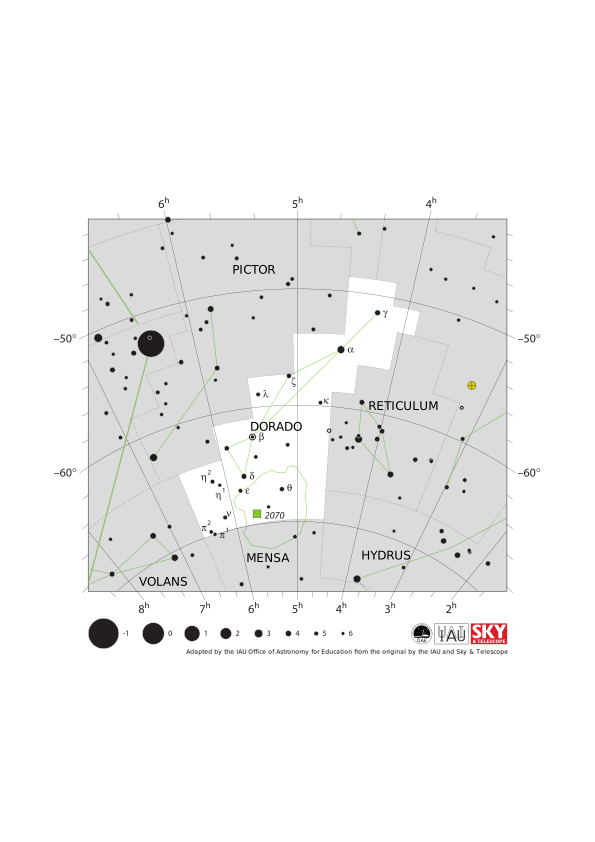
This page describes an image Dorado Constellation Map
Baixar arquivo ( imagem 94.49 kB)
Baixar arquivo PDF (PDF file 155.00 kB)
Legenda do diagrama:
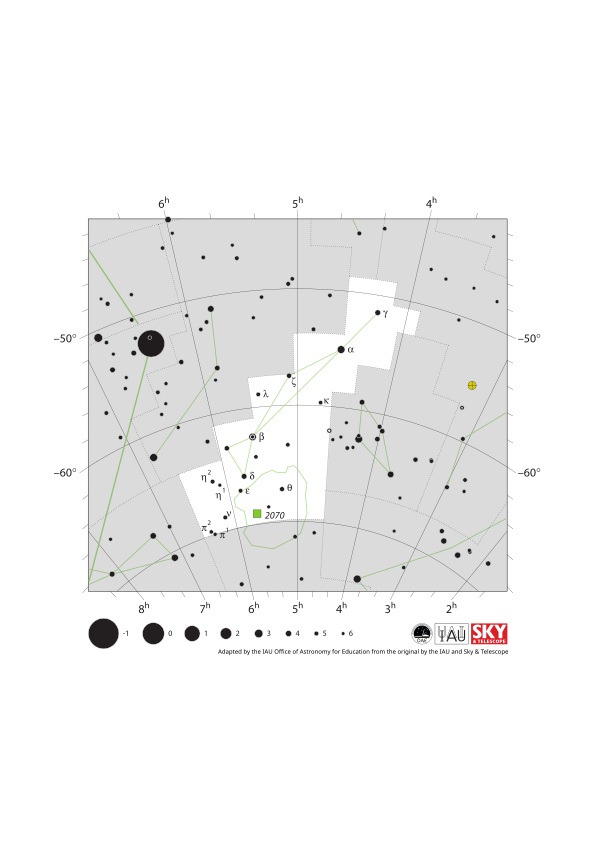
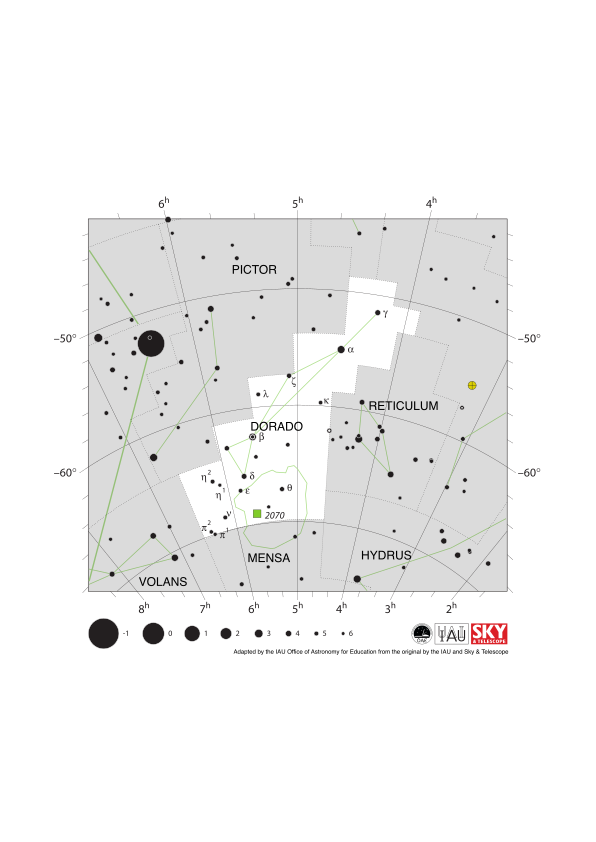
The constellation Dorado with its bright stars and surrounding constellations. Dorado is surrounded by (going clockwise from the top): Pictor, Caelum, Horologium, Reticulum, Hydrus, Mensa and Volans.
Dorado is a southern constellation and thus the whole constellation is visible at some point in the year from the whole southern hemisphere. The whole constellation is also visible to equatorial regions of the northern hemisphere. Dorado is circumpolar for temperate and antarctic regions of the southern hemisphere. This constellation is best viewed in the northern hemisphere winter and southern hemisphere summer.
The Large Magellanic Cloud (LMC), a satellite galaxy of the Milky Way, lies in Dorado and the neighboring constellation Mensa. The outline of the Large Magellanic Cloud is marked here as a roughly circular loop in green. The open cluster NGC 2070 lies at the heart of the Tarantula Nebula. This is marked here with a green square.
The y-axis of this diagram is in degrees of declination with north as up and the x-axis is in hours of right ascension with east to the left. The sizes of the stars marked here relate to the star's apparent magnitude, a measure of its apparent brightness. The larger dots represent brighter stars. The Greek letters mark the brightest stars in the constellation. These are ranked by brightness with the brightest star being labeled alpha, the second brightest beta, etc., although this ordering is not always followed exactly. The dotted boundary lines mark the IAU's boundaries of the constellations and the solid green lines mark one of the common forms used to represent the figures of the constellations. Neither the constellation boundaries, nor the lines joining the stars appear on the sky.
Crédito do diagrama: Adapted by the IAU Office of Astronomy for Education from the original by the IAU and Sky & Telescope. Link do crédito
Status da tradução dos diagramas: Ainda não aprovado por um revisor
Licença do diagrama: Creative Commons Atribuição 4.0 Internacional (CC BY 4.0) Creative Commons Atribuição 4.0 Internacional (CC BY 4.0) ícones
Termos relacionados do glossário:
Aglomerado aberto
, Ascensão Reta (AR)
, Constelação
, Coordenadas celestes
, Declinação
, Estrelas circumpolares
, Grande Nuvem de Magalhães (LMC)
, Magnitude aparente
, Nebulosa
Categorias
Astronomia a Olho Nu
Quer criar sua própria tradução ou versão deste diagrama? Então
baixe a versão SVG
deste diagrama em inglês (309.83 kB). Você pode editá-la usando
programas como o Inkscape (gratuito) ou o Adobe Illustrator
(proprietário). Apenas lembre-se de creditar adequadamente o autor do original.
Você também pode criar sua própria versão ou tradução deste diagrama adicionando texto a uma versão
deste diagrama sem texto. Basta baixar um dos arquivos abaixo:
Baixar arquivo sem texto ( imagem 88.20 kB)
Baixar arquivo PDF sem texto (arquivo PDF 142.41 kB)
Em outros idiomas
Inglês: Dorado Constellation MapItaliano: Mappa della Costellazione del Dorado
Chinês Tradicional: 劍魚座星圖
Chinês Simplificado: 剑鱼座星图
As legendas dos diagramas apresentadas no site da OAE foram escritas, traduzidas e revisadas por meio de um esforço coletivo da OAE, dos Centros e Nós da OAE, dos Coordenadores Nacionais de Educação em Astronomia (NAECs) da OAE e de outros voluntários. Você pode encontrar a lista completa de créditos do nosso projeto de tradução aqui. Todas as legendas de arquivos de mídia são publicadas sob uma licença Creative Commons CC BY-4.0 e devem ser creditadas à "IAU OAE". Os próprios arquivos de mídia podem ter licenças diferentes (veja acima) e devem ser creditados conforme indicado acima em "crédito".
Se você notar algum erro neste diagrama ou em sua legenda, por favor entre em contato.