Glossary term: Astronomical Survey
Description: An astronomical survey is a collection of astronomical data obtained through observations of the whole of, or a region of, the sky. These surveys often contain information on the positions of the astronomical objects they catalog at a particular point in time as well as their brightnesses, colors, and other properties. Large astronomical surveys map the sky to both provide data for astronomical research and to help select targets for large telescopes.
The design of an astronomical survey will depend on its scientific objectives, for example aiming at the whole sky, large parts of the sky, or in smaller areas only. Surveys covering small areas or "pencil-beam" surveys can concentrate more time observing one part of the sky and thus can detect fainter objects than some wider surveys.
Astronomical surveys may cover specific parts of the electromagnetic spectrum such as radio waves or the infrared, or may combine data from different wavelength ranges.
Some astronomical surveys make repeated observations of the same part of the sky allowing the scientific study of the movement of objects across the sky and of the change in brightness of astronomical objects or the appearance of transient objects such as supernovae. By measuring the yearly change in the positions, astronomers can also calculate the distance of the objects using parallax. Another type of astronomical survey is a spectroscopy survey that measures the spectra of thousands (or millions) of stars, galaxies, and other astronomical objects.
Related Terms:
- Brightness
- Color
- Infrared Astronomy
- Optical Astronomy
- Parallax
- Radio Astronomy
- Sky Map
- Spectrum
- Supernova
See this term in other languages
Term and definition status: This term and its definition have been approved by a research astronomer and a teacher
The OAE Multilingual Glossary is a project of the IAU Office of Astronomy for Education (OAE) in collaboration with the IAU Office of Astronomy Outreach (OAO). The terms and definitions were chosen, written and reviewed by a collective effort from the OAE, the OAE Centers and Nodes, the OAE National Astronomy Education Coordinators (NAECs) and other volunteers. You can find a full list of credits here. All glossary terms and their definitions are released under a Creative Commons CC BY-4.0 license and should be credited to "IAU OAE".
If you notice a factual error in this glossary definition then please get in touch.
In Other Languages
- Arabic: المسح الفلكي
- German: Durchmusterung
- Spanish: Estudio Astronómico
- French: Relevé astronomique
- Italian: indagine astronomica
- Japanese: サーベイ観測 (external link)
- Brazilian Portuguese: Levantamento Astronômico
- Simplified Chinese: 天文巡天
- Traditional Chinese: 天文巡天
Related Media

Pan-STARRS Survey: Mosaic of the Northern Sky
Caption: This circular mosaic was created from thousands of sky images taken by the Pan-STARRS Observatory, a 1.8-meter telescope located on the volcano Haleakalā on Maui, Hawai`i. The centre of the circle marks the north celestial pole, while the outer boundary corresponds to a declination of −30 degrees — the southern limit of the survey from that location. Each part of this image was visited multiple times during the survey with each location imaged in five different colors with multiple images per color to catch objects changing in brightness and to find moving objects such as asteroids. This dataset is a powerful example of an astronomical survey, in which the sky is systematically photographed to build large, uniform catalogs of celestial objects.
The wide, bright band running roughly from top to bottom is the Milky Way, with the Galactic centre appearing near the lower edge where the glow is strongest. Across the image are hundreds of millions of detected sources, most of them stars within our own galaxy, along with many distant galaxies in the background. Surveys like Pan-STARRS are essential for studying the structure of the Milky Way and for discovering new objects across vast areas of the sky.
Credit: Richard White (STScI), Pan-STARRS1 Science Consortium
credit link
License: PD Public Domain icons
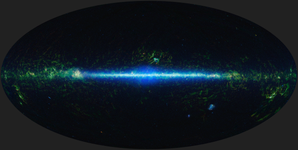
WISE Survey Capturing the Whole Sky in Infrared Light
Caption: This image presents the entire sky mapped in infrared light from space by the WISE satellite. While dust in the plane of the Milky Way blocks visible light, obscuring the heart of our Galaxy, infrared light passes through the dust. The most prominent feature is the broad, bright band running horizontally through the centre — this is the plane of our Milky Way galaxy. Numerous brighter knots and patches appear above and below the band, marking regions of active star formation and nearby galaxies.
Such a dataset is a classic example of an astronomical survey, in which large portions of the sky is scanned to build a comprehensive catalogue of cosmic sources. The WISE satellite operated in space, allowing it to study parts of the infrared spectrum blocked by Earth's atmosphere.
Credit: NASA/JPL-Caltech
credit link
License: PD Public Domain icons