This page describes an image Conjunction of Mercury and Venus above the Moon
Descargar archivo ( imagen 2.43 MB)
Pie de foto:
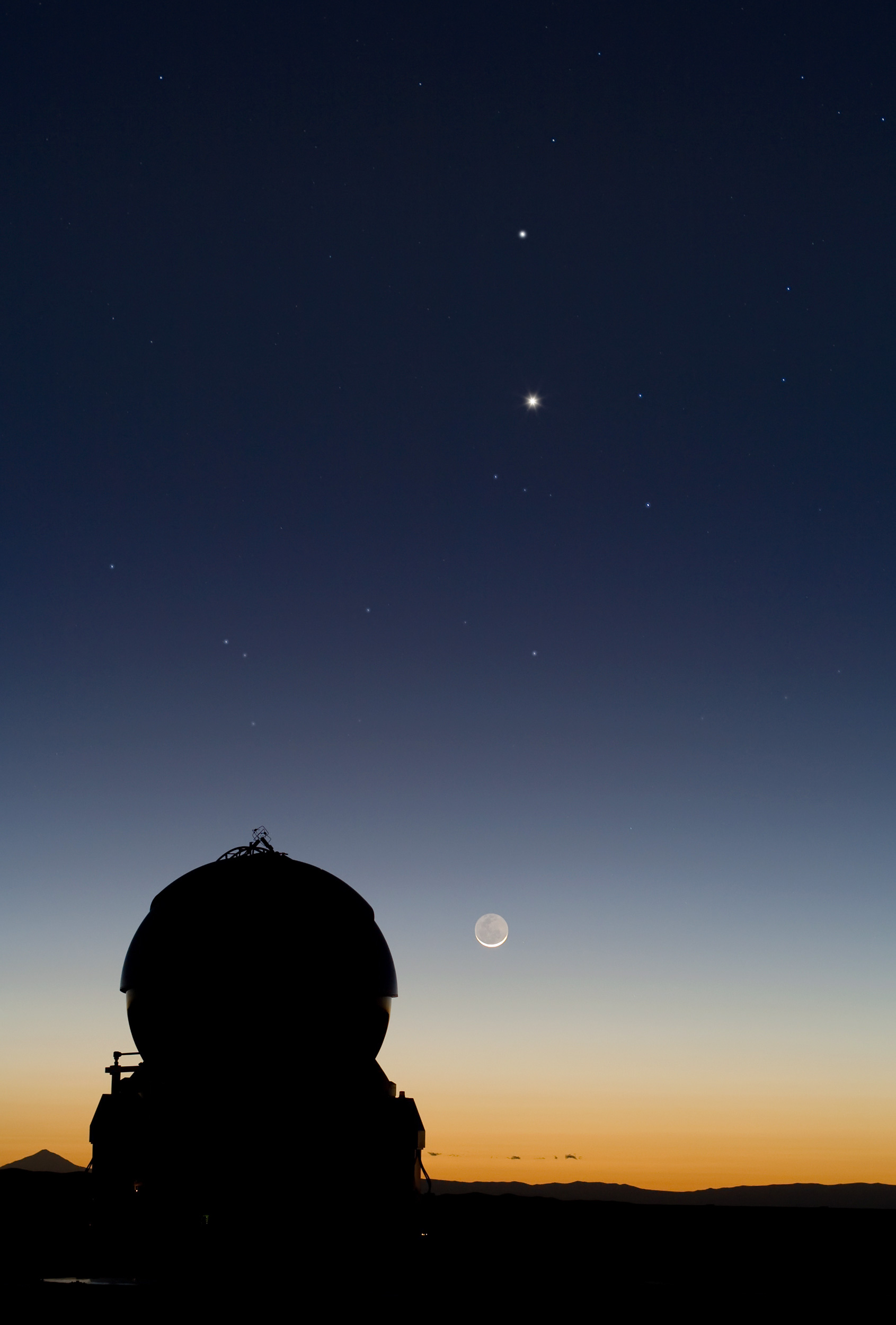
From the observing deck at the European Southern Observatory’s Paranal site in Chile, in March 2008, astronomers captured a conjunction of celestial objects—a moment when two or more astronomical objects appear close together in the sky as seen from Earth. In this scene, the innermost planets Mercury and Venus appear aligned above the Moon, forming a pattern against the sky just before dawn. Although they are at very different distances from Earth, the geometry of their orbits brought them into almost the same line of sight, creating this beautiful cosmic alignment.
In the image, the bright crescent Moon is visible low in the sky near the horizon, forming the most prominent object in the lower part of the scene. Just above the Moon, the brighter planet Venus can be seen, while Mercury, fainter and further from the horizon, appears nearby in the upper part of the image.
Desplázate hasta los subtítulos en otros idiomas
Crédito de la imagen: ESO/Y. Beletsky Enlace del crédito
Términos relacionados del glosario:
Conjunción
Licencia de la imagen: Creative Commons Reconocimiento 4.0 Internacional (CC BY 4.0) Creative Commons Reconocimiento 4.0 Internacional (CC BY 4.0) íconos
Las descripciones de los archivos multimedia que aparecen en la página web de la OAE han sido redactadas, traducidas y revisadas gracias al esfuerzo conjunto de la OAE y los Centros y Nodos de la OAE, los Coordinadores Nacionales de Educación Astronómica (NAECs) y otros voluntarios. Puedes consultar la lista completa de los créditos de nuestro proyecto de traducción aquí. Todos los pies de foto de los archivos multimedia se publican bajo una Creative Commons CC BY-4.0 licencia y deben atribuirse a la "IAU OAE". Los propios archivos multimedia pueden tener diferentes licencias (véase más arriba) y deben citarse tal y como se indica en "credit".
Pies de foto en diferentes idiomas:
Pie de foto: Von der Aussichtsplattform am Standort der Europäischen Südsternwarte auf dem Paranal in Chile aus hielten Astronomen im März 2008 eine Konjunktion von Himmelsobjekten fest – einen Moment, in dem zwei oder mehr astronomische Objekte vom Erdboden aus betrachtet dicht beieinander am Himmel stehen. In dieser Szene erscheinen die innersten Planeten Merkur und Venus in einer Linie über dem Mond und bilden kurz vor Tagesanbruch ein markantes Muster am Himmel. Obwohl sie sich in sehr unterschiedlichen Entfernungen von der Erde befinden, bringt die Geometrie der Umlaufbahnen der beiden Planeten und des Monds sie fast auf dieselbe Sichtlinie, wodurch diese wunderschöne Konstellation entsteht.
Auf dem Bild ist die helle Mondsichel tief am Himmel nahe dem Horizont zu sehen: sie bildet das auffälligste Objekt im unteren Teil der Szene. Direkt über dem Mond ist der hellere Planet Venus zu erkennen, während Merkur, der schwächer leuchtet und weiter vom Horizont entfernt ist, im oberen Teil des Bildes erscheint.
Crédito de la imagen: ESO/Y. Beletsky
Términos relacionados del glosario: Konjunktion Estado de la traducción de los subtítulos: Aún no ha sido aprobado por un revisor o revisora
Traductores de las leyendas: Simon Kraus
Pie de foto: From the observing deck at the European Southern Observatory’s Paranal site in Chile, in March 2008, astronomers captured a conjunction of celestial objects—a moment when two or more astronomical objects appear close together in the sky as seen from Earth. In this scene, the innermost planets Mercury and Venus appear aligned above the Moon, forming a pattern against the sky just before dawn. Although they are at very different distances from Earth, the geometry of their orbits brought them into almost the same line of sight, creating this beautiful cosmic alignment.
In the image, the bright crescent Moon is visible low in the sky near the horizon, forming the most prominent object in the lower part of the scene. Just above the Moon, the brighter planet Venus can be seen, while Mercury, fainter and further from the horizon, appears nearby in the upper part of the image.
Crédito de la imagen: ESO/Y. Beletsky
Términos relacionados del glosario: Conjunction
Pie de foto: Dal ponte di osservazione della sede di Paranal dell’Osservatorio Europeo Australe in Cile, nel marzo 2008, gli astronomi hanno immortalato una congiunzione di corpi celesti: un momento in cui due o più corpi celesti appaiono vicini tra loro nel cielo, visti dalla Terra. In questa scena, i pianeti più interni, Mercurio e Venere, appaiono allineati sopra la Luna, formando una figura nel cielo poco prima dell’alba. Sebbene si trovino a distanze molto diverse dalla Terra, la geometria delle loro orbite li ha portati quasi sulla stessa linea di vista, creando questo splendido allineamento cosmico.
Nell'immagine, la brillante falce di Luna è visibile in basso nel cielo vicino all'orizzonte, costituendo l'oggetto più prominente nella parte inferiore della scena. Appena sopra la Luna si vede il pianeta più luminoso, Venere, mentre Mercurio, più debole e più lontano dall'orizzonte, appare nelle vicinanze nella parte superiore dell'immagine.
Crédito de la imagen: ESO/Y. Beletsky
Términos relacionados del glosario: Congiunzione Estado de la traducción de los subtítulos: Aún no ha sido aprobado por un revisor o revisora
Traductores de las leyendas: Giuliana Giobbi
Pie de foto: A partir do mirante do Observatório Europeu do Sul, em Paranal, no Chile, em março de 2008, astrônomos registraram uma conjunção de objetos celestes — um momento em que dois ou mais objetos astronômicos aparecem próximos uns dos outros no céu, vistos da Terra. Nesta imagem, os planetas mais internos, Mercúrio e Vênus, aparecem alinhados acima da Lua, formando um padrão no o céu pouco antes do amanhecer. Embora estejam a distâncias muito diferentes da Terra, a geometria de suas órbitas os colocou quase na mesma linha de visão, criando este belo alinhamento cósmico.
Na imagem, a Lua crescente brilhante é visível baixa no céu, perto do horizonte, sendo o objeto mais destacado na parte inferior. Logo acima da Lua, pode-se ver o planeta mais brilhante, Vênus, enquanto Mercúrio, mais fraco e mais distante do horizonte, aparece próximo, na parte superior da imagem.
Crédito de la imagen: ESO/Y. Beletsky
Términos relacionados del glosario: Conjunção Estado de la traducción de los subtítulos: Aún no ha sido aprobado por un revisor o revisora
Traductores de las leyendas: Eduardo Monfardini Penteado