Término del glosario: Estrella supergigante
Descripción: Las supergigantes son las estrellas más grandes y luminosas. Pueden ser varios cientos de veces más grandes que el Sol y muchos miles de veces más luminosas. Ocupan la región superior del diagrama Hertzsprung-Russell, con magnitudes visuales absolutas comprendidas entre −3 y −8. El rango de temperaturas de las estrellas supergigantes abarca desde unos 3 400 kelvin (K) hasta más de 20 000 K. Se trata de estrellas masivas o bien de estrellas que se encuentran en una fase muy avanzada de su evolución estelar. Las estrellas supergigantes pueden identificarse a partir de sus espectros, que presentan líneas distintivas sensibles a la alta luminosidad y a la baja gravedad superficial: estas líneas espectrales son estrechas en comparación con la anchura de las líneas de las estrellas más pequeñas. Ejemplos típicos de estrellas supergigantes son Betelgeuse, en Orión, y las variables cefeidas.
Términos relacionados:
Ver este término en otros idiomas
Estado del término y la definición: La definición original de este término en inglés ha sido aprobada por unastrónomo o astrónoma investigadora y un docente La traducción de este término y su definición aún están pendientes de aprobación
El Glosario multilingüe de la OAE es un proyecto de la Oficina de Astronomía para la Educación de la UAI (OAE) en colaboración con la Oficina de Divulgación de Astronomía de la UAI (OAO). Los términos y definiciones fueron seleccionados, redactados y revisados gracias al esfuerzo colectivo de la OAE, los Centros y Nodos de la OAE, los Coordinadores Nacionales de Educación Astronómica (NAECs) y otros voluntarios. Puedes encontrar una lista completa de créditos aquí. Todos los términos del glosario y sus definiciones se publican bajo la licencia Creative Commons CC BY-4.0 y deben atribuirse a la "IAU OAE".
Si detectas algún error de contenido o de traducción en este término del glosario o en ladefinición, ponte en contacto con nosotros.
En otros idiomas
- Árabe: نجم فائق الضخامة
- Alemán: Überriesen
- Inglés: Supergiant Star
- Persa: ستاره ابرغول
- Francés: Étoile supergéante
- Italiano: Stella supergigante
- Japonés: 超巨星 (enlace externo)
- Coreano: 초거성
- Portugués de Brasil: Estrela supergigante
- Chino simplificado: 超巨星
- Chino tradicional: 超巨星
Contenidos relacionados

The red supergiant Betelgeuse
Pie de foto: The image shows Betelgeuse, a red supergiant in the constellation Orion, observed by the Atacama Large Millimeter/submillimeter Array (ALMA). ALMA consists of many antennae spread across a plain in Northern Chile. The observations from all of these receivers is synthesised together by a central computer to form an image. The wide distances between the antennae mean that is can resolve very fine details.
Most stars we observe are just seen as points of light, but Betelgeuse is so large (with a radius about 1,400 times larger than the Sun) and is sufficiently nearby that it is one of the few stars to have been resolved to show it as an extended object.
Betelgeuse is a massive star, more than 14 times the mass of the Sun and is relatively young for a star (less than 14 million years old). However, its high mass led to it having a very hot core which burned through its hydrogen fuel quickly. It has since evolved through many stages and now appears as a red supergiant, it's final stage before exploding as a supernova. When such an explosion will happen is not known for certain, but it could be in around 100,000 years. Such an explosion would be visible from Earth, even during the day.
Crédito: ALMA (ESO/NAOJ/NRAO)/E. O’Gorman/P. Kervella
enlace de crédito
License: CC-BY-4.0 Creative Commons Reconocimiento 4.0 Internacional (CC BY 4.0) íconos
Diagramas relacionados
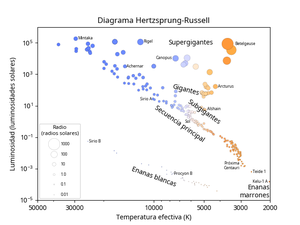
Diagrama Hertzsprung-Russell
Pie de foto: Este diagrama muestra la temperatura y luminosidad de diferentes estrellas. El tamaño de cada punto representa el radio de la estrella y su color es el que vería el ojo humano. El color de las estrellas oscila entre un azul apagado y un naranja rojizo apagado. Ninguna estrella tiene un color puro como el rojo, el verde o el azul, ya que los espectros de las estrellas incluyen luz de muchos colores diferentes. Sin embargo, las estrellas más rojas suelen denominarse rojas y las más azules, azules. La muestra de estrellas utilizada para hacer este diagrama se eligió para mostrar una amplia gama de estrellas de diferentes tipos, por lo que el número relativo de cada tipo de estrella no es representativo de la frecuencia con la que cada tipo se encuentra.
Desde arriba a la izquierda hasta abajo a la derecha hay una larga línea de estrellas que queman hidrógeno en sus núcleos. Ésta es la llamada secuencia principal. En esta línea se encuentran las estrellas Mintaka, Achernar, Sirio A, el Sol y Próxima Centauri. Los objetos situados alrededor de Próxima Centauri, en el extremo inferior derecho de la secuencia principal, se denominan enanas rojas. En la parte inferior derecha de las enanas rojas se encuentran Teide 1 y Kelu-1 A. Estos dos objetos son enanas marrones, objetos de masa demasiado baja para tener núcleos lo suficientemente calientes como para fusionar hidrógeno durante un periodo de tiempo prolongado. Como no queman hidrógeno, las enanas marrones no se consideran estrellas de la secuencia principal. El nombre de enana marrón no está relacionado con su color.
Por encima de la secuencia principal se encuentran las subgigantes, gigantes y supergigantes. Se trata de estrellas que han terminado de quemar hidrógeno en su núcleo y han evolucionado hasta convertirse en objetos de mayor tamaño. El brillo de una estrella depende de su temperatura y tamaño, de modo que las gigantes son más brillantes que las estrellas de radio más pequeño pero con la misma temperatura. Con el tiempo, estos objetos se acercarán al final de su vida y atravesarán una fase de nebulosa planetaria o se convertirán en supernovas. Las estrellas que terminan su vida con una fase de nebulosa planetaria se convierten en un tipo de remanente estelar denominado enana blanca. Estos objetos son mucho más pequeños que las estrellas de la misma temperatura, por lo que son más débiles y se encuentran muy por debajo de la secuencia principal. Las estrellas que terminan su vida como supernovas se convierten en agujeros negros o estrellas de neutrones. Éstas no se muestran en este gráfico.
Crédito: IAU OAE/Niall Deacon
License: CC-BY-4.0 Creative Commons Reconocimiento 4.0 Internacional (CC BY 4.0) íconos
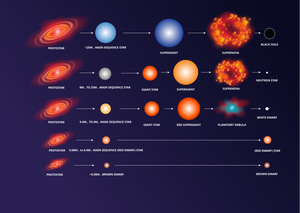
Stellar Evolution
Pie de foto: This diagram shows the life cycle of stars of different masses. The mass of the different types of star increases from bottom to top with time going from left to right.
The life cycle of a star depends on its mass, with lower mass stars have longer lifetimes. All stars form from clouds of gas that collapse under their own gravity. As the star collapses, its core becomes hotter and denser. If the star has a mass greater than 0.08 solar masses (0.08 times the mass of the Sun), the pressure of the star’s mass pushing down on its core creates a high enough core temperature for hydrogen fusion to ignite. This burns hydrogen into helium in the star’s core, providing a heat source to power the star and to stop its core from collapsing further. If the collapsing object has a mass below 0.08 solar masses then it does not ignite hydrogen fusion in its core. It continues to cool and slowly contract. Such substellar objects are known as brown dwarfs, shown here in the lowest row.
After stars have formed, they burn hydrogen in their cores and begin their so-called main sequence phase. The most massive stars (>25 solar masses, shown here at the top) have very high core temperatures and thus burn through their hydrogen fuel more quickly. This means they may only spend a few million years on the main sequence burning hydrogen in their cores. Once the hydrogen in the core is exhausted the star’s core contracts, becomes hotter and helium burning starts in the core. While the core contracts, the outer layers of the star expand and it becomes a supergiant. For the most massive stars strong stellar winds strip off the cooler outer layers, leading to the star being very large and very hot, a blue supergiant. Once helium is exhausted in the core, carbon is burned, and then heavier elements. Eventually the star ends with an iron core. Fusing iron into heavier elements does not generate energy so at this point fusion stops in the core. Once this core of iron is massive enough, it and the surrounding matter suddenly collapses to form a black hole and the outer layers are flung off in a supernova explosion.
Slightly lower mass stars (between 8 and 25 solar masses, seen here second top) evolve in a similar way although they do not have strong enough winds to push their outer layers away and become blue supergiants, instead it evolves into a red supergiant. While such stars also collapse and create supernova explosions. The remnant of the star’s core is not massive enough to collapse into a black hole. Instead, its electrons and protons combine to form neutrons and it is supported by a quantum mechanical effect called neutron degeneracy pressure. This results in the remnant of the star being a tiny neutron star, several solar masses in mass but only a few kilometres across.
For stars similar in mass to the Sun (between 0.4 and 8 solar masses, seen here in the middle row), the star burns hydrogen in its core until the hydrogen in its core is exhausted. At this point a hydrogen burning shell forms around the core. Eventually the core will become hot enough to burn helium into carbon and oxygen. After this the star is left with a carbon and oxygen core surrounded by shells burning helium and hydrogen. These shells are unstable producing thermal pulsations that convulse the star. Eventually these pulsations become so extreme that the star’s outer layers are thrown off. This leaves the carbon and oxygen core as a white dwarf supported by electron degeneracy pressure. The outer layers of the star form what is known as a planetary nebula (which doesn’t actually have anything to do with planets despite the name).
The lowest mass stars (seen here in the second bottom row) are so low in mass that their evolutionary timescales are much longer than the age of the universe. This means that none have evolved beyond the main-sequence. Low mass stars are fully convective meaning material in the core is constantly being mixed with material above. This means that all the hydrogen in the star would eventually be burned in the core, but this will take trillions of years.
Crédito: Danielle Futselaar/IAU OAE
License: CC-BY-4.0 Creative Commons Reconocimiento 4.0 Internacional (CC BY 4.0) íconos