Término del glosario: Estación espacial
Descripción: Una estación espacial es una nave espacial que permanece en órbita durante un periodo de tiempo considerable y que sirve de hogar a largo plazo para los seres humanos en el espacio. En concreto, ofrece condiciones de vida adecuadas, desde aire respirable hasta una temperatura bien regulada. Hasta ahora, todas las estaciones espaciales han dependido de suministros regulares de comida y agua. Hasta la fecha, las estaciones espaciales se encuentran o se han encontrado en órbitas terrestres bajas; la Estación Espacial Internacional, por ejemplo, orbita a unos 420 kilómetros sobre el nivel del mar. Una estación en órbita se encuentra en caída libre, y tanto los astronautas como el equipo y la estación espacial experimentan la misma aceleración debida a la gravedad terrestre. Dado que los astronautas y el equipo dentro de la estación espacial se aceleran con la misma magnitud y dirección que su entorno en la estación, experimentan la sensación de ingravidez, aunque en realidad no estén en ingravidez. Esta sensación se denomina a menudo microgravedad, aunque este nombre puede resultar confuso, ya que la fuerza gravitatoria de la Tierra sigue siendo considerable en la estación espacial, los astronautas y el equipo. Las estaciones espaciales se utilizan principalmente para la investigación, en particular sobre el efecto de la microgravedad en los seres humanos; una preparación importante para las siguientes etapas de la exploración espacial.
Términos relacionados:
Ver este término en otros idiomas
Estado del término y la definición: La definición original de este término en inglés ha sido aprobada por unastrónomo o astrónoma investigadora y un docente La traducción de este término y su definición aún están pendientes de aprobación
El Glosario multilingüe de la OAE es un proyecto de la Oficina de Astronomía para la Educación de la UAI (OAE) en colaboración con la Oficina de Divulgación de Astronomía de la UAI (OAO). Los términos y definiciones fueron seleccionados, redactados y revisados gracias al esfuerzo colectivo de la OAE, los Centros y Nodos de la OAE, los Coordinadores Nacionales de Educación Astronómica (NAECs) y otros voluntarios. Puedes encontrar una lista completa de créditos aquí. Todos los términos del glosario y sus definiciones se publican bajo la licencia Creative Commons CC BY-4.0 y deben atribuirse a la "IAU OAE".
Si detectas algún error de contenido o de traducción en este término del glosario o en ladefinición, ponte en contacto con nosotros.
En otros idiomas
- Árabe: المحطة الفضائية
- Alemán: Raumstation
- Inglés: Space Station
- Francés: Station spatiale
- Italiano: Stazione spaziale
- Portugués de Brasil: Estação Espacial
- Chino simplificado: 空间站
- Chino tradicional: 空間站
Contenidos relacionados
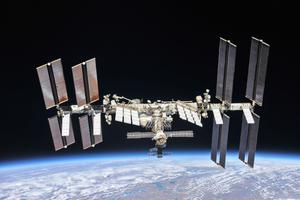
International Space Station
Pie de foto: The International Space Station (ISS) is in orbit around the Earth. Different crews with personnel from many countries have been working there constantly since 2000. The ISS is a laboratory that provides a microgravity environment for experiments in engineering, science, and medicine. The entire structure is more than 100 metres long and flies at an altitude of approximately 400 kilometres above ground.
Crédito: NASA
enlace de crédito
License: PD Dominio público íconos

Astronauts working outside the ISS
Pie de foto: In this image, astronauts Robert L. Curbeam (USA) and Christer Fuglesang (Sweden) are seen working outside the International Space Station (ISS), visible against the backdrop of the Earth with New Zealand visible below. They are attaching a truss segment to the ISS to keep it rigid and to route electricity and liquid coolants. Extending over 15 meters and weighing more than 10,000 kilograms, these trusses are not easy objects to work with, especially outside of a space station. The astronauts are wearing large white spacesuits and are attached to the hull of the ISS to ensure they do not drift off into space.
Crédito: STS-116 Shuttle Crew, NASA
enlace de crédito
License: PD Dominio público íconos