Término del glosario: Eclipse solar
Descripción: Un eclipse solar se produce cuando la Tierra, la Luna y el Sol se alinean en una línea recta, con la Luna situada entre la Tierra y el Sol. Cuando se observa desde la superficie de la Tierra, el disco lunar cubre el disco solar en el cielo; desde el espacio podemos ver la sombra de la Luna desplazándose por la cara iluminada de la Tierra.
Existen diferentes tipos de eclipses solares. Los totales, en los que el disco lunar cubre por completo el Sol; los parciales, en los que solo una fracción del disco solar queda cubierta incluso en el momento máximo del eclipse; y los anulares, en los que la Luna se encuentra más lejos de lo habitual y, por lo tanto, parece más pequeña de lo normal, lo que permite que un anillo del disco solar siga siendo visible incluso en el momento de máximo del eclipse.
Durante un eclipse solar total, el punto más oscuro de la sombra de la Luna sobre la Tierra se denomina «umbra», y el borde de la sombra se denomina «penumbra». Los observadores que se encuentran en la umbra ven un eclipse total, mientras que los que se encuentran en la penumbra ven un eclipse parcial.
Términos relacionados:
Ver este término en otros idiomas
Estado del término y la definición: La definición original de este término en inglés ha sido aprobada por unastrónomo o astrónoma investigadora y un docente La traducción de este término y su definición aún están pendientes de aprobación
El Glosario multilingüe de la OAE es un proyecto de la Oficina de Astronomía para la Educación de la UAI (OAE) en colaboración con la Oficina de Divulgación de Astronomía de la UAI (OAO). Los términos y definiciones fueron seleccionados, redactados y revisados gracias al esfuerzo colectivo de la OAE, los Centros y Nodos de la OAE, los Coordinadores Nacionales de Educación Astronómica (NAECs) y otros voluntarios. Puedes encontrar una lista completa de créditos aquí. Todos los términos del glosario y sus definiciones se publican bajo la licencia Creative Commons CC BY-4.0 y deben atribuirse a la "IAU OAE".
Si detectas algún error de contenido o de traducción en este término del glosario o en ladefinición, ponte en contacto con nosotros.
En otros idiomas
- Árabe: الكسوف الشمسي
- Alemán: Sonnenfinsternis
- Inglés: Solar Eclipse
- Francés: Eclipse solaire
- Italiano: Eclissi solare
- Japonés: 日食 (enlace externo)
- Portugués de Brasil: Eclipse Solar
- Chino simplificado: 日食
- Chino tradicional: 日食
Contenidos relacionados
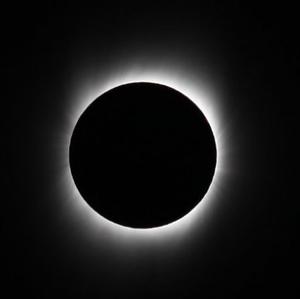
Total Solar Eclipse
Pie de foto: This image represents the total solar eclipse as observed from Kurigram in Bangladesh. Solar eclipses occur when the moon, as seen from earth, passes in front of the Sun. The moon is much smaller than the Sun, it is closer by the night amount that the angular diameters of the Sun and moon are almost the same (~approximately 1/2 a fingertip). Therefore, the moon can cover up the Sun's disk when it passes directly between the Sun and the Earth. The ring of light around the black circle is called the corona.
Crédito: Lutfar Rahman Nirjhar
enlace de crédito
License: CC-BY-3.0 Creative Commons Atribución 3.0 No portada íconos

Tránsito de Fobos desde Marte
Pie de foto: Este vídeo muestra el Sol visto desde Marte mientras su luna, Fobos, transita por el disco solar. Este vídeo está compuesto por imágenes tomadas desde la superficie marciana el 30 de septiembre de 2024 por la cámara Mastcam-Z del vehículo explorador Perseverance Mars de la NASA. Mientras que nuestra Luna tiene el tamaño perfecto para eclipsar al Sol vista desde la superficie terrestre, el tamaño y la órbita de Fobos hacen que no pueda cubrir completamente el disco solar. Esto significa que se trata de un tránsito y no de un eclipse.
Este vídeo es en tiempo real, y el tránsito completo dura sólo 32 segundos. Esto contrasta con las horas que dura un eclipse solar en la Tierra desde que la Luna oscurece parte del Sol hasta que este vuelve a ser completamente visible. Esto se debe a que el período orbital de Fobos es mucho más corto, de poco más de siete horas y media, que el de la Luna, de 27 días, y a que el disco solar parece ligeramente más pequeño desde Marte que desde la Tierra. Nótese la forma no esférica de Fobos al cruzar el disco solar.
Crédito: NASA/JPL-Caltech/ASU/MSSS
enlace de crédito
License: PD Dominio público íconos

Un eclipse solar total sobre el Observatorio La Silla, Chile
Pie de foto: Un video en tiempo real que muestra el eclipse solar total del 2 de julio de 2019 sobre el Observatorio La Silla en Chile. Este video cubre los momentos antes de la totalidad, los poco menos de dos minutos de la totalidad y los momentos después de la totalidad. Nótese que al inicio del vídeo el Sol ya estaba casi completamente oculto por la Luna, pero es difícil verlo debido al brillo del Sol y a la exposición de la cámara. De hecho, la Luna comenzó a eclipsar parcialmente al Sol aproximadamente una hora antes del inicio de esta grabación y continuaría ocultando parcialmente al Sol durante aproximadamente el mismo tiempo después.
En el punto de la totalidad se puede ver el tenue resplandor de las regiones exteriores difusas del Sol, y en el horizonte, también se puede ver el resplandor de las partes de las zonas circundantes de la Tierra que no están experimentando la totalidad.
Crédito: ESO/A. Santerne
enlace de crédito
License: CC-BY-4.0 Creative Commons Reconocimiento 4.0 Internacional (CC BY 4.0) íconos

2024 Eclipse total de Sol desde el espacio
Pie de foto: El Observatorio Climático del Espacio Profundo (DSCOVR) de la NASA captó desde el espacio el eclipse solar total sobre Norteamérica del 8 de abril de 2024 utilizando su Cámara de Imágenes Policromáticas de la Tierra (EPIC). Este vídeo muestra imágenes de la Tierra tomadas a lo largo de cuatro horas y media. Se puede ver la sombra de la Luna sobre la Tierra a medida que se desplaza de suroeste a noreste. Aunque la sombra parece cubrir una gran parte del continente, sólo una franja de hasta 185 km de ancho en el centro de la trayectoria del eclipse vio un eclipse total en algún momento de este día y, en cualquier momento dado, sólo la parte central de la sombra habría experimentado un eclipse solar total. La mayor parte de la zona cubierta por esta sombra sólo vio un eclipse parcial.
DSCOVR se encuentra en L1, un punto gravitatorio estable entre el Sol y la Tierra, y observa el lado diurno de la Tierra.
Crédito: Equipo EPIC de NASA/DSCOVR/Michala Garrison y Wanmei Liang
enlace de crédito
License: PD Dominio público íconos

Eclipse total de Sol desde Casper, Wyoming, EE.UU.
Pie de foto: Este vídeo muestra el eclipse total de Sol del 21 de agosto de 2017 observado desde Casper, Wyoming, Estados Unidos, por un equipo de astrónomos de la Agencia Espacial Europea (ESA). Este vídeo se ha acelerado considerablemente; en realidad, el momento de la totalidad duró poco menos de dos minutos y medio, mientras que el tiempo transcurrido desde que la Luna comenzó a ocultar al Sol hasta que este quedó completamente al descubierto fue de dos horas y 48 minutos.
Antes del eclipse podemos ver varias manchas solares en el Sol. La Luna se mueve a través del Sol, cubriendo todo el disco solar visible desde el punto de la Tierra desde el que se tomó este vídeo. En la totalidad podemos ver la corona solar difusa que normalmente queda eclipsada por el brillante disco solar.
Nótese que, aunque los bordes del Sol parecen más brillantes justo antes y justo después de la totalidad, esto se debe a que el tiempo de exposición de la cámara se ha ajustado para que las características visibles durante la totalidad sean más evidentes. Hacia el final del vídeo, una fina nube comienza a afectar a las observaciones.
Crédito: Crédito del vídeo: ESA/CESAR ; Derechos de autor de la música: Flight Of The Angel 3 por Chris Blackwell, audionetwork.com
enlace de crédito
License: CC-BY-SA-3.0-IGO Creative Commons Attribution-ShareAlike 3.0 IGO íconos
Diagramas relacionados

Total Solar Eclipse
Pie de foto: This not to scale diagram shows what happens during a total solar eclipse. The Moon orbits the Earth, but its orbit is slightly tilted with respect to the Earth’s orbit around the Sun. During the new moon lunar phase, the Moon lies between the Earth and the Sun, but due to the Moon’s tilted orbit around the Earth, the Moon normally lies above or below the Sun at this point. However twice a year the Moon’s orbit lines up in such a way that the Moon can lie in a direct line between the Earth and Sun. During each of these periods (each of which last roughly a month) solar (and lunar) eclipses can occur. The Moon is about 400 times smaller than the Sun, but is 400 times closer to the Earth than the Sun. Hence the Sun and Moon have approximately the same angular size when viewed from the Earth. This means that it is possible for the Moon to completely cover the Sun when viewed from Earth. This is known as a total solar eclipse.
Here we see a schematic of such and eclipse. The Moon casts a shadow on the Earth known as the umbra. This is a roughly circular shadow a few hundred kilometres across although its shape can be severely distorted when the eclipse is at the edge of the illuminated part of the Earth. Any region within the umbra will see the Moon completely cover the Sun and thus will experience a total solar eclipse. Outside of the umbra there are regions where the Moon will cover part of the Sun. This partial shadow is known as the penumbra. Regions in the penumbra will experience a partial solar eclipse.
An eclipse is a dynamic event with the Moon moving in its orbit and the Earth rotating. Hence the umbra and penumbra move across the Earth’s surface together. The path the umbra takes across the Earth is known as the path of totality. Let’s consider one particular region that lies in the path of totality: except in rare cases where an eclipse begins at sunrise, a region that experiences totality will first see the Moon cover part of the Sun and gradually move across Sun until it is totally covered. From outside the Earth this would appear as the penumbra moving over this particular region followed by the umbra moving over this region. Once the Moon moves so that it no longer completely covers the Sun, totality ends and the umbra moves away from this particular region. The Moon will continue to uncover the Sun until (unless the Sun sets before the end of the eclipse) the Sun is completely uncovered. From outside the Earth this would appear as the umbra moving away from our particular region and the edge of the penumbra approaching and eventually passing over the region.
Outside of the path or totality there is a much broader region that will lie in the penumbra but will be missed by the umbra. Such regions will not experience a total solar eclipse during this event, only a partial solar eclipse.
Crédito: Aneta Margraf/IAU OAE
License: CC-BY-4.0 Creative Commons Reconocimiento 4.0 Internacional (CC BY 4.0) íconos