Término del glosario: Galaxia irregular
Descripción: Una galaxia irregular es un tipo de galaxia con poca o ninguna simetría (presenta una morfología o forma distorsionada). Suelen ser más pequeñas que las galaxias espirales y elípticas, y a menudo contienen cantidades significativas de gas en proceso de formación estelar. Las Nubes de Magallanes Gran y Pequeña son galaxias irregulares, relativamente cercanas (aproximadamente a 160 000 años luz y 200 000 años luz) a nuestra Vía Láctea, que pueden observarse a simple vista desde el hemisferio sur de la Tierra.
Términos relacionados:
Ver este término en otros idiomas
Estado del término y la definición: La definición original de este término en inglés ha sido aprobada por unastrónomo o astrónoma investigadora y un docente La traducción de este término y su definición aún están pendientes de aprobación
El Glosario multilingüe de la OAE es un proyecto de la Oficina de Astronomía para la Educación de la UAI (OAE) en colaboración con la Oficina de Divulgación de Astronomía de la UAI (OAO). Los términos y definiciones fueron seleccionados, redactados y revisados gracias al esfuerzo colectivo de la OAE, los Centros y Nodos de la OAE, los Coordinadores Nacionales de Educación Astronómica (NAECs) y otros voluntarios. Puedes encontrar una lista completa de créditos aquí. Todos los términos del glosario y sus definiciones se publican bajo la licencia Creative Commons CC BY-4.0 y deben atribuirse a la "IAU OAE".
Si detectas algún error de contenido o de traducción en este término del glosario o en ladefinición, ponte en contacto con nosotros.
En otros idiomas
- Árabe: المجرة غير المنتظمة
- Bengalí: নৈমিত্তিক ছায়াপথ
- Alemán: Irreguläre Galaxie
- Inglés: Irregular Galaxy
- Francés: Galaxie irrégulière
- Italiano: Galassia irregolare
- Japonés: 不規則銀河 (enlace externo)
- Coreano: 불규칙은하
- Portugués de Brasil: Galáxia Irregular
- Chino simplificado: 不规则星系
- Chino tradicional: 不規則星系
Contenidos relacionados

NGC 5264 - An irregular island
Pie de foto: The dwarf irregular galaxy NGC 5264 is located 15 million light years away. It is only about 11,000 light years across, much smaller than our Milky Way, and consists of approximately a billion stars. It lacks the spiral structure of our home Galaxy. The small blue patches in NGC 5264 mark groups of young hot blue stars. This suggests that stars formation in this galaxy is still on-going.
Crédito: ESA/Hubble and NASA
enlace de crédito
License: CC-BY-4.0 Creative Commons Reconocimiento 4.0 Internacional (CC BY 4.0) íconos
Diagramas relacionados
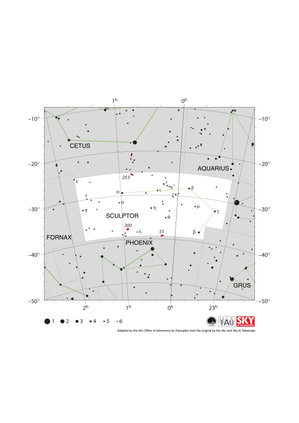
Sculptor Constellation Map
Pie de foto: The constellation Sculptor with its brighter stars and surrounding constellations. Sculptor is surrounded by (going clockwise from the top): Cetus, Aquarius, Piscis Austrinus, Grus, Phoenix and Fornax.
Sculptor is a southern constellation and thus the whole constellation is visible at some point in the year throughout the southern hemisphere. The whole constellation is also visible in equatorial and most temperate regions of the northern hemisphere. Parts of the constellation are also visible to the remaining northern temperate regions. Sculptor is best viewed in the evening in the late northern hemisphere autumn and late southern hemisphere spring.
The irregular galaxy NGC 55, and the spiral galaxies NGC 253 and NGC 300 all lie in Sculptor. There are marked here with red ellipses.
The y-axis of this diagram is in degrees of declination with north as up and the x-axis is in hours of right ascension with east to the left. The sizes of the stars marked here relate to the star's apparent magnitude, a measure of its apparent brightness. The larger dots represent brighter stars. The Greek letters mark the brightest stars in the constellation. These are ranked by brightness with the brightest star being labeled alpha, the second brightest beta, etc., although this ordering is not always followed exactly. The dotted boundary lines mark the IAU's boundaries of the constellations and the solid green lines mark one of the common forms used to represent the figures of the constellations. Neither the constellation boundaries, nor the lines joining the stars appear on the sky.
Crédito: Adapted by the IAU Office of Astronomy for Education from the original by the IAU and Sky & Telescope
License: CC-BY-4.0 Creative Commons Reconocimiento 4.0 Internacional (CC BY 4.0) íconos