This page describes an image Jährliche Parallaxe
Datei runterladen ( Bild 1.43 MB)
PDF Datei runterladen (PDF file 249.22 kB)
Auch in Schwarzweiß verfügbar
Datei runterladen ( Bild 193.40 kB)
PDF Datei runterladen (PDF file 280.57 kB)
Untertitel Diagramm:
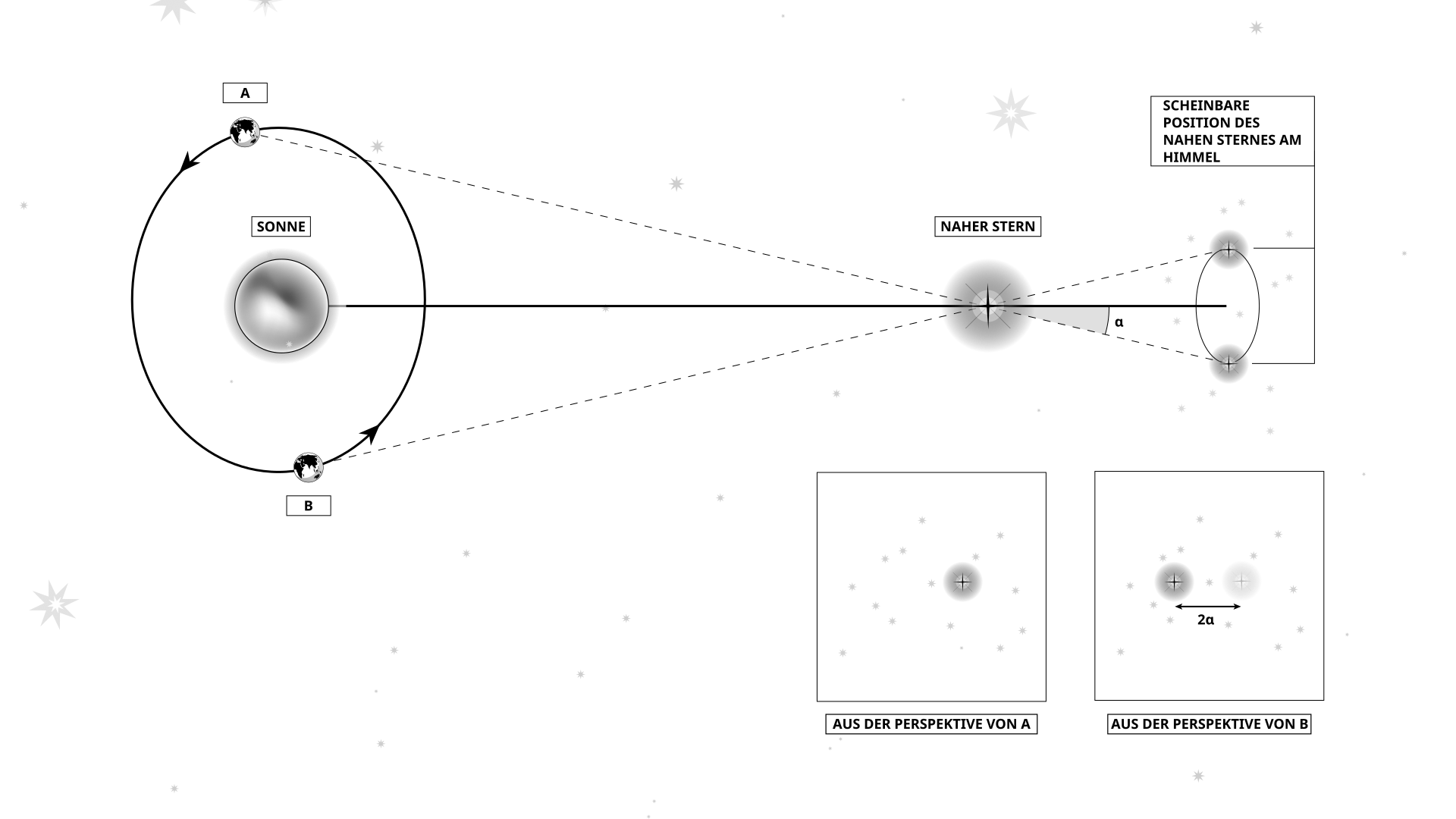
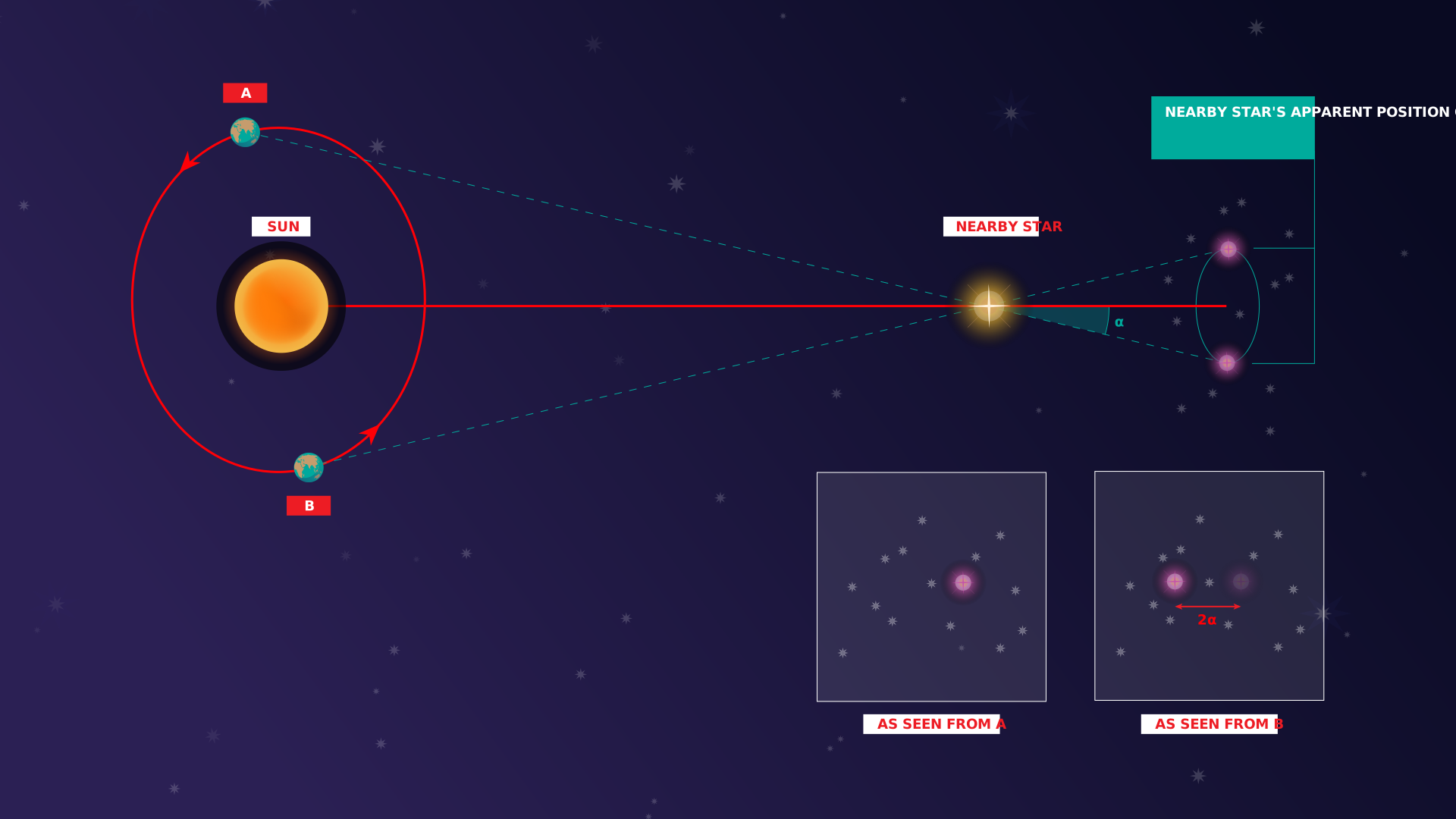
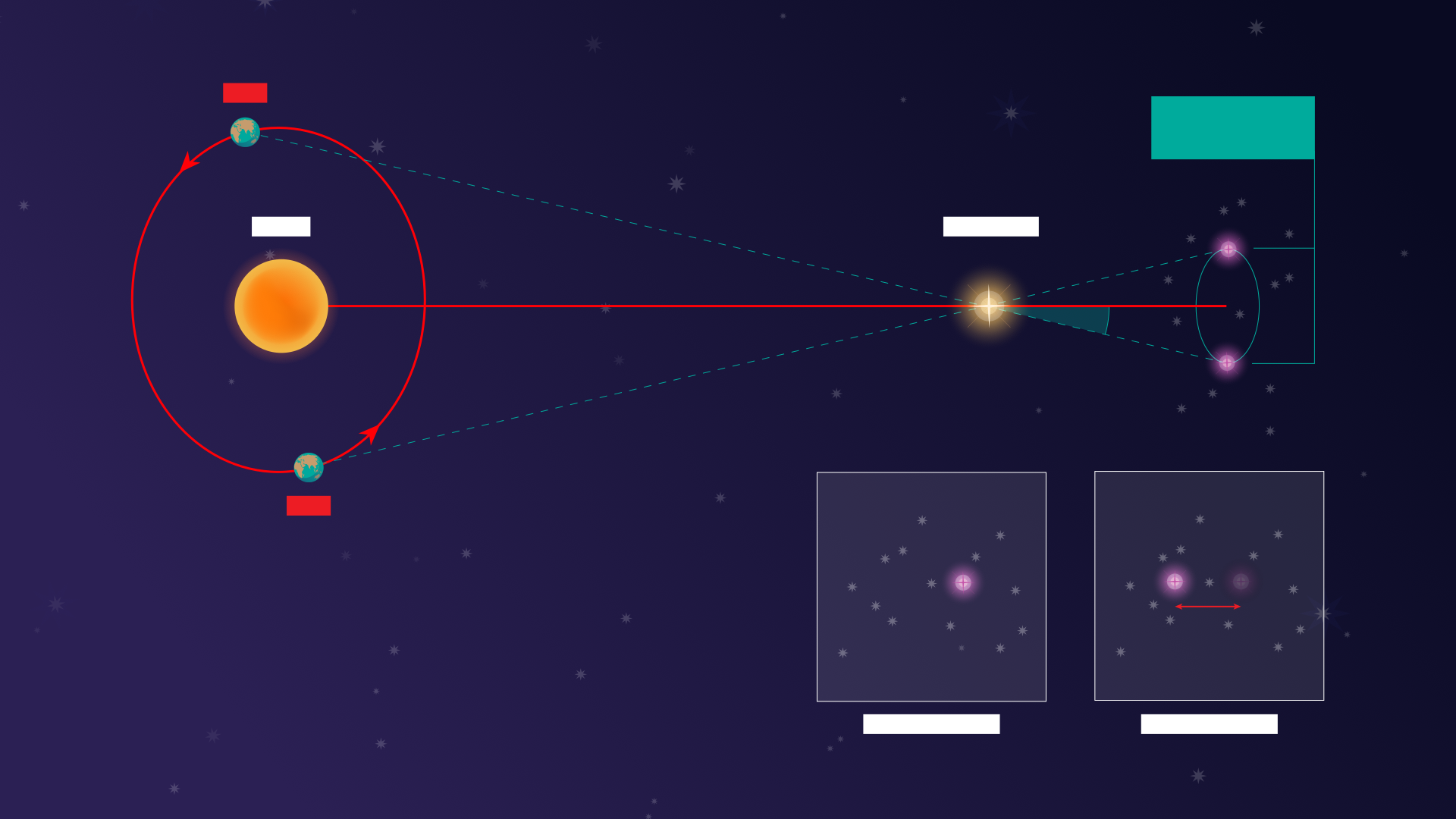
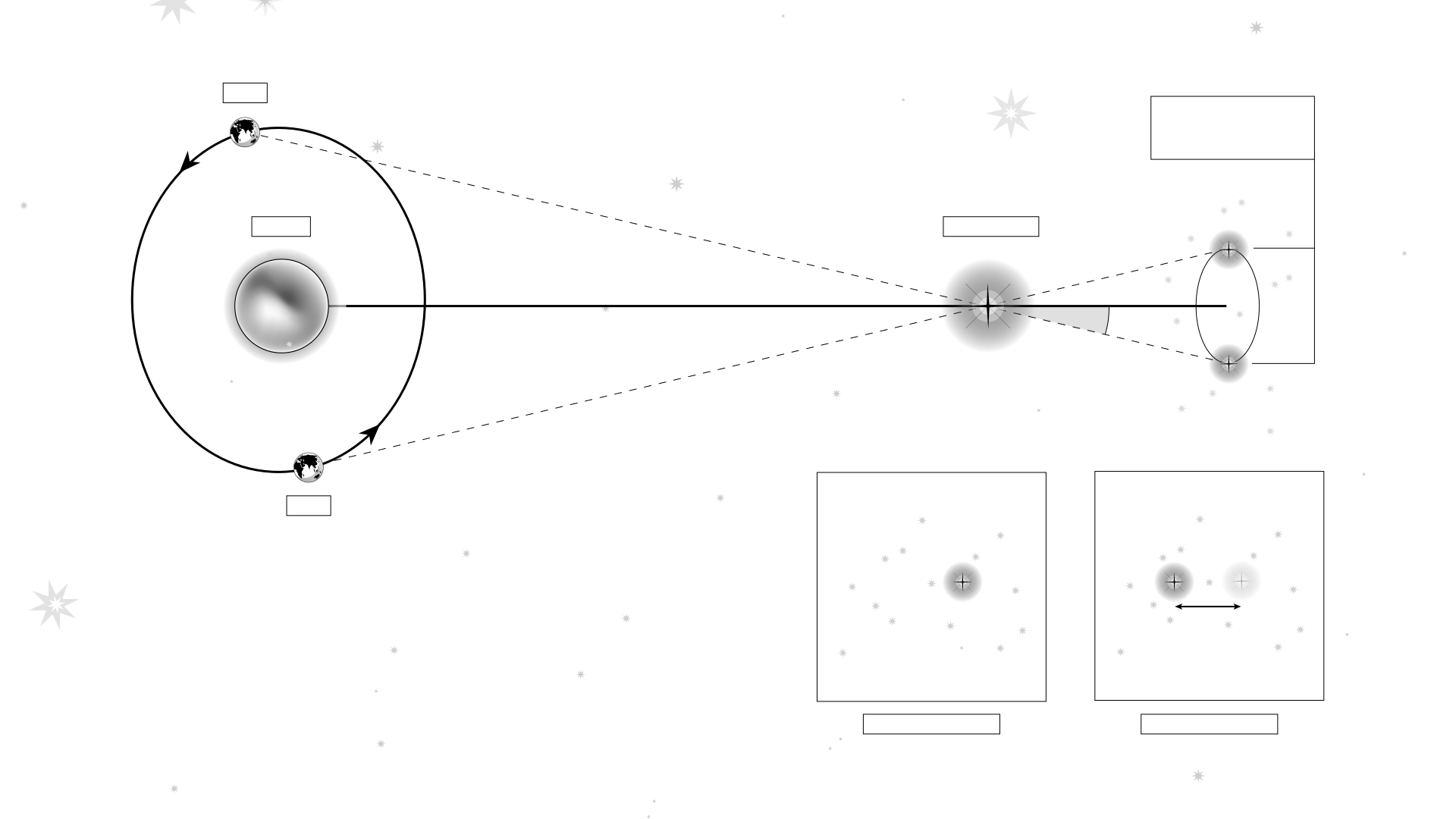
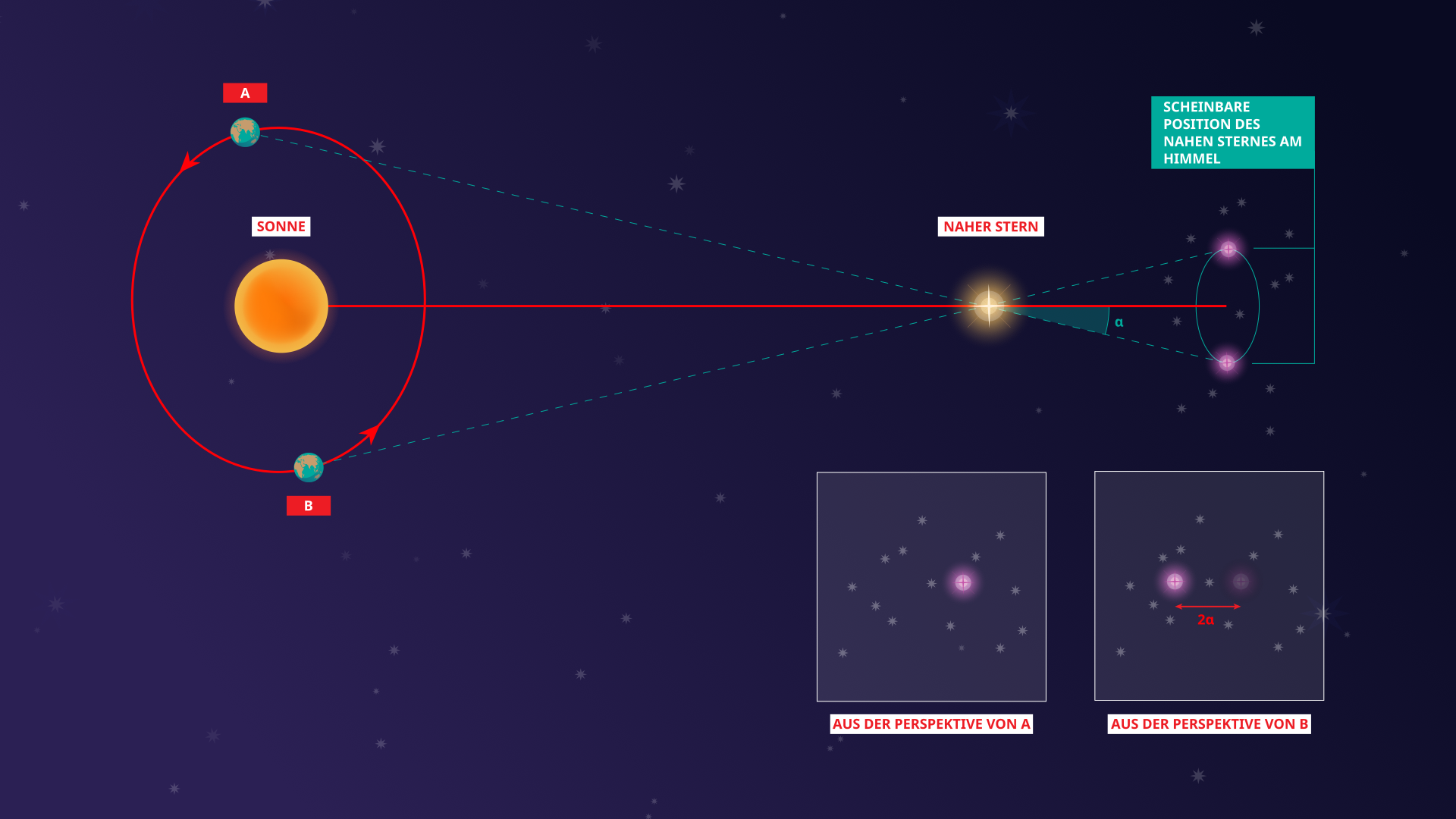
Die Entfernungsbestimmung war in der Astronomie schon immer eine Herausforderung. Eine der wichtigsten Methoden zur Entfernungsmessung ist die jährliche Parallaxe. Die Erde umkreist die Sonne im Laufe eines Jahres, was bedeutet, dass sie sich innerhalb von sechs Monaten von einer Seite der Sonne (hier als Position A dargestellt) zur anderen Seite (Position B) bewegt. In den verbleibenden sechs Monaten kehrt sie dann wieder in ihre ursprüngliche Position zurück. Diese Bewegung verändert geringfügig die Perspektive, aus der ein Beobachter auf der Erde den Nachthimmel sieht. Dies ist vergleichbar mit der Veränderung der Blickperspektive, die man erlebt, wenn man eine Szene erst mit dem linken und dann mit dem rechten Auge betrachtet. Durch die veränderte Blickperspektive verschieben sich nahegelegene Objekte in Ihrem Blickfeld. Der jährliche Umlauf der Erde um die Sonne verändert die Perspektive des Beobachters so stark, dass sich die beobachteten Positionen von Himmelsobjekten verschieben. Wie groß dieser Effekt ist, hängt von der Entfernung zum Himmelsobjekt ab. Bei nahen Sternen sind die Verschiebungen der beobachteten Position größer als bei weiter entfernten Sternen.
Die Positionsverschiebung wird als trigonometrische oder jährliche Parallaxe (die wir hier mit α bezeichnen) genannt und ist definiert als die Positionsverschiebung eines Sterns im Vergleich zu dem, was ein Beobachter im Zentrum des Sonnensystems (der Sonne) sehen würde. In dieser Abbildung sehen wir den Stern aus zwei Perspektiven, die sechs Monate auseinanderliegen (Positionen A und B). Bei Beobachtung von Position A aus beträgt die Positionsverschiebung des Sterns α, bei Beobachtung von Position B aus hingegen –α. Somit beträgt die relative Differenz der Sternposition zwischen der Beobachtung von den Positionen A und B gerade 2α.
Die Größe der trigonometrischen oder jährlichen Parallaxe in Bogensekunden beträgt ungefähr 1 geteilt durch die Entfernung in Parsec. Eine Bogensekunde (oft mit dem Symbol ″ dargestellt) entspricht dem Winkeldurchmesser, den ein Stab von einem Meter Länge hätte, wenn man ihn aus einer Entfernung von 206 km betrachtet. Ein Parsec (oft mit „pc“ abgekürzt) entspricht 3,26 Lichtjahren oder 30,86 Billionen Kilometern. Das sind 206.265 astronomische Einheiten (der mittleren Entfernung zwischen Erde und Sonne). Kein anderer Stern ist näher als 1 pc an der Sonne, daher weisen alle Sterne am Himmel trigonometrische Parallaxen von weniger als einer Bogensekunde auf.
Während trigonometrische Parallaxen seit langem zur Messung der Entfernungen zu Objekten innerhalb unseres Sonnensystem oder zu nahen Sternen verwendet werden, haben jüngste Fortschritte die Grenzen dieser Entfernungsmessungen weiter verschoben. Der Gaia-Satellit hat die Grenzen der Parallaxenmessungen auf über tausend Parsec erweitert. Auch Radioteleskop-Arrays können die Positionen sehr weit entfernter Objekte und damit deren trigonometrische Parallaxe sehr genau bestimmen.
Zu beachten ist, dass Erde und Sonne hier nicht maßstabsgetreu dargestellt sind und die Neigung der Erdachse nicht genau wiedergegeben wird.
Quelle Diagramm: Aneta Margraf/IAU OAE.
Diagramm Übersetzungsstatus: Noch nicht bestätigt von einem Rezensenten
Diagramm-Übersetzer: Simon Kraus
Diagramm-Lizenz: Creative Commons Namensnennung 4.0 International (CC BY 4.0) Creative Commons Namensnennung 4.0 International (CC BY 4.0) Symbole
Ähnliche Glossarbegriffe:
Astronomische Einheit
, Jährliche Parallaxe
, Parallaxe
, Winkelausdehnung
Kategorien:
Beobachtende Astronomie
Möchtest du deine eigene Übersetzung oder Version dieses Diagrammes erstellen? Dann downloade die SVG
Version dieses Diagrammes auf Englisch (189.90 kB). Du kannst diese Version mit Programmen wie Inkscape (kostenlos) oder Adobe Illustrator (kostenpflichtig) bearbeiten. Bitte verweise dennoch auf den originalen Autor.
Auch in Schwarzweiß verfügbar ( Bild 189.90 kB).
Du kannst Deine eigene Version oder Übersetzung dieses Diagrammes erstellen, indem du einer textlosen Version dieses Diagrammes eigenen Text zufügst.
Downloade einfach eine dieser Dateien:
Download Text-Free File ( Bild 1.40 MB)
Download Text-Free PDF File (PDF file 244.27 kB)
Auch in Schwarzweiß verfügbar:
Download Text-Free File ( Bild 167.00 kB)
Download Text-Free PDF File (PDF file 275.50 kB)
The diagram captions presented on the OAE website were written, translated and reviewed by a collective effort from the OAE, the OAE Centers and Nodes, the OAE National Astronomy Education Coordinators (NAECs) and other volunteers. You can find a full list of credits for our translation project here. All media file captions are released under a Creative Commons CC BY-4.0 license and should be credited to "IAU OAE". The media files themselves may have different licenses (see above) and should be credited as listed above under "credit".
Sollte dir ein Fehler in diesem Diagramm oder seiner Unterschrift auffallen, bitte kontaktiere uns.