This page describes an image Annual Parallax
Télécharger le fichier ( image 1.43 MB)
Télécharger le fichier PDF (PDF file 248.89 kB)
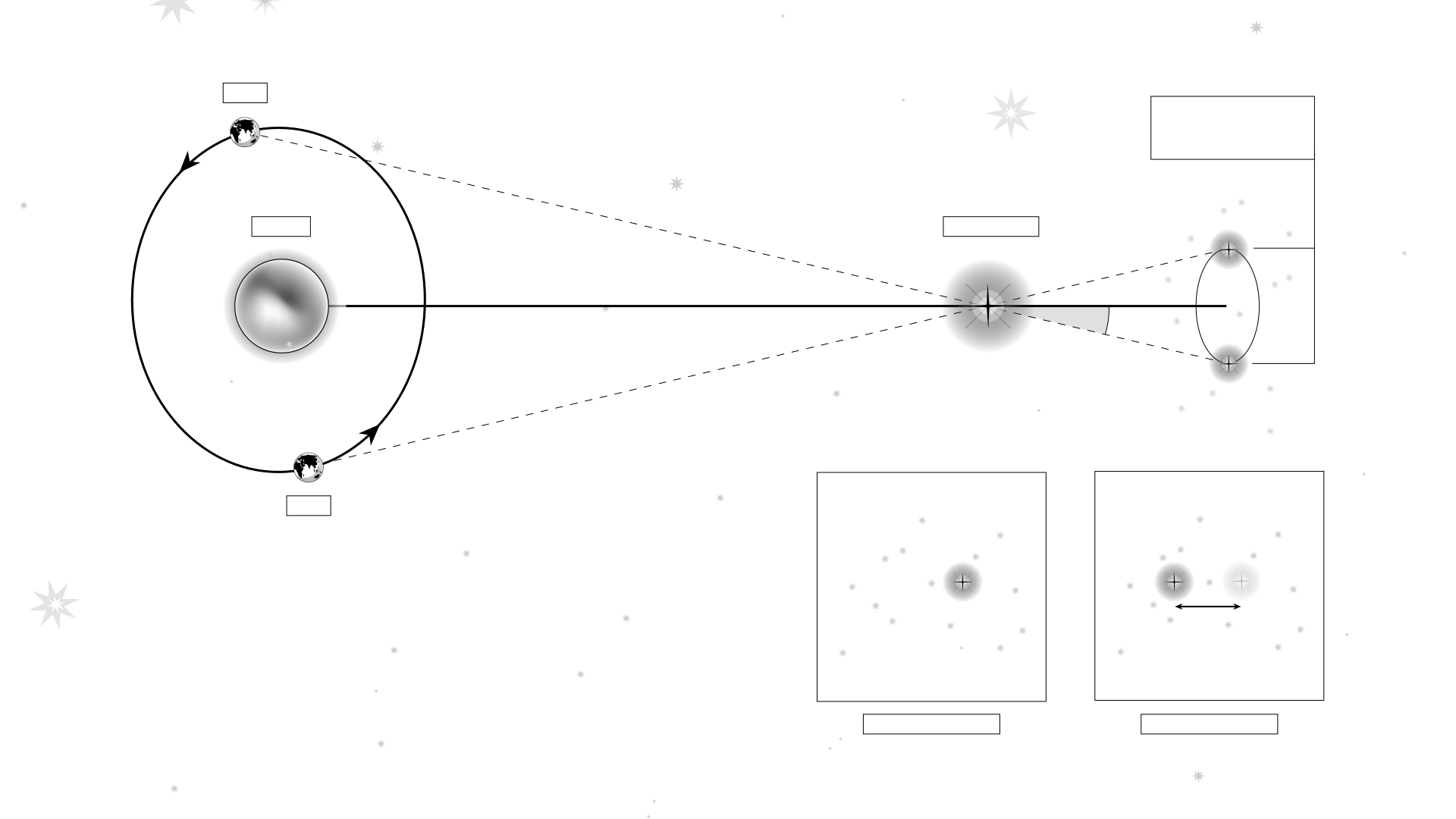
Also available in black and white
Télécharger le fichier ( image 1.43 MB)
Télécharger le fichier PDF (PDF file 248.89 kB)
Légende du diagramme :
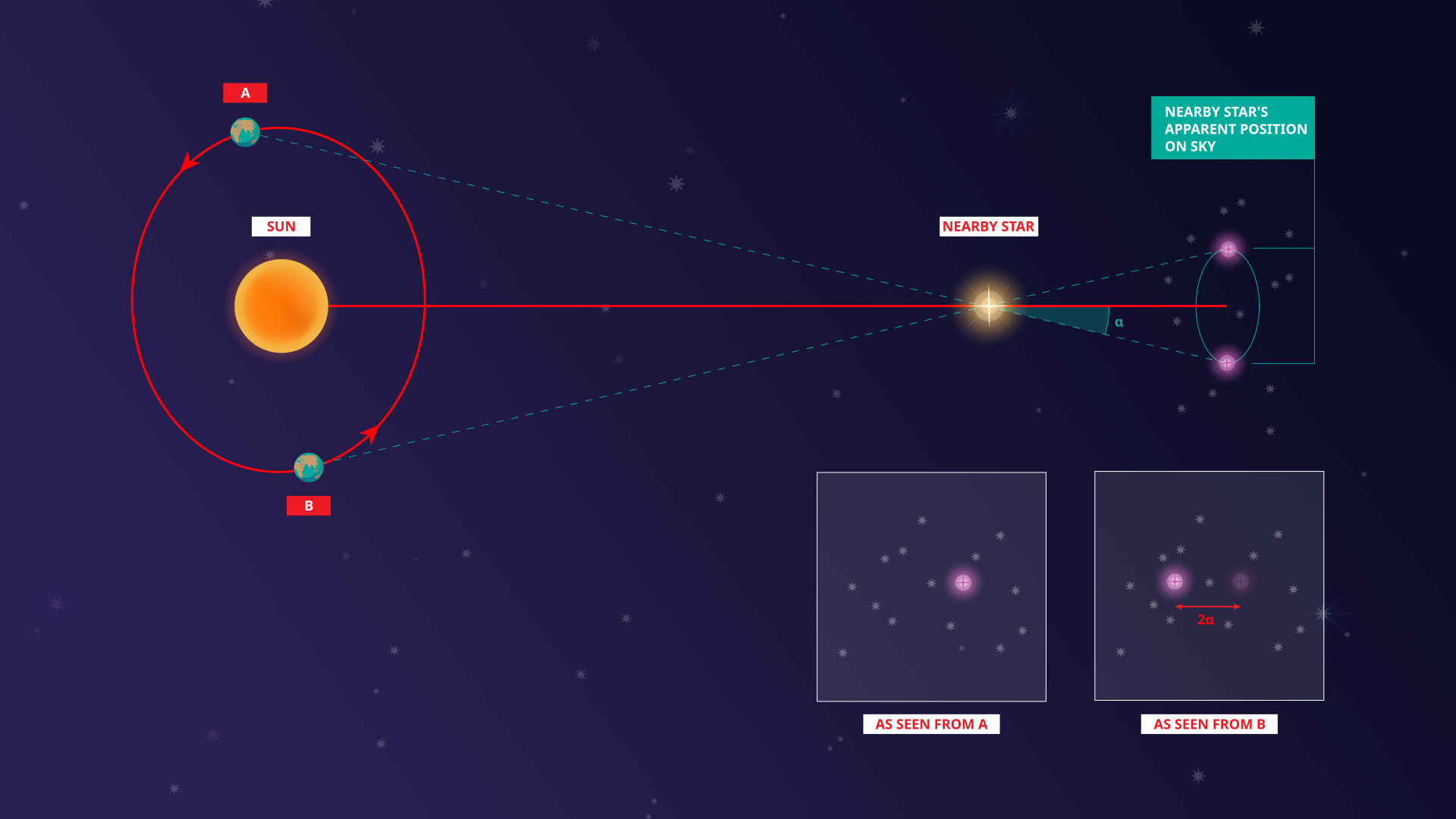
Distance determination has historically been a challenge for astronomy. One of the primary ways to measure distance is to use annual parallax. The Earth orbits around the Sun over the course of a year meaning that it moves from one side of the Sun (shown here as position A) to the other side of the Sun (position B) over the course of six months. It then moves back to its original position over the remaining six months. This movement subtly changes the perspective an observer on Earth sees the night sky from. This is similar to the change in viewing perspective you may get when viewing a scene from your left eye and then your right eye. The change of viewing perspective causes nearby objects to shift in position in your vision. The annual motion of the Earth around the Sun changes the perspective of the observer enough to shift the observed positions of celestial objects. How big this effect is depends on the distance to the celestial object. Nearby stars will have bigger shifts in observed position than more distant stars.
The positional shift is known as the trigonometric or annual parallax (which we will call α here) and is defined as the shift in position of a star compared to what an observer at the center of the Solar System (the Sun) would see. In this diagram we see the star viewed from perspectives six months apart (positions A and B). When observed from position A the star’s shift in position will be α while when observed at position B it will be –α. Thus the relative difference in the stars position between being observed at position A and position B will be 2α.
The size of the trigonometric or annual parallax in arcseconds is approximately 1 divided by the distance in parsecs. An arcsecond (often represented by a ″ symbol) is the angular diameter a one-metre-long stick would have when viewed from 206 km away. A parsec (often abbreviated to pc) is 3.26 light years or 30.86 trillion kilometres. This is 206,265 astronomical units (the typical distance between the Earth and the Sun). No other star is closer than 1 pc to the Sun so all stars in the sky have trigonometric parallaxes less than one arcsecond.
While trigonometric parallaxes have long been used to measure the distances to objects in our Solar System or nearby stars, recent advances have pushed the boundaries of these distance measures further. The Gaia satellite has pushed the boundaries of parallax measurements to over a thousand parsecs. Arrays of radio telescopes can also very accurately measure the positions of very distant objects and thus their trigonometric parallax.
Note the Earth and Sun are not to scale here and the Earth’s axial tilt is not accurately represented.
Crédit du diagramme : Aneta Margraf/IAU OAE.
État de la traduction du diagramme: Pas encore approuvé par un·e relecteur(rice)
Licence du diagramme : Creative Commons (CC) Attribution 4.0 International (CC BY 4.0) Creative Commons (CC) Attribution 4.0 International (CC BY 4.0) Icônes
Termes du glossaire en rapport :
Diamètre angulaire
, Parallaxe
, Parallaxe annuelle
, Unité astronomique
Catégories :
Astronomie observationnelle
Want to make your own translation or version of this diagram? Then
download the SVG
version of this diagram in English (189.90 kB). You can edit this using
software like Inkscape (free) or Adobe Illustrator
(proprietary). Just remember to credit the author of the original appropriately.
Also available in black and white ( image 189.90 kB).
You can also make your own version or translation of this diagram by adding adding text to a version of
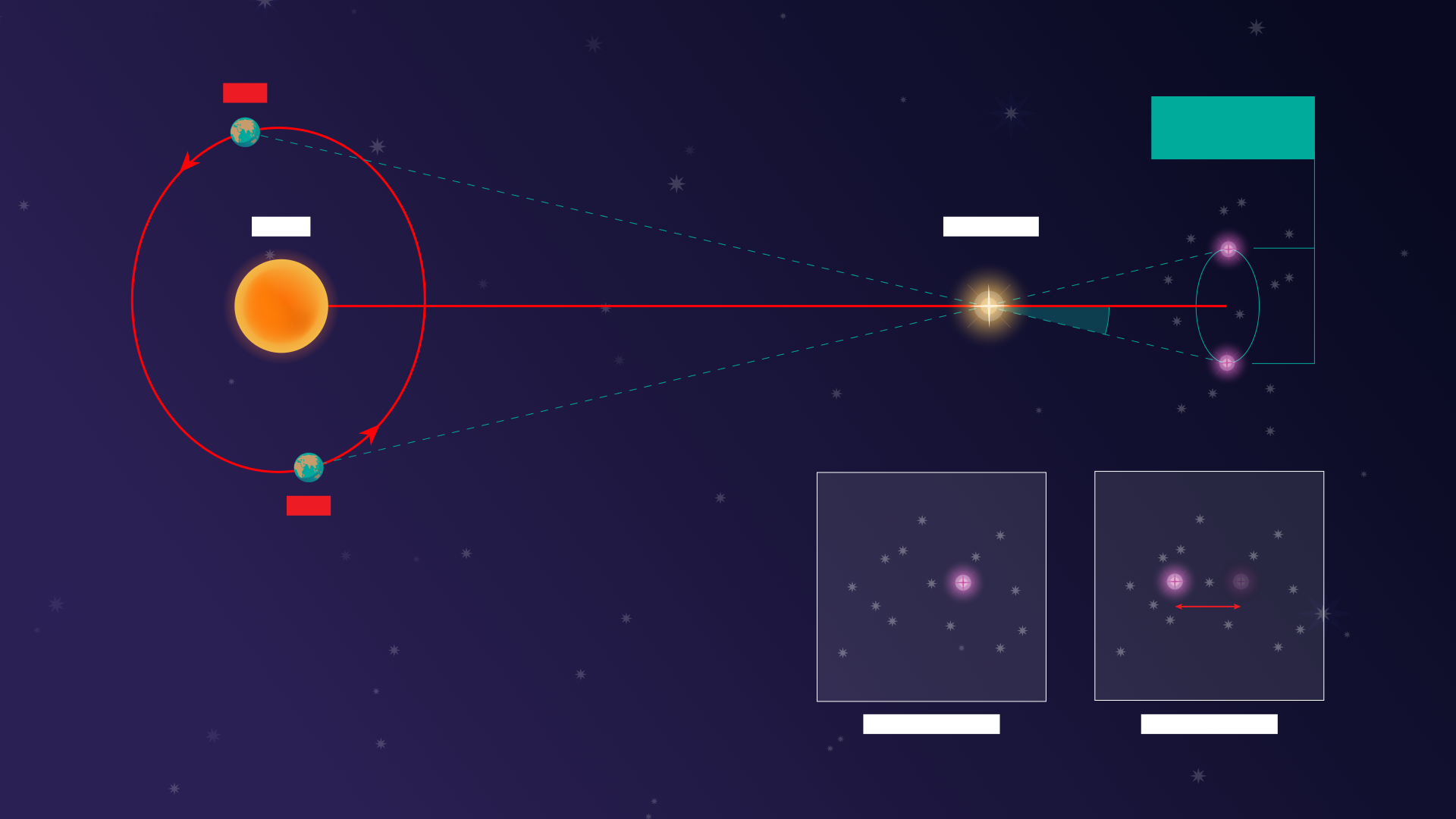
this diagram with no text. Just download one of the following files:
Download Text-Free File ( image 1.40 MB)
Download Text-Free PDF File (PDF file 244.27 kB)
Also available in black and white:
Download Text-Free File ( image 167.00 kB)
Download Text-Free PDF File (PDF file 275.50 kB)
Dans d'autres langues
Anglais: Annual ParallaxItalien: Parallasse annuale
Allemand: Jährliche Parallaxe
Les légendes des diagrammes sur le site de l'OAE ont été écrites, traduites et relues grâce à un effort collectif de l'OAE, les Centres et les Noeuds de l'OAE, les Coordinateurs Nationaux de l'Astronomie pour l'Education de l'OAE(NAECs) et d'autres volontaires. La liste complète des crédits pour ce projet est disponible ici . Toutes les légendes des fichiers média sont déposés sous licence Creative Commons CC BY-4.0 et doivent être créditées au nom de "IAU OAE". Les fichiers média eux-mêmes peuvent avoir des licences différentes (voir plus haut) et et doivent être crédités comme indiqué ci-dessus sous le terme "credit".
Si vous constatez une erreur dans ce diagramme ou sa légende, veuillez nous contacter .
Ceci pourrait vous intéresser également







- Ressources
- Moteur de recherche des ressources pédagogiques
- Parcourir les ressources pédagogiques par Sujet
- Parcourir les images
- AstroEdu - Activités en classe
- Grandes Idées - Littéracie en astronomie
- Glossaire
- Rapports de l'OAE
- L'astronomie pour l'Education à travers le monde
- Sélection de ressources externes