بلغات أخرى
- الألمانيّة: Konjunktion
- الإنجليزيّة: Conjunction
- الإسبانيّة: Conjunción
- الفرنسيّة: Conjonction
- الإيطاليّة: Congiunzione
- اليابانيّة: 合 (رابط خارجي)
- الكوريّة: 합
- البرتغاليّة البرازيليّة: Conjunção
- الصينيّة المبسطة: 合
- الصينيّة التقليدية: 合
وسائط ذات صلة
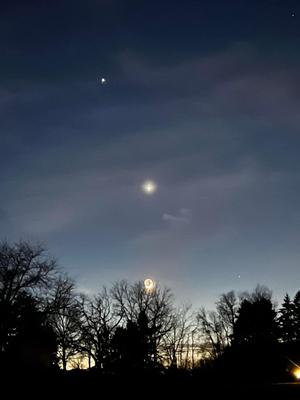
اقتران كوكب المشتري والزهرة والقمر
Moon-Mercury-Pleiades Conjunction
الشرح: Honourable mention in the 2022 IAU OAE Astrophotography Contest, category Still images of celestial patterns.
This photograph shows the young lunar crescent, some of the nine brightest stars of the Pleiades (with one behind a cloud) on the right, and the planet Mercury, looking slightly red, in the middle of the image.
This picture is rather suggestive of the idea that the Pleiades might possibly consist of seven stars. However, the viewer is misled by the clouds; five of the stars form a tiny chariot, one is next to the handle, and three are at the other end of the quadrilateral. Eight stars would be clearly visible if there were no clouds.
This configuration of the young Moon next to the Pleiades is visible only in the northern hemisphere spring. Thus it was used by the ancient Babylonians to determine the second month of their year and to judge whether or not an intercalary month was necessary. At least as early as the second millennium before the common era, the Babylonians used several asterisms for each month, with another one of them reappearing every five days after invisibility during daylight. To determine the necessity of intercalation in order to synchronise the solar and the lunar year, the Babylonians used several asterisms, not only the Pleiades. For instance, they also made use of the bright stars Arcturus and Sirius, and they observed a configuration with the Moon as well as heliacal phenomena. The modern Jewish and modern Islamic traditions still make use of some of the Babylonian astronomical rules. However, given that the constellations have shifted as a result of precession, and the fact that nowadays we also have computational means to calculate our calendars, this configuration of the small crescent Moon and the Pleiades is less useful, though it remains exceptionally beautiful. Thus the ancient Babylonian and middle Babylonian tradition survives only rudimentarily. Furthermore, it is unlikely that it is depicted in the Nebra Disc from Bronze Age Europe, as has long been claimed.
This image was taken on Elba Island, Italy, in May 2022.
المصدر: Giulio Colombo/ IAU OAE
License: CC-BY-4.0 المشاع الإبداعي نَسب المُصنَّف 4.0 دولي (CC BY 4.0) أيقونات

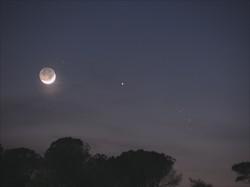
Conjunction of Mercury and Venus above the Moon
الشرح: From the observing deck at the European Southern Observatory’s Paranal site in Chile, in March 2008, astronomers captured a conjunction of celestial objects—a moment when two or more astronomical objects appear close together in the sky as seen from Earth. In this scene, the innermost planets Mercury and Venus appear aligned above the Moon, forming a pattern against the sky just before dawn. Although they are at very different distances from Earth, the geometry of their orbits brought them into almost the same line of sight, creating this beautiful cosmic alignment.
In the image, the bright crescent Moon is visible low in the sky near the horizon, forming the most prominent object in the lower part of the scene. Just above the Moon, the brighter planet Venus can be seen, while Mercury, fainter and further from the horizon, appears nearby in the upper part of the image.
المصدر: ESO/Y. Beletsky
رابط المصدر
License: CC-BY-4.0 المشاع الإبداعي نَسب المُصنَّف 4.0 دولي (CC BY 4.0) أيقونات
الرسوم التوضيحية المرتبطة

Opposition and Conjunction
الشرح: This diagram shows the Earth's orbit around the Sun and the orbits of two other planets, one orbiting the Sun outside the Earth's orbit and one orbiting the Sun inside the Earth's orbit. At different times in the orbits of both of these planets, their positions appear to line up with the Earth and the Sun. At these points each planet would appear close to the Sun when viewed from Earth. When this happens each planet is said to be in conjunction with the Sun.
For the planet that orbits the Sun within the Earth's orbit it can be in conjunction with the Sun twice in its orbit, once when it is between the Sun and the Earth and once when it is on the other side of the Sun from the Earth. When the planet is in conjunction between the the Sun and Earth it is said to be in inferior conjunction and when it is in conjunction on the far side of the Sun from the Earth it is said to be in superior conjunction.
For the planet orbiting the Sun outside the Earth's orbit, it can sometimes be on the other side of the sky. At this point the Earth lies between the planet and the Sun. The planet in this case is said to be in opposition.
Opposition and conjunction are not just limited to planets and other types of solar system objects such as dwarf planets, comets and asteroids can also be in opposition and conjunction. However only those objects that have an orbit that takes them outside the Earth's orbit can be in opposition.
Conjunction is also used to refer to alignments in the sky between planets in the Solar System. For example when Jupiter and Venus appear very close on the sky when viewed from Earth they are said to be in conjunction with each other.
المصدر: Aneta Margraf/IAU OAE
License: CC-BY-4.0 المشاع الإبداعي نَسب المُصنَّف 4.0 دولي (CC BY 4.0) أيقونات