بلغات أخرى
- الألمانيّة: Mondphase
- الإنجليزيّة: Lunar Phase
- الإسبانيّة: Fase lunar
- الفرنسيّة: Phase lunaire
- الإيطاليّة: Fase lunare
- اليابانيّة: 月の位相 (رابط خارجي)
- المهاراتية: चंद्राच्या कला
- البرتغاليّة البرازيليّة: Fase lunar
- الصينيّة المبسطة: 月相
- الصينيّة التقليدية: 月相
وسائط ذات صلة
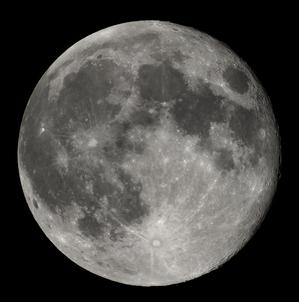
Full moon
الشرح: The image shows the nearly full Moon observed with a small telescope and a DSLR camera.
المصدر: Luc Viatour
رابط المصدر
License: CC-BY-SA-3.0 المشاع الإبداعي نَسب المُصنَّف - الترخيص بالمثل 3.0 غير موطَّنة أيقونات

Full Moon
الشرح: The full moon imaged from the Southern Hemisphere (New Zealand). During this phase the moon's illuminated half is fully visible from Earth.
المصدر: Dave Young / dcysurfer
رابط المصدر
License: CC-BY-2.0 المشاع الإبداعي نَسب المُصنَّف 2.0 عام أيقونات

First quarter moon
الشرح: The first quarter moon photographed from New Zealand. As half of the moon's illuminated half is visible, this is phase is popularly know as half moon.
المصدر: Dave Young / dcysurfer
رابط المصدر
License: CC-BY-2.0 المشاع الإبداعي نَسب المُصنَّف 2.0 عام أيقونات

First quarter moon
الشرح: The first quarter moon photographed from the Northern Hemisphere (USA). At this phase half of the moon's illuminated half is visible. This phase is popularly known as half moon.
المصدر: Stephen Rahn
رابط المصدر
License: CC0 CC0 1.0 عام (CC0 1.0) التخصيص للملك العام أيقونات

Last quarter moon
الشرح: This shows the last quarter moon photographed from the Northern Hemisphere (USA). During this phase half of the moon's illuminated half is visible. This phase is popularly known as half moon.
المصدر: Stephen Rahn
رابط المصدر
License: CC0 CC0 1.0 عام (CC0 1.0) التخصيص للملك العام أيقونات
الرسوم التوضيحية المرتبطة

Lunar Phase Northern Hemisphere
الشرح: The phases of the Moon when viewed from the Northern Hemisphere. Here north is up and east is left. The Moon orbits the Earth every 29.5 days. It is tidally locked to the Earth meaning its rotation period is the same as its orbital period and the same side of the Moon always faces the Earth. At any particular time, half of the Moon is illuminated by the Sun and half is in shadow. Over the course of the Moon’s orbit around the Earth every part of the Moon is illuminated for half of the orbit and is in shadow for the other half of the orbit.
When the Moon sits between the Earth and the Sun its illuminated half faces away from the Earth and we only see the half that is in shadow. This phase of the Moon is known as new moon. As the Moon moves in its orbit, a small but growing sliver of the illuminated half of the Moon begins to be seen from the Earth. This illuminated sliver appears on the western side of the Moon’s face when viewed from Earth. This phase is known as waxing crescent moon. By a quarter of the way through the Moon’s orbit around the Earth the Moon appears 90° away from the Sun and half of the Moon’s illuminated half points toward the Earth. This phase is known as first quarter moon. As the orbit continues more than half of the Moon seen from Earth is now illuminated with a dark crescent. This phase is known as waxing gibbous moon. Once we reach the halfway point in the Moon’s orbit round the Earth the Moon is now on the opposite side of the Earth from the Sun and we see all of the Moon’s illuminated half. As the whole of the side of the Moon that faces the Earth is now illuminated this is referred to as full moon.
For the remaining half of the Moon’s orbit the half of the moon that faces the Earth begins to move into shadow. Hence the illuminated portion of the Moon that we see from Earth begins to shrink or wane. The western edge of the face of the Moon when viewed from Earth begins to appear dark and this grows through subsequent phases. The phases are repeated in reverse order: waning gibbous, third quarter, waning crescent and finally back to new moon.
Note the surface features of the Moon are illustrative and do not accurately represent the Moon’s true surface.
المصدر: Aneta Margraf/IAU OAE
License: CC-BY-4.0 المشاع الإبداعي نَسب المُصنَّف 4.0 دولي (CC BY 4.0) أيقونات
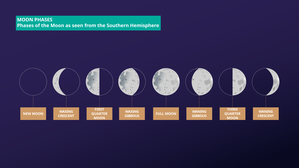
Lunar Phase Southern Hemisphere
الشرح: The phases of the Moon when viewed from the Southern Hemisphere. Here north is up and west is left The Moon orbits the Earth every 29.5 days. It is tidally locked to the Earth meaning its rotation period is the same as its orbital period and the same side of the Moon always faces the Earth. At any particular time, half of the Moon is illuminated by the Sun and half is in shadow. Over the course of the Moon’s orbit around the Earth every part of the Moon is illuminated for half of the orbit and is in shadow for the other half of the orbit.
When the Moon sits between the Earth and the Sun its illuminated half faces away from the Earth and we only see the half that is in shadow. This phase of the Moon is known as new moon. As the Moon moves in its orbit, a small but growing sliver of the illuminated half of the Moon begins to be seen from the Earth. This illuminated sliver appears on the western side of the Moon’s face when viewed from Earth. This phase is known as waxing crescent moon. By a quarter of the way through the Moon’s orbit around the Earth the Moon appears 90° away from the Sun and half of the Moon’s illuminated half points toward the Earth. This phase is known as first quarter moon. As the orbit continues more than half of the Moon seen from Earth is now illuminated with a dark crescent. This phase is known as waxing gibbous moon. Once we reach the halfway point in the Moon’s orbit round the Earth the Moon is now on the opposite side of the Earth from the Sun and we see all of the Moon’s illuminated half. As the whole of the side of the Moon that faces the Earth is now illuminated this is referred to as full moon.
For the remaining half of the Moon’s orbit the half of the moon that faces the Earth begins to move into shadow. Hence the illuminated portion of the Moon that we see from Earth begins to shrink or wane. The western edge of the face of the Moon when viewed from Earth begins to appear dark and this grows through subsequent phases. The phases are repeated in reverse order: waning gibbous, third quarter, waning crescent and finally back to new moon.
Note the surface features of the Moon are illustrative and do not accurately represent the Moon’s true surface.
المصدر: Aneta Margraf/IAU OAE
License: CC-BY-4.0 المشاع الإبداعي نَسب المُصنَّف 4.0 دولي (CC BY 4.0) أيقونات

Lunar Phase Equator
الشرح: The phases of the Moon when viewed from the Equator. Here west is up, north is left and east is down. The Moon orbits the Earth every 29.5 days. It is tidally locked to the Earth meaning its rotation period is the same as its orbital period and the same side of the Moon always faces the Earth. At any particular time, half of the Moon is illuminated by the Sun and half is in shadow. Over the course of the Moon’s orbit around the Earth every part of the Moon is illuminated for half of the orbit and is in shadow for the other half of the orbit.
When the Moon sits between the Earth and the Sun its illuminated half faces away from the Earth and we only see the half that is in shadow. This phase of the Moon is known as new moon. As the Moon moves in its orbit, a small but growing sliver of the illuminated half of the Moon begins to be seen from the Earth. This illuminated sliver appears on the western side of the Moon’s face when viewed from Earth. This phase is known as waxing crescent moon. By a quarter of the way through the Moon’s orbit around the Earth the Moon appears 90° away from the Sun and half of the Moon’s illuminated half points toward the Earth. This phase is known as first quarter moon. As the orbit continues more than half of the Moon seen from Earth is now illuminated with a dark crescent. This phase is known as waxing gibbous moon. Once we reach the halfway point in the Moon’s orbit round the Earth the Moon is now on the opposite side of the Earth from the Sun and we see all of the Moon’s illuminated half. As the whole of the side of the Moon that faces the Earth is now illuminated this is referred to as full moon.
For the remaining half of the Moon’s orbit the half of the moon that faces the Earth begins to move into shadow. Hence the illuminated portion of the Moon that we see from Earth begins to shrink or wane. The western edge of the face of the Moon when viewed from Earth begins to appear dark and this grows through subsequent phases. The phases are repeated in reverse order: waning gibbous, third quarter, waning crescent and finally back to new moon.
The perspective for this diagram is with west up, north left and east down. When the moon is viewed looking west, for example viewing the waxing crescent just after sunset, the view of the Moon would be rotated by 180°.
Note the surface features of the Moon are illustrative and do not accurately represent the Moon’s true surface.
المصدر: Aneta Margraf/IAU OAE
License: CC-BY-4.0 المشاع الإبداعي نَسب المُصنَّف 4.0 دولي (CC BY 4.0) أيقونات

Total Solar Eclipse
الشرح: This not to scale diagram shows what happens during a total solar eclipse. The Moon orbits the Earth, but its orbit is slightly tilted with respect to the Earth’s orbit around the Sun. During the new moon lunar phase, the Moon lies between the Earth and the Sun, but due to the Moon’s tilted orbit around the Earth, the Moon normally lies above or below the Sun at this point. However twice a year the Moon’s orbit lines up in such a way that the Moon can lie in a direct line between the Earth and Sun. During each of these periods (each of which last roughly a month) solar (and lunar) eclipses can occur. The Moon is about 400 times smaller than the Sun, but is 400 times closer to the Earth than the Sun. Hence the Sun and Moon have approximately the same angular size when viewed from the Earth. This means that it is possible for the Moon to completely cover the Sun when viewed from Earth. This is known as a total solar eclipse.
Here we see a schematic of such and eclipse. The Moon casts a shadow on the Earth known as the umbra. This is a roughly circular shadow a few hundred kilometres across although its shape can be severely distorted when the eclipse is at the edge of the illuminated part of the Earth. Any region within the umbra will see the Moon completely cover the Sun and thus will experience a total solar eclipse. Outside of the umbra there are regions where the Moon will cover part of the Sun. This partial shadow is known as the penumbra. Regions in the penumbra will experience a partial solar eclipse.
An eclipse is a dynamic event with the Moon moving in its orbit and the Earth rotating. Hence the umbra and penumbra move across the Earth’s surface together. The path the umbra takes across the Earth is known as the path of totality. Let’s consider one particular region that lies in the path of totality: except in rare cases where an eclipse begins at sunrise, a region that experiences totality will first see the Moon cover part of the Sun and gradually move across Sun until it is totally covered. From outside the Earth this would appear as the penumbra moving over this particular region followed by the umbra moving over this region. Once the Moon moves so that it no longer completely covers the Sun, totality ends and the umbra moves away from this particular region. The Moon will continue to uncover the Sun until (unless the Sun sets before the end of the eclipse) the Sun is completely uncovered. From outside the Earth this would appear as the umbra moving away from our particular region and the edge of the penumbra approaching and eventually passing over the region.
Outside of the path or totality there is a much broader region that will lie in the penumbra but will be missed by the umbra. Such regions will not experience a total solar eclipse during this event, only a partial solar eclipse.
المصدر: Aneta Margraf/IAU OAE
License: CC-BY-4.0 المشاع الإبداعي نَسب المُصنَّف 4.0 دولي (CC BY 4.0) أيقونات