بلغات أخرى
- البنغاليّة: মুক্ত স্তবক
- الألمانيّة: Offener Sternhaufen
- الإنجليزيّة: Open Cluster
- الإسبانيّة: Cúmulo abierto
- الفرنسيّة: Amas ouvert
- الإيطاليّة: Ammasso aperto
- اليابانيّة: 散開星団 (رابط خارجي)
- البرتغاليّة البرازيليّة: Aglomerado aberto
- الصينيّة المبسطة: 疏散星团
- الصينيّة التقليدية: 疏散星團
وسائط ذات صلة
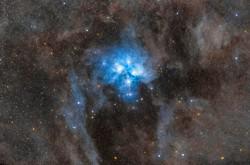
The Pleiades M45 with Majestic Dust
الشرح: Honourable mention in the 2022 IAU OAE Astrophotography Contest, category Still images of celestial patterns.
Taken in Dar Eid in Saint Catherine/Sinai, Egypt, in October 2021, this image shows the Pleiades, an open cluster also known as The Seven Sisters.
The Pleiades are located in the north-western part of the constellation Taurus, the Bull. This constellation originates from ancient Babylonian or even Sumerian belief, where it was designated the Bull of Heaven, a mighty creature owned by the sky god. In Late Babylonian times, the Pleiades were called The Bristle at the hunchback of The Bull. In China, the asterism is also called The Hair, but this does not necessarily imply any relationship between the East Asian and West Asian names of this asterism, although exchange is hypothesised with the establishment of the Silk Road.
In ancient Babylonian texts the term The Hair does not appear. Instead, the Pleiades are only called The Star Cluster in Sumerian, and the Sumerian term was used in later languages as a loanword. The Sumerian and early Babylonian religion associated all constellations with specific deities, including gods, demons, messengers of gods. The Star Cluster was associated with a deity of the Netherworld that was called The Seven and was considered an ensemble of seven speaking weapons or strongly armed gods. The later Greek name of the Seven Sisters might possibly have sprung from an intercultural misunderstanding of this older religious association, since, in fact, seven stars are not seen in this cluster.
The star cluster of the Pleiades is really prominent in the sky, and thus was used for several cultural purposes, such as determining the calendar and the spring equinox. However, its significance is frequently overstated in cultural astronomy. As the tradition of representing it with seven dots originates from an ancient Sumerian belief, we should be careful about interpreting any group of seven dots on cave walls and archaeological sites across Europe, Asia and America from the Stone Age onwards as a representation of the Pleiades.
Modern astrophysics has found that the star cluster of the Pleiades is extraordinarily young, so there was certainly not an additional star in ancient times. Furthermore, we know that the bright stars are only the core region of an open star cluster that consists of hundreds of stars scattered over an area of the sky which exceeds the bright core by one or two of its diameters in any direction. The photograph does not even show the whole cluster. The group is thought to be about 400 light-years away from Earth, which is relatively close in astronomical terms.
المصدر: Mohamed Usama/IAU OAE
License: CC-BY-4.0 المشاع الإبداعي نَسب المُصنَّف 4.0 دولي (CC BY 4.0) أيقونات
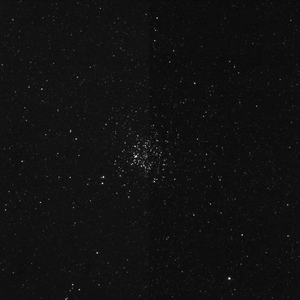
The Wild Duck Open Cluster
الشرح: This image shows the Wild Duck Cluster (also known as Messier 11 or M11), a bright grouping of stars that forms what astronomers call an open cluster in our Milky Way galaxy. Open clusters are collections of stars that were born from the same giant cloud of gas and dust and are still loosely held together by gravity. Most open clusters will slowly fall apart over hundreds of millions of years are they orbit through the galaxy. In this view, hundreds of stars appear close together against the dark background of space, with many shining at different brightnesses depending on their size and temperature.
The Wild Duck Cluster lies about 6,000 light-years from Earth and is around 300 million years old. Because the stars in an open cluster share a common origin, astronomers can use them as laboratories for testing theories on stellar evolution and behaviour.
المصدر: NASA/JPL
رابط المصدر
License: PD الملكية العامة أيقونات
الرسوم التوضيحية المرتبطة

خريطة كوكبة أندروميدا
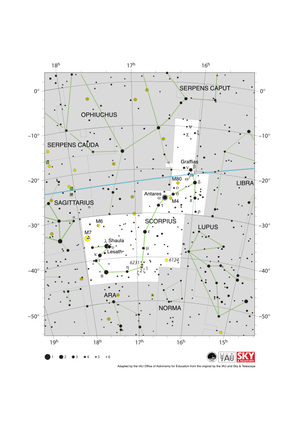
Scorpius Constellation Map
الشرح: The constellation Scorpius (often commonly called Scorpio) along with its bright stars and surrounding constellations. Scorpius is surrounded by (going clockwise from the top) Ophiuchus, Serpens Caput, Libra, Lupus, Norma, Ara, Corona Australis and Sagittarius. Scorpius’s brightest star Antares appears in the heart of the constellation with the famous tail of Scoprius in the south-east (lower left). Scorpius lies on the ecliptic (shown here as a blue line), this is the path the Sun appears to take across the sky over the course of a year. The Sun only spends a short amount of time in late November in Scorpius. The other planets of the Solar System can often be found in Scorpius.
Scorpius lies south of the celestial equator. The whole constellation is not visible from the most arctic regions of the world with parts of Scorpius obscured for observers in northern parts of Asia, Europe and North America. Scorpius is most visible in the evenings in the northern hemisphere summer and southern hemisphere winter.
The yellow circles mark the positions of the open clusters M6, M7 & NGC 6231 while the yellow circles with plus signs superimposed on them mark the globular clusters M4 and M80.
The y-axis of this diagram is in degrees of declination with north as up and the x-axis is in hours of right ascension with east to the left. The sizes of the stars marked here relate to the star's apparent magnitude, a measure of its apparent brightness. The larger dots represent brighter stars. The Greek letters mark the brightest stars in the constellation. These are ranked by brightness with the brightest star being labeled alpha, the second brightest beta, etc., although this ordering is not always followed exactly. The circle around Antares indicates that it is a variable star. The dotted boundary lines mark the IAU's boundaries of the constellations and the solid green lines mark one of the common forms used to represent the figures of the constellations. The blue line marks the ecliptic, the path the Sun appears to travel across the sky over the course of one year. Neither the constellation boundaries, nor the line marking the ecliptic, nor the lines joining the stars appear on the sky.
المصدر: Adapted by the IAU Office of Astronomy for Education from the original by IAU/Sky & Telescope
License: CC-BY-4.0 المشاع الإبداعي نَسب المُصنَّف 4.0 دولي (CC BY 4.0) أيقونات
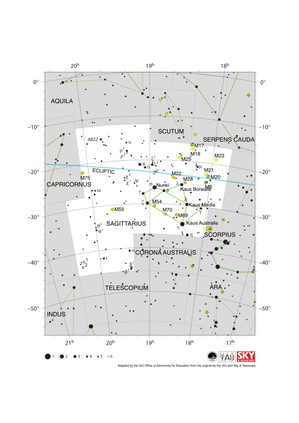
Sagittarius Constellation Map
الشرح: The constellation Sagittarius along with its bright stars and surrounding constellations. Sagittarius is surrounded by (going clockwise from the top) Aquila, Scutum, Serpens Cauda, Ophiuchus, Scorpius, Corona Australis, Telescopium, Microscopium and Capricornus. The brighter stars in Sagittarius form a distinctive teapot shape. Sagittarius lies on the ecliptic (shown here as a blue line), this is the path the Sun appears to take across the sky over the course of a year. The Sun is in Sagittarius from mid December to mid January. The other planets of the Solar System can often be found in Sagittarius.
Sagittarius lies south of the celestial equator. The famous teapot asterism is visible for all but the most arctic regions of the world but the most southerly parts of the constellation are not visible in northern parts of Asia, Europe and North America. Sagittarius is most visible in the evenings in the northern hemisphere summer and southern hemisphere winter.
The supermassive black hole Sagittarius A* which lies at the center of our Milky Way Galaxy is sits on the western (here right-hand) edge of Sagittarius. Due to it covering an area at the center of our Galaxy, Sagittarius is home to many star clusters including open clusters (marked here with yellow circles) and globular clusters (marked here with yellow circles with + signs superimposed on them). Three nebulae are also marked here with green squares.
The y-axis of this diagram is in degrees of declination with north as up and the x-axis is in hours of right ascension with east to the left. The sizes of the stars marked here relate to the star's apparent magnitude, a measure of its apparent brightness. The larger dots represent brighter stars. The Greek letters mark the brightest stars in the constellation. These are ranked by brightness with the brightest star being labeled alpha, the second brightest beta, etc., although this ordering is not always followed exactly. The dotted boundary lines mark the IAU's boundaries of the constellations and the solid green lines mark one of the common forms used to represent the figures of the constellations. Neither the constellation boundaries, nor the line marking the ecliptic, nor the lines joining the stars appear on the sky.
المصدر: Adapted by the IAU Office of Astronomy for Education from the original by IAU/Sky & Telescope
License: CC-BY-4.0 المشاع الإبداعي نَسب المُصنَّف 4.0 دولي (CC BY 4.0) أيقونات
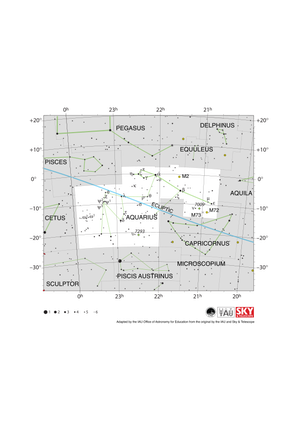
Aquarius Constellation Map
الشرح: The constellation Aquarius along with its bright stars and surrounding constellations. Aquarius is surrounded by (going clockwise from the top) Pegasus, Equuleus, Aquila, Capricornus, Piscis Austrinus, Sculptor, Cetus and Pisces. Aquarius lies on the ecliptic (shown here as a blue line), this is the path the Sun appears to take across the sky over the course of a year. The Sun is in Aquarius from mid February to mid March. The other planets of the Solar System can often be found in Aquarius.
Aquarius spans the celestial equator and is thus visible at some time in the year from all of planet Earth. In the most arctic or antarctic regions of the world, some parts of the constellation may not be visible. Aquarius is most visible in the evenings in the northern hemisphere autumn and southern hemisphere spring.
The yellow circles with plus symbols superimposed on them mark the globular clusters M2 and M72. The green circles superimposed on plus symbols mark the planetary nebulae NGC 7293 (the Helix Nebula) and NGC 7002 (the Saturn Nebula). M73 (marked with an x symbol) is a coincident grouping of stars previously erroneously classified as an open cluster.
The y-axis of this diagram is in degrees of declination with north as up and the x-axis is in hours of right ascension with east to the left. The sizes of the stars marked here relate to the star's apparent magnitude, a measure of its apparent brightness. The larger dots represent brighter stars. The Greek letters mark the brightest stars in the constellation. These are ranked by brightness with the brightest star being labeled alpha, the second brightest beta, etc., although this ordering is not always followed exactly. The dotted boundary lines mark the IAU's boundaries of the constellations and the solid green lines mark one of the common forms used to represent the figures of the constellations. Neither the constellation boundaries, nor the line marking the ecliptic, nor the lines joining the stars appear on the sky.
المصدر: Adapted by the IAU Office of Astronomy for Education from the original by IAU/Sky & Telescope
License: CC-BY-4.0 المشاع الإبداعي نَسب المُصنَّف 4.0 دولي (CC BY 4.0) أيقونات
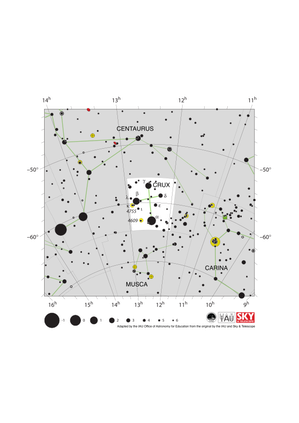
Crux Constellation Map
الشرح: The constellation Crux (commonly known as the Southern Cross or Crux Australis) showing its bright stars and surrounding constellations. The Southern Cross is surrounding by (going clockwise from the top) Centaurus, Carina and Musca. The brightest star is alpha Crucis which appears at the bottom of the constellation's famous kite shape. The Southern Cross is visible from southern and equatorial regions of the world. In more southerly parts of the world it is circumpolar so is always above the horizon. In other parts of the southern hemisphere and in equatorial regions it is most visible in the evenings in the southern hemisphere autumn.
The yellow circles show the locations of two open clusters, NGC 4755 (known as the Jewel Box) and NGC 4609.
The line joining gamma and alpha Crucis (the third and first brightest stars in the Southern Cross) points in the approximate direction of the South Celestial Pole. This has led to the Southern Cross playing an important role in celestial navigation, allowing navigators from different astronomical traditions to find their bearings.
The y-axis of this diagram is in degrees of declination with north as up and the x-axis is in hours of right ascension with east to the left. The sizes of the stars marked here relate to the star's apparent magnitude, a measure of its apparent brightness. The larger dots represent brighter stars. The Greek letters mark the brightest stars in the constellation. These are ranked by brightness with the brightest star being labeled alpha, the second brightest beta, etc., although this ordering is not always followed exactly. The dotted boundary lines mark the IAU's boundaries of the constellations and the solid green lines mark one of the common forms used to represent the figures of the constellations. Neither the constellation boundaries, nor the lines joining the stars appear on the sky.
المصدر: Adapted by the IAU Office of Astronomy for Education from the original by IAU/Sky & Telescope.
License: CC-BY-4.0 المشاع الإبداعي نَسب المُصنَّف 4.0 دولي (CC BY 4.0) أيقونات