بلغات أخرى
- الألمانيّة: Spiegelteleskop
- الإنجليزيّة: Reflecting Telescope
- الإسبانيّة: Telescopio reflector
- الفرنسيّة: Télescope à réflexion
- الإيطاليّة: Telescopio a riflessione
- اليابانيّة: 反射望遠鏡 (رابط خارجي)
- المهاراتية: परावर्ती दूरदर्शी
- البرتغاليّة البرازيليّة: Telescópio Refletor
- الصينيّة المبسطة: 反射式望远镜
- الصينيّة التقليدية: 反射式望遠鏡
وسائط ذات صلة
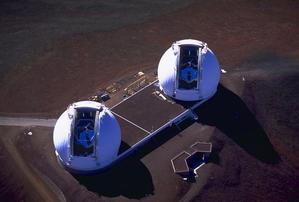
تلسكوبات كيك 1و2
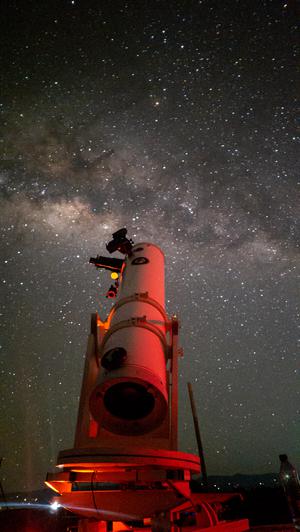
Learning Nights
الشرح: Honorable mention in the 2023 IAU OAE Astrophotography Contest, category of Still images taken exclusively with smartphones/mobile devices.
Beneath the sprawling expanse of the night sky over Colombia's Tatacoa Desert, a telescope finds its alignment with the majestic galactic core, while a smartphone captures this cosmic encounter. This snapshot, taken on 9 June 2023 during an astronomy camp, epitomises the accessible beauty of celestial marvels. It showcases the mesmerising grandeur of the night sky, inviting both the casual stargazer and the passionate astronomer alike. The splendour of the Milky Way, elegantly captured through a mobile device, seamlessly bridges the gap between sophisticated equipment and the pure, profound joy of observing the stars.
المصدر: Juan Pablo Botero Londoño/IAU OAE (CC BY 4.0)
License: CC-BY-4.0 المشاع الإبداعي نَسب المُصنَّف 4.0 دولي (CC BY 4.0) أيقونات
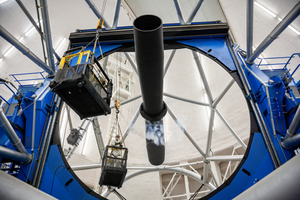
Gemini South's primary mirror and telescope structure
الشرح: This is the primary mirror and supporting structure of a large optical telescope at the Gemini South Observatory in Chile. The primary mirror is the largest and most important mirror in a reflecting telescope: its gently curved surface gathers light from faint stars, galaxies, and nebulae and reflects that light to a focal point. At this focal point light is either fed directly in to an instrument to record spectra and images or redirected to such an instrument by a series of further mirrors. The sturdy metal framework around the primary mirros keeps the mirror precisely aligned and protected while the telescope moves to track objects across the sky.
In telescopes that use mirrors instead of lenses, such as this one, the mirror is what collects and focuses the light from distant celestial objects. Larger mirrors can capture more light, allowing astronomers to see fainter and more distant objects. A larger primary mirror can also take sharper images of the sky, but this is often negated by the blurring effect of the Earth's atmopshere. A primary mirror must be perfectly smooth to tolerances of fractions of a wavelength of light so that it produces sharp, clear images. We can think of the primary mirror as the “eye” of the telescope that looks out into space, with its shape and support enabling powerful astronomical observations.
المصدر: International Gemini Observatory/NOIRLab/NSF/AURA/M. Paredes
رابط المصدر
License: CC-BY-4.0 المشاع الإبداعي نَسب المُصنَّف 4.0 دولي (CC BY 4.0) أيقونات
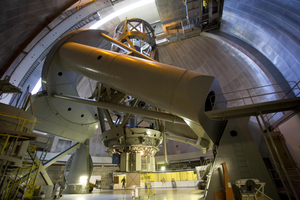
The Hale Telescope
الشرح: This image shows the Hale Telescope at the Palomar Observatory in northern San Diego County, California, USA and operated by the California Institute of Technology (Caltech). With its 5.1 m primary mirror, the Hale Telescope was the largest effective optical telescope in the world from its first light in 1949 until 1993.
Here we see the Hale Telescope when not in operation. The telescope itself is the large, vertical, approximately cylindrical object in the centre of the image. Telescopes like this use mirrors to gather faint light and form clear images of distant targets, enabling scientists to study everything from nearby stars and planets to remote galaxies. The primary mirror, seen here at the bottom of the telescope, focusses light from the sky to the prime focus at the top of the telescope. Instruments such as cameras and spectrographs can be placed at this prime focus or alternatively a secondary mirror can reflect light back down the telescope and through a hole in the primary mirror to instruments.
The telescope is supported by a large mount, seen here at an angle to the telescope. This particular mount is a type of equatorial mount. This means that one of the rotation axes of the mount points to the celestial poles. When a star or galaxy moves across the sky due to the Earth's rotation, the telescope only has rotate on this axis to keep pointing at that star or galaxy. Most modern large telescopes use a different kind of mount and rely on computer calculations to accurately track an object across the sky.
The Hale Telescope is housed under a large rotating dome that opens at night so the telescope can track objects across the sky.
المصدر: JPL/Caltech/Palomar Observatory
رابط المصدر
License: PD الملكية العامة أيقونات







.jpg)