This page describes an image Spiral Galaxy UGC 2885
Download File ( image 4.87 MB)
Image caption:
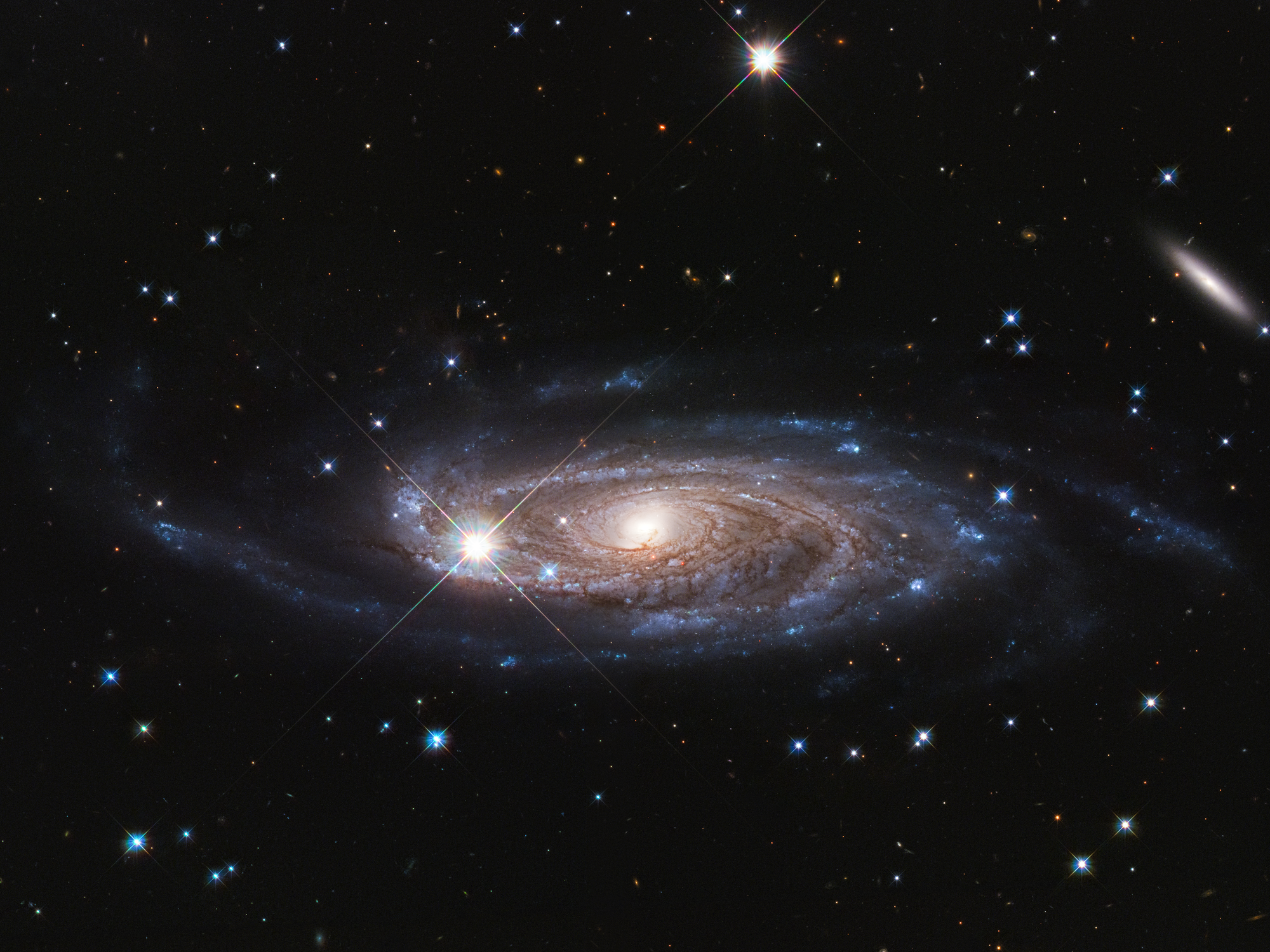
This image shows UGC 2885, a spiral galaxy located in the constellation Perseus, about 230 million light-years from Earth. Spiral galaxies have rotating disks of stars, gas, and dust, with spiral arms extending outward from the central region. In UGC 2885, these arms are very broad and faint, revealing the galaxy’s large size. This galaxy is tilted at an angle to the observer on Earth, meaning it does not appear as the circular "grand design" spiral it would look like if viewed face-on, nor as the thin line with a central bulge it would appear as if viewed edge-on.
UGC 2885 is remarkable because it is roughly twice the diameter of the Milky Way. It was studied by astronomer Vera Rubin, whose observations of how galaxies rotate — including systems like this one — played a key role in the search for dark matter.
The bright star which appears to the left of the galaxy's center is a foreground object not related to the galaxy.
Scroll to captions in other languages
Image credit: NASA, ESA, Benne Holwerda (University of Louisville) Credit Link
Related glossary terms:
Disk Galaxy
, Spiral Galaxy
Image license: Public Domain Public Domain icons
The media file captions presented on the OAE website were written, translated and reviewed by a collective effort from the OAE, the OAE Centers and Nodes, the OAE National Astronomy Education Coordinators (NAECs) and other volunteers. You can find a full list of credits for our translation project here. All media file captions are released under a Creative Commons CC BY-4.0 license and should be credited to "IAU OAE". The media files themselves may have different licenses (see above) and should be credited as listed above under "credit".
If you notice a factual error in this caption or an error in any of its translations then please get in touch.
Captions in Different Languages:
Image caption: Dieses Bild zeigt UGC 2885, eine Spiralgalaxie im Sternbild Perseus, die etwa 230 Millionen Lichtjahre von der Erde entfernt ist. Spiralgalaxien bestehen aus rotierenden Scheiben aus Sternen, Gas und Staub von deren Zentrum aus sich Spiralarme nach außen erstrecken. Bei UGC 2885 sind diese Arme sehr breit aber leuchtschwach, was auf die große Ausdehnung der Galaxie hindeutet. Diese Galaxie ist gegenüber dem Beobachter auf der Erde geneigt, was bedeutet, dass sie weder als kreisförmige „Grand-Design“-Spirale erscheint, wie sie bei einer Draufsicht aussehen würde, noch als dünne Linie mit einem zentralen Bulge, wie Spiralgalaxien bei einer seitlichen Betrachtung erscheinen.
UGC 2885 ist bemerkenswert, da ihr Durchmesser etwa doppelt so groß ist wie der der Milchstraße. Sie wurde von der Astronomin Vera Rubin untersucht, deren Beobachtungen zur Rotation von Galaxien – einschließlich Systemen wie diesem – eine Schlüsselrolle bei der Suche nach dunkler Materie spielten.
Der helle Stern, der links vom Zentrum der Galaxie zu sehen ist, ist ein Vordergrundobjekt, das nichts mit der Galaxie zu tun hat.
Image credit: NASA, ESA, Benne Holwerda (Universität Louisville)
Related glossary terms: Scheibengalaxie , Spiralgalaxie Caption translation status: Not yet approved by a reviewer
Caption translators: Simon Kraus
Image caption: Questa immagine mostra UGC 2885, una galassia a spirale situata nella costellazione di Perseo, a circa 230 milioni di anni luce dalla Terra. Le galassie a spirale presentano dischi rotanti composti da stelle, gas e polvere, con bracci a spirale che si estendono verso l'esterno dalla regione centrale. In UGC 2885, questi bracci sono molto ampi e deboli, rivelando le grandi dimensioni della galassia. Questa galassia è inclinata rispetto all'osservatore sulla Terra, il che significa che non appare come la spirale circolare di "grande disegno" che sembrerebbe se vista di fronte, né come la linea sottile con un rigonfiamento centrale che apparirebbe se vista di profilo.
UGC 2885 è notevole perché ha un diametro pari a circa il doppio di quello della Via Lattea. È stata studiata dall'astronoma Vera Rubin, le cui osservazioni su come ruotano le galassie — compresi sistemi come questo — hanno svolto un ruolo chiave nella ricerca della materia oscura.
La stella luminosa che appare a sinistra del centro della galassia è un oggetto in primo piano non correlato alla galassia.
Image credit: NASA, ESA, Benne Holwerda (Università di Louisville)
Related glossary terms: Galassia a disco , Galassia a spirale Caption translation status: Not yet approved by a reviewer
Caption translators: Giuliana Giobbi
Image caption: Esta imagem mostra a UGC 2885, uma galáxia espiral localizada na constelação de Perseus, a cerca de 230 milhões de anos-luz da Terra. As galáxias espirais possuem discos rotativos compostos por estrelas, gás e poeira, com braços espirais que se estendem a partir da região central. Em UGC 2885, esses braços são muito largos e fracos, revelando o grande tamanho da galáxia. Esta galáxia está inclinada em relação ao observador na Terra, o que significa que não aparece como a espiral circular de “bem efinida” que veríamos se fosse observada de frente, nem como uma linha fina com um bojo central caso fosse observada de prfil.
UGC 2885 é notável porque possui aproximadamente o dobro do diâmetro da Via Láctea. Ela foi estudada pela astrônoma Vera Rubin, cujas observações sobre como as galáxias giram — incluindo sistemas como este — desempenharam um papel fundamental na busca pela matéria escura. A estrela brilhante que aparece à esquerda do centro da galáxia é um objeto em primeiro plano não relacionado à galáxia.
Image credit: NASA, ESA, Benne Holwerda (Universidade de Louisville)
Related glossary terms: Disco Galaxy , Galáxia espiral Caption translation status: Not yet approved by a reviewer
Caption translators: Eduardo Monfardini Penteado