词条 巨星
描述: 巨星是指与其他具有相同颜色的恒星相比,体积和亮度都异常巨大的恒星。恒星并非一开始就是巨星,而是在演化的不同阶段间歇性地变成巨星。
对于并非巨星的大多数恒星来说,它们的颜色和光度(即单位时间内释放的能量)之间有着直接的关系。这些恒星被称为“主序星”,它们释放的能量来自于内核区域氢向氦的核聚变。当内核区域的氢供应耗尽时,氢聚变会在内核周围的外壳中继续进行,恒星会膨胀并变得更亮、更红。最终,恒星中心的温度可能会高到足以使比氢更重的元素发生核聚变,从而为恒星提供额外的能量来源。在这一转换过程中,这类恒星会膨胀到更大的体积,冷却后变得更红,整体上也会变得更亮——它们被称为红巨星。以太阳为例,当它膨胀成为红巨星时,体积和亮度都会增大数百倍,温度也会降低很多。而对质量不同的恒星来说,它们还会经历更多的进化阶段,这些阶段通常很短暂,这些恒星会变成蓝巨星,甚至是更亮的红超巨星或蓝超巨星。
巨星的光度型被定为III,比亚巨星(光度型为IV)更亮,但比亮巨星(光度型为II)和超巨星(光度型为I)更暗。
总的来说,巨星非常罕见。这是因为巨星阶段的持续时间相对较短(对于像太阳这样的恒星来说,巨星阶段的持续时间只有几亿年,而主序星阶段的持续时间为百亿年)。但由于它们的光度很高,因此在夜空中肉眼可见的恒星中,巨星的比例明显偏高。
红巨星的例子包括牧夫座的大角星,以及鲸鱼座的蒭藁增二。
相关词条
用其他语言查看该词条
词条和定义状态: 该术语的英文原始定义已通过天文研究人员和教师的审核 该术语及其定义的译文仍待审核
OAE多语言词汇表是由国际天文学联合会(IAU) 天文教育办公室(OAE) 和 国际天文学联合会(IAU) 天文推广办公室(OAO)合作的项目。. 术语和定义由 OAE中心, OAE 国家天文教育协调员(NAECs) 以及其他志愿者共同选择、撰写和审阅。您可以在 找到完整的致谢列表。所有词汇表术语及其定义均根据 Creative Commons CC BY-4.0许可证发布 且版权归属于 “IAU OAE”。
如果您发现此词汇术语或定义中的事实或翻译错误, 请向 发邮件 联系.
其他语言版本
- 阿拉伯语: النجم العملاق
- 德语: Riesenstern
- 英语: Giant Star
- 西班牙语: Estrella gigante
- 波斯语: ستاره غول
- 法语: Étoile géante
- 意大利语: Stella gigante
- 日语: 巨星 (外部链接)
- 韩语: 거성
- 巴西葡萄牙语: Estrela gigante
- 繁体中文: 巨星
相关媒体

The red supergiant Betelgeuse
图注: The image shows Betelgeuse, a red supergiant in the constellation Orion, observed by the Atacama Large Millimeter/submillimeter Array (ALMA). ALMA consists of many antennae spread across a plain in Northern Chile. The observations from all of these receivers is synthesised together by a central computer to form an image. The wide distances between the antennae mean that is can resolve very fine details.
Most stars we observe are just seen as points of light, but Betelgeuse is so large (with a radius about 1,400 times larger than the Sun) and is sufficiently nearby that it is one of the few stars to have been resolved to show it as an extended object.
Betelgeuse is a massive star, more than 14 times the mass of the Sun and is relatively young for a star (less than 14 million years old). However, its high mass led to it having a very hot core which burned through its hydrogen fuel quickly. It has since evolved through many stages and now appears as a red supergiant, it's final stage before exploding as a supernova. When such an explosion will happen is not known for certain, but it could be in around 100,000 years. Such an explosion would be visible from Earth, even during the day.
来源: ALMA (ESO/NAOJ/NRAO)/E. O’Gorman/P. Kervella
来源链接
相关图表
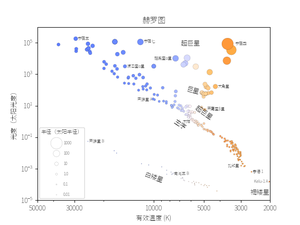
赫罗图
图注: 这张图展示了不同恒星温度和亮度。每个点的大小代表恒星的半径,颜色代表人眼所看到的颜色。恒星的颜色从淡蓝色到淡橙红色不等,没有恒星具有像红、绿或蓝这样的纯颜色,因为恒星的光谱包含了许多不同颜色的光。然而,最红的恒星通常被称为红恒星,最蓝的恒星被称为蓝恒星。为了展示不同类型的恒星,制作这个图表的恒星样本选择上并没有反映出每种类型恒星的实际数量比例。
从左上到右下是一条长长的恒星带,这些恒星在其核心燃烧氢气,这被称为主序。在这条线上,我们可以看到参宿三(Mintaka)、波江座α星(Achernar)、天狼星A(Sirius A)、太阳和比邻星(Proxima Centauri)等恒星。在主序线右下方的比邻星周围的天体被称为红矮星。在红矮星的右下方是Teide 1和Kelu-1 A。这两个天体是褐矮星,它们的质量太低,核心没有足够的热量来持续地进行氢融合。由于它们不燃烧氢,褐矮星不被认为是主序星。"褐矮星"这个名字与它们的颜色无关。
在主序星的上方,我们发现次巨星、巨星和超巨星。这些是已经完成了核心的氢燃烧并演化成更大天体的恒星。恒星的亮度取决于其温度和大小,因此巨星比具有较小半径但相同温度的恒星更亮。随着时间的推移,这些天体将走向生命的尽头,经历行星状星云阶段或变成超新星。以行星状星云阶段结束生命的恒星会形成一种叫做白矮星的恒星残骸。这种天体比相同温度的恒星小得多,因此更暗淡,并且位于主序星带的显著下方。以超新星结束生命的恒星会成为黑洞或中子星。这些在这个图表上没有显示。
来源: IAU OAE/Niall Deacon