Glossary term: Night
Description: Night is a period of darkness when the Sun is below the horizon. Night lasts from sunset to sunrise. On most of the Earth, each 24-hour day has one night. However, north of the Arctic Circle and south of the Antarctic Circle, there are periods of darkness around the winter solstice where the polar night can last for months. These areas have no night around the time of the summer solstice.
The period when the Sun is just below the horizon is called twilight. During twilight, the Sun still illuminates part of the sky. Twilight is divided into three equal periods: Civil twilight, nautical twilight, and astronomical twilight. During civil twilight – when the Sun is zero to six degrees below the horizon – the sky is relatively bright so artificial illumination such as street lighting is often not required. Nautical twilight – when the Sun is six to 12 degrees below the horizon – has both bright stars visible and a sky bright enough to see the horizon even on a moonless night. This allows sailors to navigate using celestial navigation. Astronomical twilight is when the Sun is 12 to 18 degrees below the horizon.
Related Terms:
See this term in other languages
Term and definition status: This term and its definition have been approved by a research astronomer and a teacher
The OAE Multilingual Glossary is a project of the IAU Office of Astronomy for Education (OAE) in collaboration with the IAU Office of Astronomy Outreach (OAO). The terms and definitions were chosen, written and reviewed by a collective effort from the OAE, the OAE Centers and Nodes, the OAE National Astronomy Education Coordinators (NAECs) and other volunteers. You can find a full list of credits here. All glossary terms and their definitions are released under a Creative Commons CC BY-4.0 license and should be credited to "IAU OAE".
If you notice a factual error in this glossary definition then please get in touch.
Related Media

ISS' view of nightly Japan
Caption: This nighttime photograph of Earth was taken from the International Space Station (ISS) by astronaut Scott Kelly in 2015 during Expedition 44. It captures the nation of Japan lit up after dark, with bright city lights tracing urban centers, major roadways, and densely populated regions. The view from orbit at night highlights how human activity shows up as patterns of light on Earth’s surface, with well-lit areas contrasting sharply against the surrounding darkness of rural regions and open water.
Photographs like this highlight what “night” looks like from space — not just a lack of sunlight, but also a time when artificial light reveals the rhythms of human life across the globe. From hundreds of kilometers above the planet, the night side of Earth appears as a tapestry of glowing clusters and dark spaces, offering insight into population distribution, infrastructure, and how cities remain active long after sunset. The ISS’s low orbit allows astronauts to capture these detailed views of Earth after dark, helping us appreciate both natural and human elements of nighttime on our planet.
Credit: NASA
credit link
License: PD Public Domain icons
Related Activities
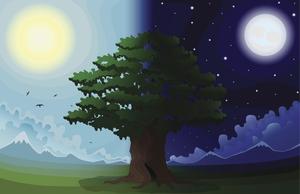
Why Do We Have Day and Night?
astroEDU educational activity (links to astroEDU website) Description: Explore day and night of Earth.
License: CC-BY-4.0 Creative Commons Attribution 4.0 International (CC BY 4.0) icons
Tags:
Tilt
Age Ranges:
6-8
, 8-10
, 10-12
Education Level:
Primary
, Secondary
Areas of Learning:
Modelling
, Simulation focussed
, Structured-inquiry learning
Costs:
Low Cost
Duration:
1 hour 30 mins
Group Size:
Group
Skills:
Asking questions
, Communicating information
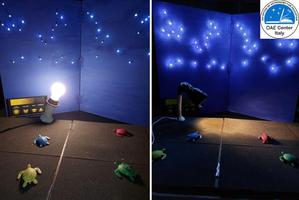
Let there be light… but not too much!
astroEDU educational activity (links to astroEDU website) Description: Build a model to learn what light pollution is and what its effects are.
License: CC-BY-4.0 Creative Commons Attribution 4.0 International (CC BY 4.0) icons
Tags:
Pollution
, sky observation
, lighting source
Age Ranges:
6-8
, 8-10
, 10-12
Education Level:
Middle School
, Primary
Areas of Learning:
Discussion Groups
, Modelling
, Observation based
, Project-based learning
Costs:
Medium Cost
Duration:
2 hours
Group Size:
Group
Skills:
Asking questions
, Developing and using models
, Engaging in argument from evidence