Glossary term: Protostar
Description: A protostar is an early stage in the star formation process. It is a large mass of gas and dust formed as a result of the contraction of a giant molecular cloud in the interstellar medium. As the cloud collapses, gravitational energy is converted into heat, warming the still-forming protostar. This phase may take anywhere from 105 to 107 years, depending on the mass of the star, with more massive stars forming more quickly. It begins with an increase in density in the molecular cloud core and ends with the formation of a pre-main-sequence star. Pre-main-sequence stars of similar mass to the Sun are known as T-Tauri stars. Once hydrogen fusion ignites in the core of a star it begins producing energy and becomes a main sequence star.
Related Terms:
See this term in other languages
Term and definition status: This term and its definition have been approved by a research astronomer and a teacher
The OAE Multilingual Glossary is a project of the IAU Office of Astronomy for Education (OAE) in collaboration with the IAU Office of Astronomy Outreach (OAO). The terms and definitions were chosen, written and reviewed by a collective effort from the OAE, the OAE Centers and Nodes, the OAE National Astronomy Education Coordinators (NAECs) and other volunteers. You can find a full list of credits here. All glossary terms and their definitions are released under a Creative Commons CC BY-4.0 license and should be credited to "IAU OAE".
If you notice a factual error in this glossary definition then please get in touch.
In Other Languages
- Arabic: النجوم البدائية
- German: Protostern
- Spanish: Protoestrella
- French: Protoétoile
- Hindi: प्रोटोस्टार
- Italian: Protostella
- Japanese: 原始星 (external link)
- Korean: 원시별
- Marathi: प्रोटोस्टार
- Nepali: भ्रूण तारा / प्रोटोतारा
- Brazilian Portuguese: Protoestrela
- Simplified Chinese: 原恒星
- Traditional Chinese: 原恆星
Related Media
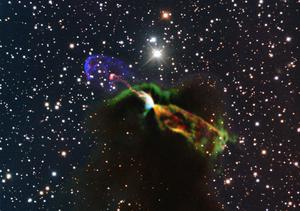
Witnessing the birth of a star
Caption: A combination of radio and visible light imaged with the Atacama Large Millimeter/submillimeter Array (ALMA) and European Southern Observatory's New Technology Telescope (NTT) revealing birth of a star forming the Herbig-Haro object HH 46/47. ALMA observations shown in orange and green unveil the energetic jet from the central protostar otherwise hidden at visible wavelength due to dust obscuration and dense gas. NTT observations in pink and purple highlight the visible light from the jet emitted towards the observer.
Credit: ESO/ALMA (ESO/NAOJ/NRAO)/H. Arce. Acknowledgements: Bo Reipurth
credit link
License: CC-BY-3.0 Creative Commons Attribution 3.0 Unported icons
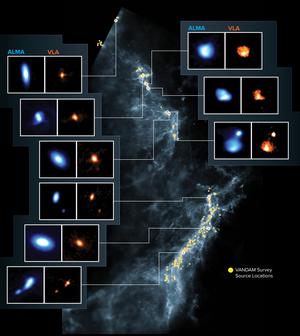
Stellar birth environment
Caption: Snapshot of the formation of multiple protostars in the Orion Molecular Clouds with a closer look at each of them with the Atacama Large Millimeter/submillimeter Array and Very Large Array. Such an image provides unique insights of the process and early stages of star formation as well as the influence of the parent cloud in which they form.
Credit: ALMA (ESO/NAOJ/NRAO), J. Tobin; NRAO/AUI/NSF, S. Dagnello; Herschel/ESA
credit link
License: CC-BY-3.0 Creative Commons Attribution 3.0 Unported icons