Glossary term: Apollo
Description: There are two meanings of the word Apollo in astronomy. The first refers to the Apollo program that put the first human beings on the surface of the Moon. These missions were mostly powered by the Saturn V rocket. In total there were fourteen numbered missions launched (Apollo 4–17); eleven missions were crewed with nine of these going to the Moon, of which six made lunar landings with the other three orbiting the Moon.
On the other hand, a group of near-Earth asteroids is also known as Apollo, named after the asteroid (1862) Apollo. This group of asteroids is characterized as having a semi-major axis greater than the Earth–Sun distance of one astronomical unit (AU) and with perihelion distances less than 1 AU. This means that during their orbits, Apollo asteroids move from inside the Earth's orbit to outside the Earth's orbit although these asteroids rarely come close to the Earth itself.
Related Terms:
See this term in other languages
Term and definition status: This term and its definition have been approved by a research astronomer and a teacher
The OAE Multilingual Glossary is a project of the IAU Office of Astronomy for Education (OAE) in collaboration with the IAU Office of Astronomy Outreach (OAO). The terms and definitions were chosen, written and reviewed by a collective effort from the OAE, the OAE Centers and Nodes, the OAE National Astronomy Education Coordinators (NAECs) and other volunteers. You can find a full list of credits here. All glossary terms and their definitions are released under a Creative Commons CC BY-4.0 license and should be credited to "IAU OAE".
If you notice a factual error in this glossary definition then please get in touch.
Related Media
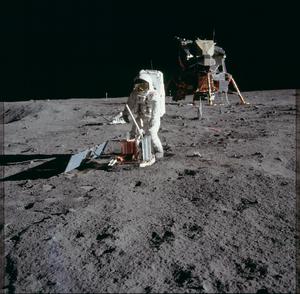
Apollo 11 lunar activity
Caption: NASA astronaut Edwin 'Buzz' Aldrin installs a seismometer in front of the Apollo 11 Eagle lunar lander during an extravehicular activity (EVA) on the Moon. Neil Armstrong shot this photo during the first human mission to the surface of the Moon in 1969.
Credit: NASA/Project Apollo Archive
credit link
License: PD Public Domain icons

Lift-off of Apollo 11 on a Saturn V rocket
Caption: The Apollo 11 Saturn V Space vehicle lifts off with Astronauts Neil A. Armstrong, Michael Collins and Edwin E. Aldrin, Jr., at 9:32 a.m. local time on July 16, 1969, from Launch Complex 39A at NASA's Kennedy Space Center, for the first Moon landing.
Credit: NASA
credit link
License: PD Public Domain icons