Termo do glossário: Formação planetária
Descrição: Quando uma nuvem de gás cósmico colapsa para formar uma estrela, essa estrela nascente é cercada por um disco de gás e poeira em rotação. Esse é um disco protoplanetário, onde os planetas se formam: partículas de poeira cobertas de gelo aderem umas às outras, formando aglomerados um pouco maiores, que continuam a crescer. Ainda há questões em aberto sobre como ocorrem as etapas seguintes: por exemplo, qual é o papel do movimento turbulento do gás em aproximar esses aglomerados? Eventualmente, formam-se os chamados planetesimais com mais de um quilômetro de tamanho. Alguns deles são atraídos pela sua própria gravidade para formar planetas maiores, outros permanecem como os primeiros asteroides. Alguns protoplanetas conseguem atrair grandes quantidades de gás, tornando-se gigantes gasosos. Outros protoplanetas em regiões frias e distantes da estrela central acumulam grandes quantidades de material congelado juntamente com o gás, tornando-se gigantes gelados. Outros, com menos gás, tornam-se planetas terrestres.
Termos relacionados:
Ver este termo em outros idiomas
Status do termo e da definição: A definição original deste termo em inglês foi aprovada por um astrônomo(a) pesquisador(a) e um(a) professor(a) A tradução deste termo e de sua definição ainda aguarda aprovação
O Glossário Multilíngue da OAE é um projeto do Escritório da IAU de Astronomia para a Educação (OAE) em colaboração com o Escritório da IAU para Divulgação da Astronomia (OAO). Os termos e definições foram selecionados, escritos e revisados por meio de um esforço coletivo da OAE, dos Centros e Nós da OAE, dos Coordenadores Nacionais de Educação em Astronomia (NAECs) da OAE e de outros voluntários. Você pode encontrar uma lista completa dos créditos aqui. Todos os termos do glossário e suas definições são disponibilizados sob uma licença Creative Commons CC BY-4.0 e devem ser creditados à "IAU OAE".
Se você notar algum erro factual ou de tradução neste termo do glossário ou em sua definição, por favor entre em contato.
Em outros idiomas
- Árabe: تكوُّن الكواكب
- Alemão: Planetenentstehung
- Inglês: Planet Formation
- Espanhol: Formación de planetas
- Persa: شکل گیری سیارهها
- Francês: Formation de planètes
- Italiano: Formazione dei pianeti
- Chinês Simplificado: 行星形成
- Chinês Tradicional: 行星形成
Mídia relacionada
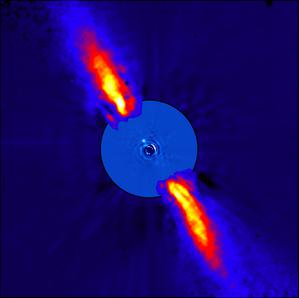
beta Pictoris b
Legenda: This composite of two images shows the planet beta Pictoris b and a disk of material both of which orbit the young star beta Pictoris. Both are taken in infrared light. The inner image was one of the first pictures taken of a planet around another star (an exoplanet). This image was made using a technique called adaptive optics which removes the blurring effect of the Earth's atmosphere that spreads out a star's light. The star's light is then concentrated tightly enough that it can be hidden behind a blocking circle (shown here in black) called a coronagraph. The ripples around this are artifacts of the imaging process. Beta Pictoris b, a gas giant planet about twelve times the mass of Jupiter, appears as a dot above and to the left of the black circle.
The outer image shows the thermal emission from the warm disk of material surrounding the young star beta Pictoris. As we are viewing this disk edge-on it appears as a line. This disk of gas and dust provided the material to form beta Pictoris b.
Crédito: ESO/A.-M. Lagrange et al.
link do crédito
License: CC-BY-4.0 Creative Commons Attribution 4.0 International (CC BY 4.0) ícones
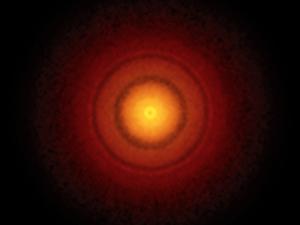
Planet formation around the star TW Hydrae
Legenda: This image shows the disk around the young star TW Hydrae. This star is only about 10 million years old, young enough that planets are still forming in a disk of gas and dust around it. This image was created using an array of submillimetre telescopes, each of which looks like a satellite dish. The signals from these telescopes were combined by a central processing computer to make this image. The lighter and darker patches show areas of the disk where there is more or less dust respectively. The dark rings and bright rings are evidence that the dust in the disk has been shepherded into some orbits and away from others. This is likely because there is one or more planets that are still forming hidden in the disk.
The whole image shows the disk around TW Hydrae out to a distance of about 70 astronomical units frm the central star. The two outer dark rings are separated from the central star by approximately the average distance between the Sun and Uranus and the average distance between the Sun and Pluto. The inner central hole appears to have been carved out by a planet orbiting TW Hydrae at a distance similar to the distance between the Earth and the Sun.
Crédito: S. Andrews (Harvard-Smithsonian CfA); B. Saxton (NRAO/AUI/NSF); ALMA (ESO/NAOJ/NRAO)
link do crédito
License: CC-BY-4.0 Creative Commons Attribution 4.0 International (CC BY 4.0) ícones

O planeta PDS 70b dentro de um disco protoplanetário
Legenda: Uma imagem do planeta PDS 70b. A jovem estrela PDS 70b é rodeada por um disco protoplanetário. Discos como este contêm gás, partículas finas semelhantes a areia que os astrônomos chamam de poeira e também corpos maiores, que variam de objetos do tamanho de seixos a protoplanetas (planetas que ainda estão se formando).
Esta imagem foi capturada em luz infravermelha usando óptica adaptativa. A óptica adaptativa é uma técnica que utiliza espelhos flexíveis e análise computacional para remover o efeito de desfocagem causado pela atmosfera terrestre. Isso permite que os astrônomos observem regiões próximas a estrelas como a PDS 70, que de outra forma seriam ofuscadas pela luz da estrela espalhada pela atmosfera terrestre. No centro há um círculo preto. Isso é causado por um coronógrafo, um pequeno dispositivo que bloqueia a luz da estrela central. Ele é cercado por um oval brilhante, luz infravermelha emitida pelo material no disco protoplanetário. À direita do círculo preto que cobre a estrela há um ponto brilhante. Trata-se de PDS 70b, um planeta gigante ainda em formação.
Crédito: ESO/ A. Müller, MPIA
link do crédito
License: CC-BY-4.0 Creative Commons Attribution 4.0 International (CC BY 4.0) ícones
Diagramas relacionados
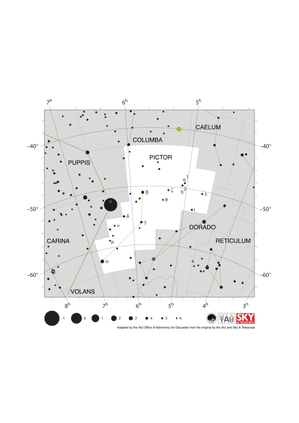
Pictor Constellation Map
Legenda: The constellation Pictor with its bright stars and surrounding constellations. Pictor is surrounded by (going clockwise from the top): Columba, Caelum, Dorado, Volans, Carina and Puppis. Pictor is notable for its second brightest star, Beta Pictoris. This young star hosts a large disk of dusty material left over from the planet formation process along with two planets, one of which Beta Pictoris b was one of the first planets to be directly imaged by astronomers.
Pictor is a southern constellation and thus the whole constellation is visible at some point in the year throughout the southern hemisphere. The whole constellation is also visible from some equatorial regions of the northern hemisphere with parts of the constellation visible to the remaining northern equatorial regions and some northern hemisphere temperate zones. Pictor is best viewed in the northern hemisphere winter and southern hemisphere summer.
The y-axis of this diagram is in degrees of declination with north as up and the x-axis is in hours of right ascension with east to the left. The sizes of the stars marked here relate to the star's apparent magnitude, a measure of its apparent brightness. The larger dots represent brighter stars. The Greek letters mark the brightest stars in the constellation. These are ranked by brightness with the brightest star being labeled alpha, the second brightest beta, etc., although this ordering is not always followed exactly. The dotted boundary lines mark the IAU's boundaries of the constellations and the solid green lines mark one of the common forms used to represent the figures of the constellations. Neither the constellation boundaries, nor the lines joining the stars appear on the sky.
Crédito: Adapted by the IAU Office of Astronomy for Education from the original by the IAU and Sky & Telescope
License: CC-BY-4.0 Creative Commons Attribution 4.0 International (CC BY 4.0) ícones
Atividades relacionadas
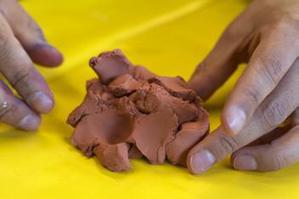
Creating Asteroids
astroEDU educational activity (links to astroEDU website) Description: Have fun, building asteroids using clay!
License: CC-BY-4.0 Creative Commons Attribution 4.0 International (CC BY 4.0) ícones
Tags:
Hands-on
, Model
Faixas etárias:
4-6
, 6-8
, 8-10
Nível de ensino:
Pré-escola
, Básico
Áreas de aprendizagem:
Modelagem
, Aprendizagem por investigação estruturada
Custos:
Custo médio
Duração:
1 hour 30 mins
Tamanho do grupo:
Grupo
Habilidades:
Comunicar informações
, Desenvolver e usar modelos