Bridging Research and Classrooms: 2026 Astronomy Teacher Training in China
Published: 3rd September 2026 08:00 (UTC)
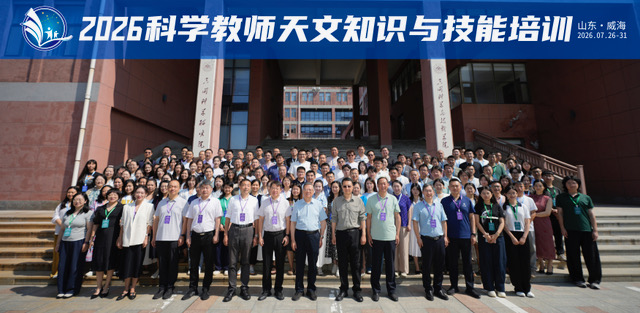
From 26 to 31 July 2026, the 2026 Training on Astronomical Knowledge and Skills for Science Teachers was held at Shandong University Weihai Campus, China. Organized by the OAE Center China-Nanjing and the Beijing Planetarium, the six-day program brought together more than 120 science teachers and science museum educators from 25 provincial-level regions across China.
The training activities focused on the theme “Planets”, connecting school science education with modern astronomy and covering topics from the Solar System to exoplanets. Through expert lectures, teaching workshops, and observational practice, the program aimed to support teachers in developing both astronomy knowledge and classroom teaching skills.
The training was designed following the IAU OAE Transparency Standards for Teacher Training. To improve access, financial support was provided for teachers from regions with fewer educational resources.
The IAU OAE Big Ideas for Astronomy framework was introduced throughout the training to help teachers connect astronomy concepts with students’ learning progression. The theme of planets provided a natural link between the framework and school curricula, allowing teachers to explore how topics such as planetary systems, Earth as a planet, and exoplanet research can be incorporated into classroom activities.
To address different levels of experience among participants, the training included two groups: a Foundation Class focusing on basic astronomy concepts, observation skills, and school astronomy activities, and an Advanced Class focusing on topics such as exoplanet science, astronomical data analysis, and inquiry-based learning.
The program followed a three-stage learning approach. Participants first learned from astronomers and science education experts through lectures covering both fundamental astronomy and current research. Nearly 20 experts from universities and research institutes delivered specialized lectures. The opening lecture was delivered by Professor Gang Zhao, Academician of the Chinese Academy of Sciences, who introduced recent developments in exoplanet research and discussed the significance of searching for life beyond Earth.
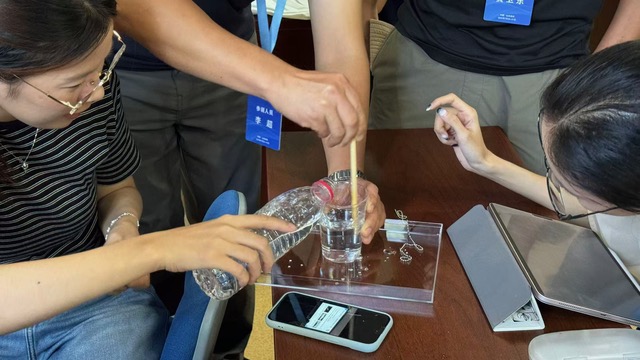
Teachers then took part in teaching workshops, where they explored how to transform astronomy knowledge into classroom activities. Experts provided practical guidance on topics such as the design and classroom application of astronomy educational tools, and introduced NASE exoplanet-themed activities as examples for classroom practice. During these sessions, OAE Big Ideas and astronomy education resources, including teaching cases and videos developed or collected by the center, were shared as references for lesson design.
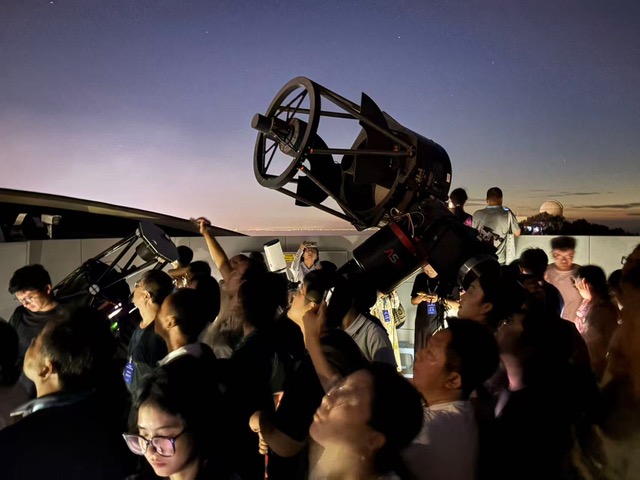
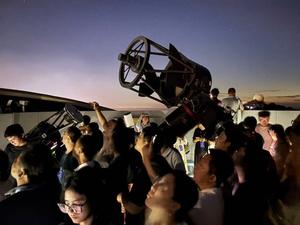
The final stage focused on practical skills. Participants received telescope training, carried out night-sky observations, and visited the Weihai Observatory and related laboratories to gain first-hand experience of astronomical observation and research environments.
A key outcome of the training was the development of astronomy teaching activities by participants. Teachers designed classroom activities on topics such as Moon phases, Solar System exploration, safe solar observation, exoplanet detection, and astronomical data analysis. These activities encouraged teachers to move beyond knowledge delivery and support students’ exploration of astronomy through scientific inquiry.
The impact of the training was evaluated through pre-test and post-test assessments. Among participants who completed both assessments, the average score increased from 64 before training to 76 after training, while the median score increased from 65 to 80. The assessment also highlighted areas for future improvement, particularly for more advanced concepts such as exoplanet detection methods.
The training received support from the international astronomy education community. Dr. Markus Pössel, Director of the IAU Office of Astronomy for Education, provided a video message for the opening ceremony, highlighting the importance of astronomy education and teacher development.
Following the training, OAE Center China-Nanjing will continue to support participating teachers through resource sharing, classroom practice follow-up, and the collection and dissemination of astronomy education cases. These efforts aim to build a sustainable network of educators and strengthen the connection between astronomy research and classroom learning.
Share on:


Documents
Contacts
Zhang HaopengOAE Center China, Nanjing - Staff
Beijing Planetarium
hpzhang_bjpatoutlook.com
Media files
Credit: OAE Center China-Nanjing
File: image 68.31 kB
Credit: OAE Center China-Nanjing
File: image 106.98 kB
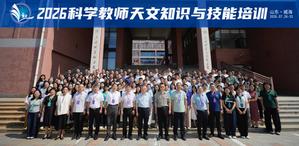
Credit: OAE Center China-Nanjing
File: image 142.12 kB