Glossary term: Occultation
Description: An occultation is when one object entirely hides another behind it. When viewed from Earth, the Moon frequently passes in front of stars. These stars are said to be occulted by the Moon. Other objects in the Solar System occasionally occult bright stars.
Occultations are useful for studying the atmospheres of distant Kuiper Belt objects. When these icy bodies occult stars, the light from the star briefly passes through the Kuiper Belt object's atmosphere. This light is imprinted with the spectral signatures of the Kuiper Belt object's atmosphere when it reaches the Earth.
When one object passes in front of another but does not entirely hide it, it is said to transit the other object.
Related Terms:
See this term in other languages
Term and definition status: This term and its definition have been approved by a research astronomer and a teacher
The OAE Multilingual Glossary is a project of the IAU Office of Astronomy for Education (OAE) in collaboration with the IAU Office of Astronomy Outreach (OAO). The terms and definitions were chosen, written and reviewed by a collective effort from the OAE, the OAE Centers and Nodes, the OAE National Astronomy Education Coordinators (NAECs) and other volunteers. You can find a full list of credits here. All glossary terms and their definitions are released under a Creative Commons CC BY-4.0 license and should be credited to "IAU OAE".
If you notice a factual error in this glossary definition then please get in touch.
In Other Languages
- Arabic: الاحتجاب
- German: Bedeckung
- Spanish: Ocultación
- French: Occultation
- Italian: occultazione
- Brazilian Portuguese: Ocultação
- Simplified Chinese: 掩星
- Traditional Chinese: 掩星
Related Media
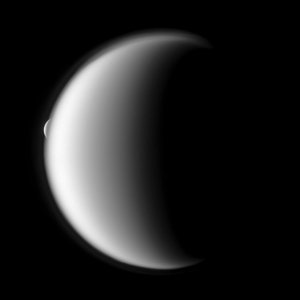
Rhea reappearing after occultation by Titan
Caption: On October 27, 2009, NASA’s Cassini spacecraft orbiting around Saturn captured this view of Saturn's moon Rhea as it began to emerge after being hidden by Saturn's largest moon Titan during an occultation. An occultation is a celestial event in which one object moves in front of another and temporarily blocks the first object from view.
In this image, Titan — about 5,150 km across — was closer to the spacecraft at about 1 million km, while Rhea — roughly 1,528 km in diameter — was farther away at about 2.3 million km. Titan’s high-altitude atmospheric haze is visible as a faint glow around its limb, showing the difference in surface and atmospheric properties between these two moons.
Scientists study occultations like this because watching how one moon disappears behind or reappears from another helps refine our understanding of their orbits and physical characteristics.
Credit: NASA/JPL/Space Science Institute
credit link
License: PD Public Domain icons