Glossary term: 목성
Description: 목성은 태양계에서 가장 크고, 태양에서 다섯 번째에 있는 거대한 행성입니다. 반지름은 약 71,300킬로미터(km)로, 지구의 약 11배에 달합니다. 목성은 가스로 이루어진 거대행성으로, 질량은 지구의 318배이며, 다른 모든 행성과 작은 천체를 합친 것보다 큽니다. 태양으로부터의 평균 거리는 약 7억 7,800만 킬로미터, 즉 5천문단위(AU) 정도이며, 태양을 한 바퀴 도는 데 약 12년이 걸립니다. 2023년 기준으로, 천문학자들은 90개가 넘는 위성(자연 위성)이 목성을 공전하고 있는 것을 발견했습니다. 목성은 육안으로도 볼 수 있을 만큼 밝은 행성입니다. ‘목성(Jupiter)’이라는 이름은 로마 신화의 신들의 왕에서 유래했습니다. 작은 망원경으로 관찰하면 목성의 다양한 색깔의 구름 띠와 거대한 폭풍 지역인 대적반(Great Red Spot)을 볼 수 있습니다. 지난 수십 년 동안 여러 우주 탐사선이 목성을 향해 보내졌으며, NASA의 주노(Juno) 탐사선은 2016년부터 목성과 그 위성들을 가장 자세히 탐사하기 시작했습니다.
Related Terms:
See this term in other languages
Term and definition status: The original definition of this term in English have been approved by a research astronomer and a teacher The translation of this term and its definition is still awaiting approval
The OAE Multilingual Glossary is a project of the IAU Office of Astronomy for Education (OAE) in collaboration with the IAU Office of Astronomy Outreach (OAO). The terms and definitions were chosen, written and reviewed by a collective effort from the OAE, the OAE Centers and Nodes, the OAE National Astronomy Education Coordinators (NAECs) and other volunteers. You can find a full list of credits here. All glossary terms and their definitions are released under a Creative Commons CC BY-4.0 license and should be credited to "IAU OAE".
If you notice a factual or translation error in this glossary term or definition then please get in touch.
Related Media
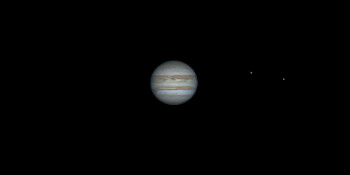
Jupiter's Rotation, by Vishal Sharma, India
Caption: Third place in the 2021 IAU OAE Astrophotography Contest, category Galilean moons: Jupiter’s Rotation, by Vishal Sharma, India.
This time-lapse beautifully shows the rotation of Jupiter and the passage of two Galilean moons on the right side of the frame. Jupiter completes one rotation in just under 10 hours and we see as the Great Red Spot makes its way from left to right. The two moons travel a noticeable fraction of their orbit in this short time. This image was taken in 2020 in the North of India.
Credit: Vishal Sharma/IAU OAE
License: CC-BY-4.0 Creative Commons 저작자표시 4.0 국제 (CC BY 4.0) icons
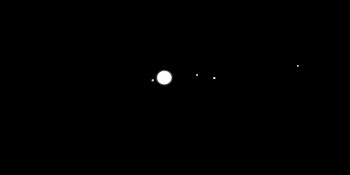
Jupiter Moons Movie2, by Nicolas Hurez, Paul-Antoine Matrangolo, and Carl Pennypacker, United States of America
Caption: Second place in the 2021 IAU OAE Astrophotography Contest, category Galilean moons.
This sequence shows the orbit of the four Galilean moons around the planet Jupiter. Almost two entire orbits of the innermost moon, Io, can be seen, with the other moons (Europa and Ganymede, but in particular Callisto) being further away, orbiting noticeably slower. The images were obtained in 2018 with the Las Cumbres Global Observatory at different locations on Earth, allowing a continuous sequence of images over approximately half a week without gaps during the day. With clear skies and over the course of several nights, the motion of the Galilean moons can also be observed with binoculars (ideally steady your elbows on a surface).
Credit: Nicolas Hurez, Paul-Antoine Matrangolo and Carl Pennypacker/IAU OAE
License: CC-BY-4.0 Creative Commons 저작자표시 4.0 국제 (CC BY 4.0) icons
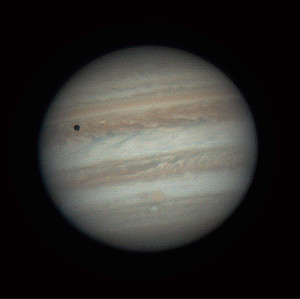
Jupiter, Io and its shadow, by Ralf Burkart, Germany
Caption: First place in the 2021 IAU OAE Astrophotography Contest, category Galilean moons.
This time-lapse of Jupiter taken in 2017 from Germany beautifully illustrates the transit of one of the Galilean moons, Io, in front of Jupiter. As this is simply a moon casting a shadow on a planet it is equivalent to a lunar eclipse on Earth observed from further away. While the shadow of the moon is clearly visible from the beginning, it might be difficult to spot the moon itself against the background of the beautiful atmospheric bands of Jupiter the first time the video is seen. Watching it repeatedly allows appreciating the rapid motion and rotation in this fantastic observation.
Credit: Ralf Burkart/IAU OAE
License: CC-BY-4.0 Creative Commons 저작자표시 4.0 국제 (CC BY 4.0) icons
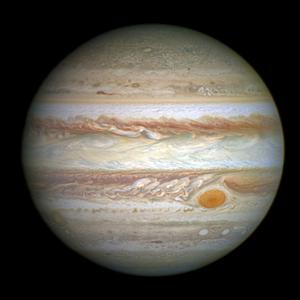
Jupiter
Caption: This full disk view of Jupiter was obtained on 21 April 2014 with Hubble's Wide Field Camera 3 (WFC3). It shows the prominent great red spot, a gigantic cyclone. Cloud ribbons cover the surface, whose colours stem from gases like ammonia and other chemical compounds.
Credit: NASA, ESA, and A. Simon (Goddard Space Flight Center)
credit link
License: CC-BY-4.0 Creative Commons 저작자표시 4.0 국제 (CC BY 4.0) icons
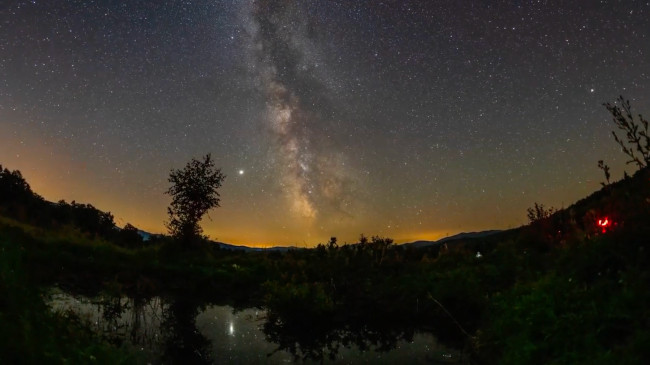
Flowing Night Sky
Caption: Honourable mention in the 2022 IAU OAE Astrophotography Contest, category Time lapses of celestial patterns.
This time-lapse was shot from Slovakia in August 2020. By fixing the relative movement of the sky to Earth's rotation in some of the frames, we can experience a different perspective as a viewer.
The Milky Way, our home galaxy, is visible throughout the whole video. The bright objects near the Milky Way are Jupiter and Saturn, close together, Jupiter being the brighter one.
This video also shows the interaction of amateur astronomers observing the Perseids meteor shower with their telescopes pointed towards the sky. An unfortunate aspect of the art of astronomical observing, clouds can suddenly cover the whole sky. The fog occurs mostly because of the higher humidity after the rain.
Most of the light trails in the sky are made by satellites, but some of them, appearing just very briefly and not very noticeably, are meteors, as the video was shot around the peak of Perseids meteor shower.
Credit: Robert Barsa/IAU OAE
License: CC-BY-4.0 Creative Commons 저작자표시 4.0 국제 (CC BY 4.0) icons
Related Activities

Meet our neighbours: Jupiter
astroEDU educational activity (links to astroEDU website) Description: Jupiter, the gas giant of the Solar System in a tactile version.
License: CC-BY-4.0 Creative Commons 저작자표시 4.0 국제 (CC BY 4.0) icons
Age Ranges:
6-8
, 8-10
, 10-12
Education Level:
Primary
Areas of Learning:
Fun activity
, Modelling
Costs:
Low Cost
Duration:
1 hour
Group Size:
Group
Skills:
Analysing and interpreting data
, Developing and using models