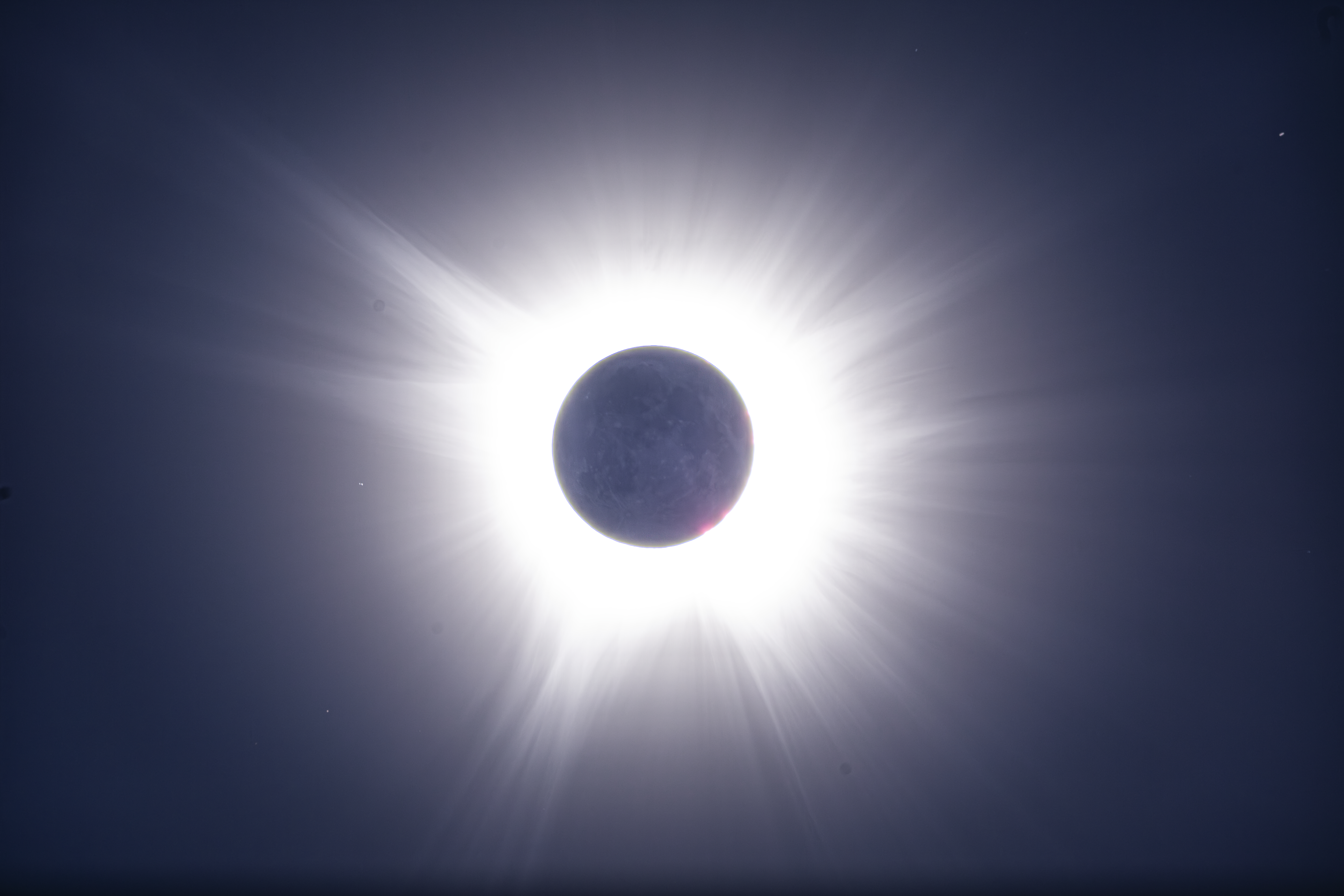
This page describes an image Moon covering the Sun
Scarica File ( immagine 15.25 MB)
Didascalia:
Moon covering the Sun during the total solar eclipse of April 8th, 2024. The solar corona is also visible at totality. Image taken in Arkansas, USA. This image was processed using a Larson-Sekanina-style technique. Multiple exposures ranging from 1/500 second to 4 seconds were stacked and combined with a rotational gradient filter to reveal fine structural detail across the corona's extreme brightness range. This is done because the inner corona saturates at longer exposures, while the outer corona and the Moon are only visible at those same longer exposures.
Didascalie in altre lingue
Crediti per l'immagine: Carolin Liefke
Licenza per l'immagine: Creative Commons Attribuzione 4.0 Internazionale (CC BY 4.0) Creative Commons Attribuzione 4.0 Internazionale (CC BY 4.0) icone
Le didascalie di file multimediali presentate sul sito web OAE sono state scritte,Tradotte e riviste tramit Sun impegno collettivo dell'OAE, dei Centri e Nodi OAE, iCoordinatori Nazionali per la Didattica dell'Astronomia e altri volontari. Trovatel'elenco completo dei crediti per il nostro progetto di traduzione. Tutte le didascaliedei file multimediali sono pubblicate sotto Creative Commons CC BY-4.0 licenza di traduzione, e dovrebbero essereaccreditate all'IAU OAE.I file multimediali stessi possono avere licenze diverse (vedi sopra) eDovrebbero essere accreditate come specificato al paragrafo "crediti"
Se noti un errore di fatto in questa didascalia o un errore in una delle sue traduzioni, per favore contattaci.
Didascalie in lingue diverse:
Didascalia: Moon covering the Sun during the total solar eclipse of April 8th, 2024. The solar corona is also visible at totality. Image taken in Arkansas, USA. This image was processed using a Larson-Sekanina-style technique. Multiple exposures ranging from 1/500 second to 4 seconds were stacked and combined with a rotational gradient filter to reveal fine structural detail across the corona's extreme brightness range. This is done because the inner corona saturates at longer exposures, while the outer corona and the Moon are only visible at those same longer exposures.
Crediti per l'immagine: Carolin Liefke