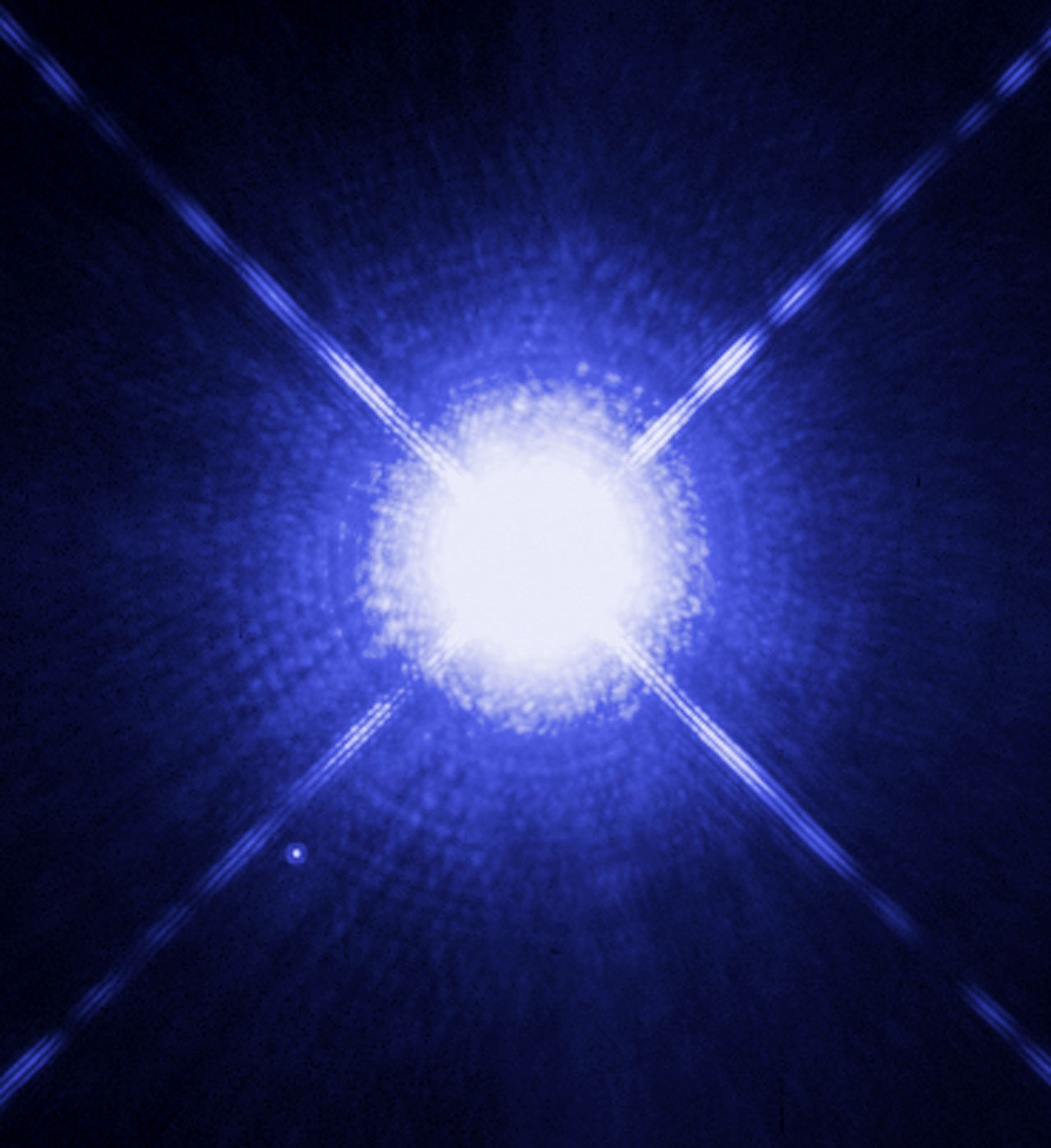
This page describes an image Sirius A with his faint white dwarf companion Sirius B
Télécharger le fichier ( image 1.45 MB)
Légende d'image :
This Hubble Space Telescope image highlights Sirius, the brightest star in Earth’s night sky, appearing as an intensely luminous object at the center with prominent cross-shaped diffraction spikes. These spikes, along with the saturated glow around the main star, are caused by the Sirius' light being spread out by the telescope and camera used to make this image. Slightly below and to the left of the main star, a tiny point of light marks Sirius B, a much dimmer object captured thanks to Hubble’s high sensitivity.
Sirius A is an A-type star, known for its high surface temperature and strong white-blue light, while Sirius B is a compact white dwarf, the dense remnant of a star that has exhausted its nuclear fuel. Together, they form a well-known Binary star system located about 8.6 light-years from Earth.
Sirius B was originally a higher mass and brighter star that burned through its hydrogen fuel more quickly than Sirius A. This led to Sirius B evolving into a red giant and eventually ending its life as a planetary nebula, leaving only the remains of its core as a white dwarf orbiting Sirius A.
Faire défiler pour afficher les légendes dans d'autres langues
Crédits pour l'image : NASA, ESA, H. Bond (STScI), and M. Barstow (University of Leicester) Lien du crédit
Termes du glossaire en rapport :
Naine blanche
, Sirius
, Étoile binaire
, Étoile de type A
Catégories :
Étoiles
Licence de l'image : Creative Commons (CC) Attribution 4.0 International (CC BY 4.0) Creative Commons (CC) Attribution 4.0 International (CC BY 4.0) Icônes
Les légendes des fichiers média présents sur le site de l'OAE ont été écrites, traduites et relues grâce à un effort collectif de l'OAE, les Centres et les Noeuds de l'OAE, les Coordinateurs Nationaux de l'Astronomie pour l'Education de l'OAE(NAECs) et d'autres volontaires. La liste complète des crédits pour ce projet est disponible ici . Toutes les légendes des fichiers média sont déposés sous licence Creative Commons CC BY-4.0 et doivent être créditées au nom de "IAU OAE". Les fichiers média eux-mêmes peuvent avoir des licences différentes (voir plus haut) et et doivent être crédités comme indiqué ci-dessus sous le terme "credit".
Si vous constatez une erreur dans cette légende ou dans un de ses traductions, veuillez nous contacter veuillez nous contacter.
Légendes proposées dans différentes langues :
Légende d'image : Dieses Bild des Hubble-Weltraumteleskops zeigt Sirius, den hellsten Stern am Nachthimmel der Erde, der als intensiv leuchtendes Objekt in der Mitte mit markanten, kreuzförmigen Beugungsspitzen erscheint. Diese Strahlen sowie das übersättigte Leuchten um den Hauptstern herum entstehen dadurch, dass das Licht von Sirius durch das Teleskop und die Kamera, mit denen dieses Bild aufgenommen wurde, gestreut wird. Etwas unterhalb und links vom Hauptstern markiert ein winziger Lichtpunkt Sirius B, ein weitaus schwächeres Objekt, das dank der hohen Empfindlichkeit des Hubble-Teleskops erfasst werden konnte.
Sirius A ist ein Stern vom Typ A, bekannt für seine hohe Oberflächentemperatur und sein starkes weiß-blaues Licht, während Sirius B ein kompakter Weißer Zwerg ist, der dichte Überrest eines Sterns, der seinen Kernbrennstoff aufgebraucht hat. Zusammen bilden sie ein bekanntes Doppelsternsystem, das etwa 8,6 Lichtjahre von der Erde entfernt liegt.
Sirius B war ursprünglich ein massereicherer und hellerer Stern, der seinen Wasserstoffvorrat schneller verbrauchte als Sirius A. Dies führte dazu, dass sich Sirius B zu einem Roten Riesen entwickelte und schließlich sein Leben als planetarischer Nebel beendete, wobei nur die Überreste seines Kerns als Weißer Zwerg zurückblieben, der Sirius A umkreist.
Crédits pour l'image : NASA, ESA, H. Bond (STScI) und M. Barstow (Universität Leicester)
Termes du glossaire en rapport : A-Stern , Doppelsternsystem , Sirius , Weißer Zwerg Statuts de la traduction de la légende: Pas encore approuvé par un·e relecteur(rice)
Traducteurs de la légende: Simon Kraus
Légende d'image : This Hubble Space Telescope image highlights Sirius, the brightest star in Earth’s night sky, appearing as an intensely luminous object at the center with prominent cross-shaped diffraction spikes. These spikes, along with the saturated glow around the main star, are caused by the Sirius' light being spread out by the telescope and camera used to make this image. Slightly below and to the left of the main star, a tiny point of light marks Sirius B, a much dimmer object captured thanks to Hubble’s high sensitivity.
Sirius A is an A-type star, known for its high surface temperature and strong white-blue light, while Sirius B is a compact white dwarf, the dense remnant of a star that has exhausted its nuclear fuel. Together, they form a well-known Binary star system located about 8.6 light-years from Earth.
Sirius B was originally a higher mass and brighter star that burned through its hydrogen fuel more quickly than Sirius A. This led to Sirius B evolving into a red giant and eventually ending its life as a planetary nebula, leaving only the remains of its core as a white dwarf orbiting Sirius A.
Crédits pour l'image : NASA, ESA, H. Bond (STScI), and M. Barstow (University of Leicester)
Termes du glossaire en rapport : A-type Star , Binary Star , Sirius , White Dwarf
Légende d'image : Questa immagine del telescopio spaziale Hubble mette in risalto Sirio, la stella più luminosa del cielo notturno terrestre, che appare come un oggetto intensamente luminoso al centro, con evidenti raggi di diffrazione a forma di croce. Questi raggi, insieme al bagliore saturo attorno alla stella principale, sono causati dalla diffusione della luce di Sirio da parte del telescopio e della fotocamera utilizzati per realizzare questa immagine. Leggermente più in basso e a sinistra della stella principale, un minuscolo punto luminoso indica Sirio B, un oggetto molto più debole catturato grazie all’elevata sensibilità di Hubble.
Sirio A è una stella di tipo A, nota per la sua elevata temperatura superficiale e l'intensa luce bianco-azzurra, mentre Sirio B è una nana bianca compatta, il denso residuo di una stella che ha esaurito il proprio combustibile nucleare. Insieme, formano un ben noto sistema stellare binario situato a circa 8,6 anni luce dalla Terra.
Sirius B era originariamente una stella più massiccia e luminosa che ha consumato il proprio combustibile a base di idrogeno più rapidamente rispetto a Sirius A. Ciò ha portato Sirius B a evolversi in una gigante rossa e, infine, a concludere la propria vita come nebulosa planetaria, lasciando solo i resti del proprio nucleo sotto forma di una nana bianca in orbita attorno a Sirius A.
Crédits pour l'image : NASA, ESA, H. Bond (STScI) e M. Barstow (Università di Leicester)
Termes du glossaire en rapport : Nana Bianca , Sirio , Stella binaria , Stella di tipo A Statuts de la traduction de la légende: Pas encore approuvé par un·e relecteur(rice)
Traducteurs de la légende: Giuliana Giobbi
Ceci pourrait vous intéresser également







- Ressources
- Moteur de recherche des ressources pédagogiques
- Parcourir les ressources pédagogiques par Sujet
- Parcourir les images
- AstroEdu - Activités en classe
- Grandes Idées - Littéracie en astronomie
- Glossaire
- Rapports de l'OAE
- L'astronomie pour l'Education à travers le monde
- Sélection de ressources externes