Terme du glossaire : Amas
Description : Un amas est un groupe d'étoiles ou de galaxies liées entre elles par la gravitation.
Termes associés :
Voir ce terme dans d'autres langues
Statut du terme et de sa définition : La définition initiale de ce terme en anglais a été aprouvée par un·e spécialiste de la recherche en astronomie et un·e spécialiste de l’éducation La traduction de ce terme et de sa définition n'ont pas encore été aprouvées
Le glossaire multilangue de l'OAE est un projet du Bureau de l'IAU de l'Astronomie pour l'Education (OAE) en collaboration avec le Bureau de l'IAU de diffusion de l'Astronomie (OAO). Les termes et définitions ont été choisis, écrits et relues grâce à un effort collectif de l'OAE, les Centres et les Noeuds de l'OAE, les Coordinateurs Nationaux de l'Astronomie pour l'Education de l'OAE(NAECs) et d'autres volontaires. La liste complète des crédits pour ce projet est disponible ici . Tous les termes du glossaire et leur définition sont déposés sous licence Creative Commons CC BY-4.0 et doivent être créditées au nom de "IAU OAE".
Si vous constatez une erreur dans ce terme ou sa définition, veuillez nous contacter .
Media associé
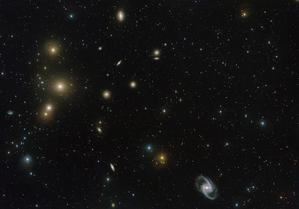
Amas de galaxies de Fornax
Légende : Les galaxies peuvent résider en groupes, comme notre groupe local, ou en amas de galaxies. L'amas de galaxies de Fornax est l'un des grands groupes de galaxies les plus proches. Sur cette image prise par le Very Large Telescope Survey Telescope VST (à l'Observatoire européen austral au Chili), on peut voir des galaxies elliptiques (sans structure définie et dans une teinte jaune) mais aussi des galaxies spirales telles que NGC 1365 en bas à droite. Cette galaxie en particulier est classée comme galaxie spirale barrée en raison de sa barre proéminente et bien définie. Le centre de l'amas de Fornax est la galaxie elliptique géante NGC 1399, visible comme la plus grande galaxie à gauche de l'image.
Crédit : ESO. Remerciements : Aniello Grado et Luca Limatola
Lien vers les crédits
License: CC-BY-4.0 Creative Commons (CC) Attribution 4.0 International (CC BY 4.0) Icônes
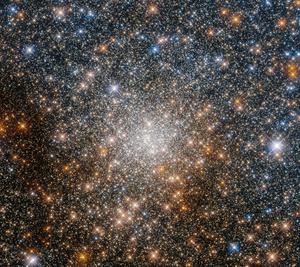
Étoiles dans les amas globulaires près du cœur de la Voie lactée
Légende : Cette image du télescope spatial Hubble présente une vue de l'intérieur de l'amas globulaire Terzan 9, composé de millions d'étoiles et situé près du cœur de notre galaxie, la Voie lactée. Cet amas globulaire se trouve dans le bulbe central de la galaxie, au milieu de la poussière interstellaire, qui masque la lumière de ces amas d'étoiles. Cette image est une combinaison de la lumière observée dans les parties visible et infrarouge du spectre électromagnétique. L'imagerie multi-longueur d'onde de la couleur et de la luminosité des étoiles permet de déterminer leur âge et, par conséquent, l'âge de l'amas d'étoiles parent.
Crédit : ESA/Hubble & NASA, R. Cohen
Lien vers les crédits
License: PD Domaine Public Icônes
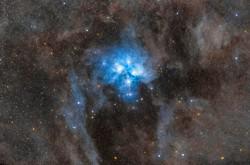
The Pleiades M45 with Majestic Dust
Légende : Honourable mention in the 2022 IAU OAE Astrophotography Contest, category Still images of celestial patterns.
Taken in Dar Eid in Saint Catherine/Sinai, Egypt, in October 2021, this image shows the Pleiades, an open cluster also known as The Seven Sisters.
The Pleiades are located in the north-western part of the constellation Taurus, the Bull. This constellation originates from ancient Babylonian or even Sumerian belief, where it was designated the Bull of Heaven, a mighty creature owned by the sky god. In Late Babylonian times, the Pleiades were called The Bristle at the hunchback of The Bull. In China, the asterism is also called The Hair, but this does not necessarily imply any relationship between the East Asian and West Asian names of this asterism, although exchange is hypothesised with the establishment of the Silk Road.
In ancient Babylonian texts the term The Hair does not appear. Instead, the Pleiades are only called The Star Cluster in Sumerian, and the Sumerian term was used in later languages as a loanword. The Sumerian and early Babylonian religion associated all constellations with specific deities, including gods, demons, messengers of gods. The Star Cluster was associated with a deity of the Netherworld that was called The Seven and was considered an ensemble of seven speaking weapons or strongly armed gods. The later Greek name of the Seven Sisters might possibly have sprung from an intercultural misunderstanding of this older religious association, since, in fact, seven stars are not seen in this cluster.
The star cluster of the Pleiades is really prominent in the sky, and thus was used for several cultural purposes, such as determining the calendar and the spring equinox. However, its significance is frequently overstated in cultural astronomy. As the tradition of representing it with seven dots originates from an ancient Sumerian belief, we should be careful about interpreting any group of seven dots on cave walls and archaeological sites across Europe, Asia and America from the Stone Age onwards as a representation of the Pleiades.
Modern astrophysics has found that the star cluster of the Pleiades is extraordinarily young, so there was certainly not an additional star in ancient times. Furthermore, we know that the bright stars are only the core region of an open star cluster that consists of hundreds of stars scattered over an area of the sky which exceeds the bright core by one or two of its diameters in any direction. The photograph does not even show the whole cluster. The group is thought to be about 400 light-years away from Earth, which is relatively close in astronomical terms.
Crédit : Mohamed Usama/IAU OAE
License: CC-BY-4.0 Creative Commons (CC) Attribution 4.0 International (CC BY 4.0) Icônes
Ceci pourrait vous intéresser également









- Ressources
- Moteur de recherche des ressources pédagogiques
- Parcourir les ressources pédagogiques par Sujet
- Parcourir les images
- AstroEdu - Activités en classe
- Grandes Idées - Littéracie en astronomie
- Glossaire
- Rapports de l'OAE
- L'astronomie pour l'Education à travers le monde
- Sélection de ressources externes