Terme du glossaire : Protubérance solaire
Description : Les protubérances solaires (parfois appelées filaments) sont des boucles de plasma qui se forment sous l'effet des champs magnétiques autour du Soleil. Elles sont temporaires mais peuvent persister pendant des semaines ou des mois et peuvent souvent être photographiées pendant les éclipses solaires. Une protubérance typique s'étend sur plusieurs milliers de kilomètres (km) ; la plus grande jamais observée a été estimée à plus de 800 000 km de long, soit environ un rayon solaire. Comme pour de nombreux phénomènes solaires, on pense que d'autres étoiles présentent également des protubérances.
Termes associés :
Voir ce terme dans d'autres langues
Statut du terme et de sa définition : La définition initiale de ce terme en anglais a été aprouvée par un·e spécialiste de la recherche en astronomie et un·e spécialiste de l’éducation La traduction de ce terme et de sa définition n'ont pas encore été aprouvées
Le glossaire multilangue de l'OAE est un projet du Bureau de l'IAU de l'Astronomie pour l'Education (OAE) en collaboration avec le Bureau de l'IAU de diffusion de l'Astronomie (OAO). Les termes et définitions ont été choisis, écrits et relues grâce à un effort collectif de l'OAE, les Centres et les Noeuds de l'OAE, les Coordinateurs Nationaux de l'Astronomie pour l'Education de l'OAE(NAECs) et d'autres volontaires. La liste complète des crédits pour ce projet est disponible ici . Tous les termes du glossaire et leur définition sont déposés sous licence Creative Commons CC BY-4.0 et doivent être créditées au nom de "IAU OAE".
Si vous constatez une erreur dans ce terme ou sa définition, veuillez nous contacter .
Dans d'autres langues
- Arabe: الشواظ الشمسي
- Allemand: Sonnenprotuberanz
- Anglais: Solar Prominence
- Espagnol: Protuberancia solar
- Italien: Protuberanza solare
- Japonais: プロミネンス (Liens externes)
- Coréen: 태양홍염
- Portugais brésilien: Proeminência solar
- Chinois simplifié: 日珥
- Chinois traditionnel: 日珥
Media associé

H-alpha image of the Sun's chromosphere
Légende : This false-color image was captured with a 10-cm telescope at the Big Bear Solar Observatory (BBSO) in the United States in July 2002. It depicts the full disk of the Sun using the H-alpha emission line of hydrogen. When observed in this spectral line, the Sun's chromosphere appears particularly prominent due to hydrogen atoms emitting light at the specific wavelength. This emission produces a distinctive red color, making features such as spicules (jets of plasma that look hair-like) and plage (bright patches in the chromosphere) highly visible. Several small solar prominences can be seen protruding from the edge of the solar disk. When prominences (also known as filaments) cross the face of the disk they appear as dark threads caused by the cooler material in the prominence absorbing light. The chromosphere is also visible in the violet part of the solar spectrum due to ionized calcium showing emissions in these wavelengths.
Crédit : Big Bear Solar Observatory (BBSO)/New Jersey Institut of Technology (NJIT)
Lien vers les crédits
License: PD Domaine Public Icônes
Activités associées
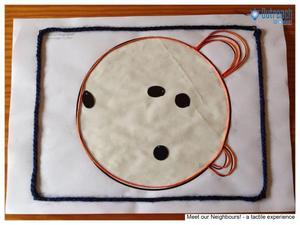
Meet Our Neighbours: Sun
astroEDU educational activity (links to astroEDU website) Description: Explore the tactile version of our star; the Sun with household materials.
License: CC-BY-4.0 Creative Commons (CC) Attribution 4.0 International (CC BY 4.0) Icônes
Mots clés :
Hands-on
, Model
, Sunspots
, Visually Impaired
, Tactile
Tranches d'âge :
6-8
, 8-10
, 10-12
Niveau scolaire :
Collège
, Primaire
, Secondaire
Domaines d'apprentissage :
Cours interactif
, Modélisation
Coûts :
Faible
Durée :
1h
Taille du groupe :
Par groupe
Compétences :
Analyser et interpréter des données
, Développer et utiliser des modèles
Ceci pourrait vous intéresser également








- Ressources
- Moteur de recherche des ressources pédagogiques
- Parcourir les ressources pédagogiques par Sujet
- Parcourir les images
- AstroEdu - Activités en classe
- Grandes Idées - Littéracie en astronomie
- Glossaire
- Rapports de l'OAE
- L'astronomie pour l'Education à travers le monde
- Sélection de ressources externes