This page describes an image Rhea reappearing after occultation by Titan
Descargar archivo ( imagen 85.73 kB)
Pie de foto:
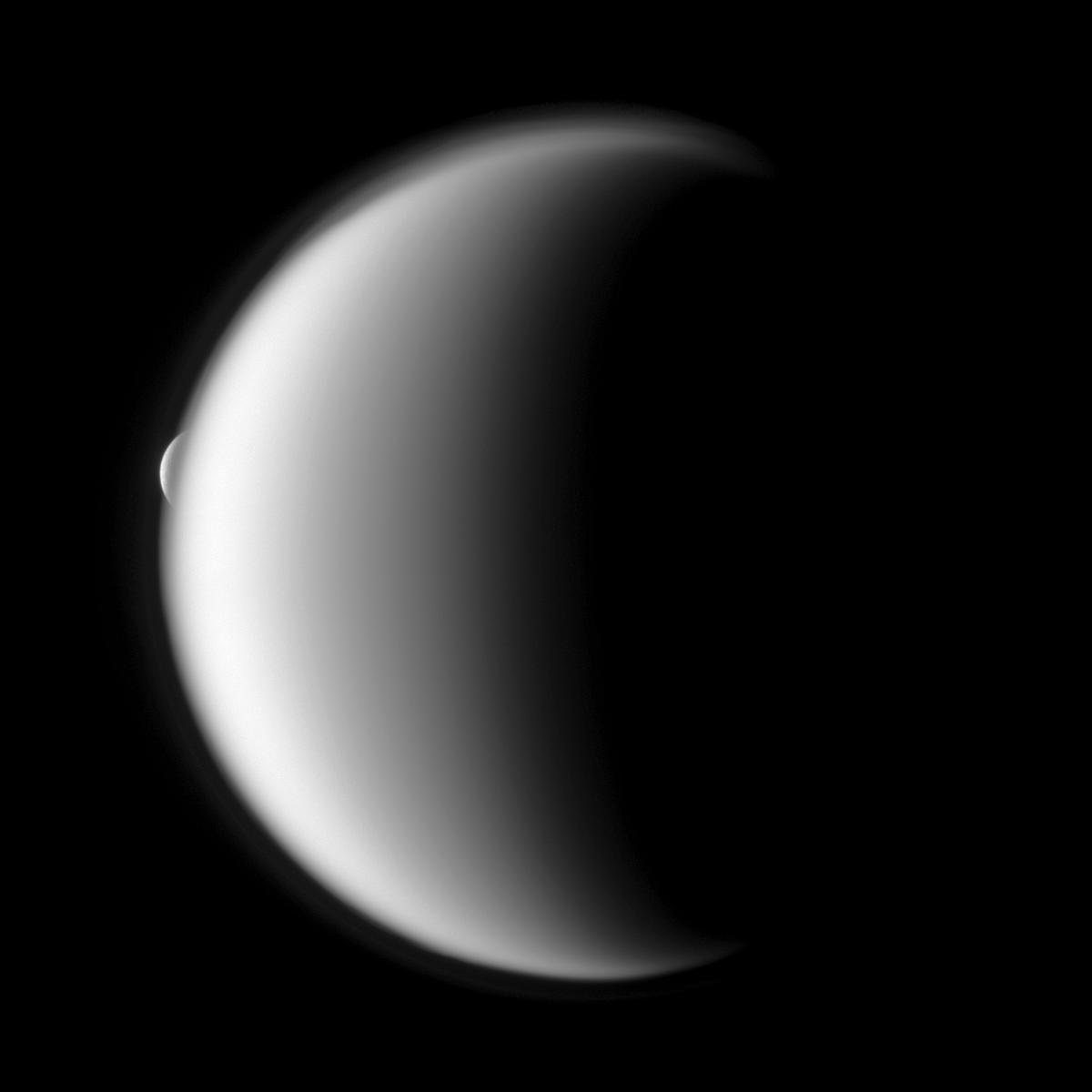
On October 27, 2009, NASA’s Cassini spacecraft orbiting around Saturn captured this view of Saturn's moon Rhea as it began to emerge after being hidden by Saturn's largest moon Titan during an occultation. An occultation is a celestial event in which one object moves in front of another and temporarily blocks the first object from view.
In this image, Titan — about 5,150 km across — was closer to the spacecraft at about 1 million km, while Rhea — roughly 1,528 km in diameter — was farther away at about 2.3 million km. Titan’s high-altitude atmospheric haze is visible as a faint glow around its limb, showing the difference in surface and atmospheric properties between these two moons.
Scientists study occultations like this because watching how one moon disappears behind or reappears from another helps refine our understanding of their orbits and physical characteristics.
Desplázate hasta los subtítulos en otros idiomas
Crédito de la imagen: NASA/JPL/Space Science Institute Enlace del crédito
Términos relacionados del glosario:
Lunas
, Ocultación
, Titán
Licencia de la imagen: Dominio público Dominio público íconos
Las descripciones de los archivos multimedia que aparecen en la página web de la OAE han sido redactadas, traducidas y revisadas gracias al esfuerzo conjunto de la OAE y los Centros y Nodos de la OAE, los Coordinadores Nacionales de Educación Astronómica (NAECs) y otros voluntarios. Puedes consultar la lista completa de los créditos de nuestro proyecto de traducción aquí. Todos los pies de foto de los archivos multimedia se publican bajo una Creative Commons CC BY-4.0 licencia y deben atribuirse a la "IAU OAE". Los propios archivos multimedia pueden tener diferentes licencias (véase más arriba) y deben citarse tal y como se indica en "credit".
Pies de foto en diferentes idiomas:
Pie de foto: Am 27. Oktober 2009 nahm die Cassini-Sonde der NASA, die den Saturn umkreist, diese Aufnahme des Saturnmondes Rhea auf, als er wieder sichtbar wurde, nachdem er während einer Okkultation vom größten Saturnmond Titan verdeckt worden war. Eine Okkultation ist ein astronomisches Ereignis, bei dem sich ein Himmelskörper vor einen anderen bewegt und diesen für einen Beobachter vorübergehend verdeckt.
Auf diesem Bild befand sich Titan – mit einem Durchmesser von etwa 5.150 km – mit einer Entfernung von etwa 1 Million km näher an der Sonde, während Rhea – mit einem Durchmesser von ungefähr 1.528 km – mit etwa 2,3 Millionen km weiter von der Sonde entfernt war. Der in großer Höhe über Titan auftretende atmosphärische Dunst ist als schwaches Leuchten um seinen Rand herum sichtbar und verdeutlicht den Unterschied in den Oberflächen- und Atmosphärenmerkmalen dieser beiden Monde.
Wissenschaftler untersuchen Okkultationen wie diese, da Beobachtungen, wie ein Mond hinter einem anderen verschwindet oder wieder hervorkommt, dazu beitragen, unser Verständnis ihrer Umlaufbahnen und physikalischen Eigenschaften zu verfeinern.
Crédito de la imagen: NASA/JPL/Space Science Institute
Términos relacionados del glosario: Bedeckung , Monde , Titan Estado de la traducción de los subtítulos: Aún no ha sido aprobado por un revisor o revisora
Traductores de las leyendas: Simon Kraus
Pie de foto: On October 27, 2009, NASA’s Cassini spacecraft orbiting around Saturn captured this view of Saturn's moon Rhea as it began to emerge after being hidden by Saturn's largest moon Titan during an occultation. An occultation is a celestial event in which one object moves in front of another and temporarily blocks the first object from view.
In this image, Titan — about 5,150 km across — was closer to the spacecraft at about 1 million km, while Rhea — roughly 1,528 km in diameter — was farther away at about 2.3 million km. Titan’s high-altitude atmospheric haze is visible as a faint glow around its limb, showing the difference in surface and atmospheric properties between these two moons.
Scientists study occultations like this because watching how one moon disappears behind or reappears from another helps refine our understanding of their orbits and physical characteristics.
Crédito de la imagen: NASA/JPL/Space Science Institute
Términos relacionados del glosario: Moons , Occultation , Titan
Pie de foto: Il 27 ottobre 2009, la sonda Cassini della NASA, in orbita attorno a Saturno, ha immortalato questa immagine della luna di Saturno, Rea, mentre iniziava a riemergere dopo essere stata nascosta da Titano, la luna più grande di Saturno, durante un’occultazione. Un’occultazione è un evento celeste in cui un oggetto si sposta davanti a un altro, nascondendolo temporaneamente alla vista.
In questa immagine, Titano — con un diametro di circa 5.150 km — era più vicino alla sonda, a circa 1 milione di km, mentre Rea — con un diametro di circa 1.528 km — era più lontana, a circa 2,3 milioni di km. La foschia atmosferica ad alta quota di Titano è visibile come un debole bagliore attorno al suo bordo, evidenziando la differenza nelle proprietà della superficie e dell’atmosfera tra queste due lune.
Gli scienziati studiano occultazioni come questa perché osservare come una luna scompaia dietro un’altra o riappaia da dietro di essa aiuta ad affinare la nostra comprensione delle loro orbite e delle loro caratteristiche fisiche.
Crédito de la imagen: NASA/JPL/Space Science Institute
Términos relacionados del glosario: Lune , occultazione , Titano Estado de la traducción de los subtítulos: Aún no ha sido aprobado por un revisor o revisora
Traductores de las leyendas: Giuliana Giobbi