This page describes an image The discovery of positron
Descargar archivo ( imagen 3.12 MB)
Pie de foto:
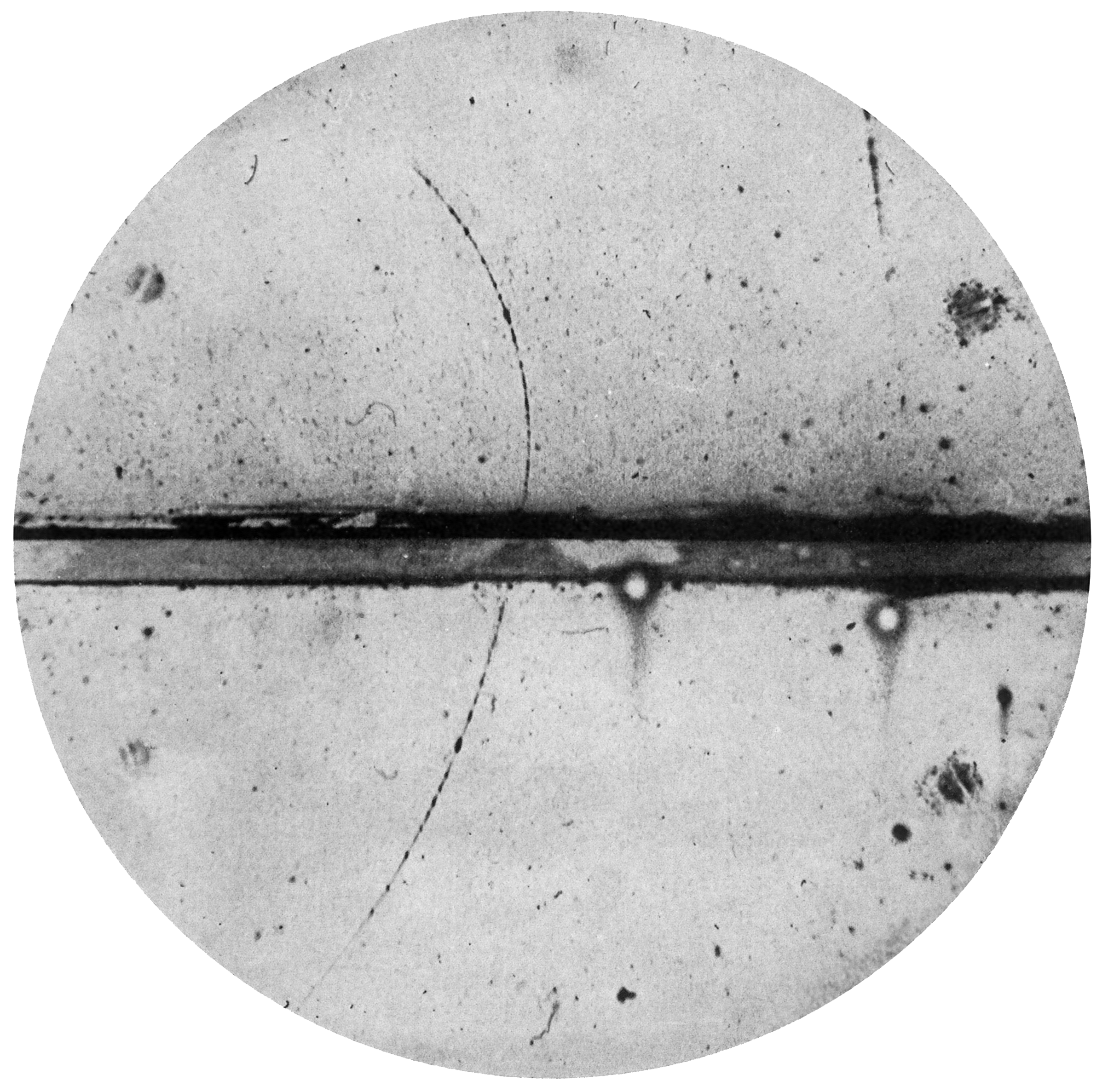
This historic photograph shows the track of a positron moving through a cloud chamber from bottom to top. When a charged particle moves through a cloud chamber it leaves behind a line of condensation, making its path visible. Cloud chambers are normally build with magnetic fields. This curves the path of the charged particle, with the curve of the path giving more information about the properties of the particle.
Here we see the first positron (the antiparticle of an electron). A thick horizontal band in the middle is a lead plate in the cloud chamber that slowed the particle down, causing the positron's path to curve more sharply after crossing the plate. This image, taken in 1932, provided the first clear visual evidence of the positron.
The discovery of the positron confirmed that antimatter exists and opened an important field of research in modern physics.
Desplázate hasta los subtítulos en otros idiomas
Crédito de la imagen: Carl D. Anderson Enlace del crédito
Términos relacionados del glosario:
Antimateria
Licencia de la imagen: Dominio público Dominio público íconos
Las descripciones de los archivos multimedia que aparecen en la página web de la OAE han sido redactadas, traducidas y revisadas gracias al esfuerzo conjunto de la OAE y los Centros y Nodos de la OAE, los Coordinadores Nacionales de Educación Astronómica (NAECs) y otros voluntarios. Puedes consultar la lista completa de los créditos de nuestro proyecto de traducción aquí. Todos los pies de foto de los archivos multimedia se publican bajo una Creative Commons CC BY-4.0 licencia y deben atribuirse a la "IAU OAE". Los propios archivos multimedia pueden tener diferentes licencias (véase más arriba) y deben citarse tal y como se indica en "credit".
Pies de foto en diferentes idiomas:
Pie de foto: Dieses historische Foto zeigt die Spur eines Positrons, das sich von unten nach oben durch eine Nebelkammer bewegt. Wenn sich ein geladenes Teilchen durch eine Nebelkammer bewegt, hinterlässt es eine Kondensationsspur, die seinen Weg sichtbar macht. Nebelkammern verfügen in der Regel über ein Magnetfeld. Diese krümmen die Bahn des geladenen Teilchens, wobei die Krümmung der Bahn weitere Informationen über die Eigenschaften des Teilchens liefert.
Hier sehen wir den ersten Nachweis eines Positrons (das Antiteilchen des Elektrons). Das breite horizontales Band in der Mitte ist eine Bleiplatte in der Nebelkammer, die das Teilchen abgebremst hat, wodurch sich die Bahn des Positrons nach dem Passieren der Platte stärker krümmt. Dieses 1932 aufgenommene Bild lieferte den ersten eindeutigen visuellen Beweis für die Existenz des Positrons.
Die Entdeckung des Positrons bestätigte die Existenz von Antimaterie und eröffnete damit ein wichtiges Forschungsgebiet der modernen Physik.
Crédito de la imagen: Carl D. Anderson
Términos relacionados del glosario: Antimaterie Estado de la traducción de los subtítulos: Aún no ha sido aprobado por un revisor o revisora
Traductores de las leyendas: Simon Kraus
Pie de foto: This historic photograph shows the track of a positron moving through a cloud chamber from bottom to top. When a charged particle moves through a cloud chamber it leaves behind a line of condensation, making its path visible. Cloud chambers are normally build with magnetic fields. This curves the path of the charged particle, with the curve of the path giving more information about the properties of the particle.
Here we see the first positron (the antiparticle of an electron). A thick horizontal band in the middle is a lead plate in the cloud chamber that slowed the particle down, causing the positron's path to curve more sharply after crossing the plate. This image, taken in 1932, provided the first clear visual evidence of the positron.
The discovery of the positron confirmed that antimatter exists and opened an important field of research in modern physics.
Crédito de la imagen: Carl D. Anderson
Términos relacionados del glosario: Antimatter
Pie de foto: Questa fotografia storica mostra la traccia di un positrone che attraversa una camera a nebbia dal basso verso l’alto. Quando una particella carica attraversa una camera a nebbia, lascia dietro di sé una scia di condensazione che ne rende visibile il percorso. Le camere a nebbia sono solitamente dotate di campi magnetici. Questi curvano il percorso della particella carica e la curvatura del percorso fornisce ulteriori informazioni sulle proprietà della particella.
Qui vediamo il primo positrone (l’antiparticella dell’elettrone). Una spessa banda orizzontale al centro è una lastra di piombo presente nella camera a nebbia che ha rallentato la particella, facendo sì che il percorso del positrone si curvi più bruscamente dopo aver attraversato la lastra. Questa immagine, scattata nel 1932, ha fornito la prima chiara prova visiva dell’esistenza del positrone.
La scoperta del positrone ha confermato l’esistenza dell’antimateria e ha aperto un importante campo di ricerca nella fisica moderna.
Crédito de la imagen: Carl D. Anderson
Términos relacionados del glosario: Antimateria Estado de la traducción de los subtítulos: Aún no ha sido aprobado por un revisor o revisora
Traductores de las leyendas: Giuliana Giobbi