Término del glosario: Remanente de supernova
Descripción: Un remanente de supernova es la estructura que queda tras la explosión de una supernova. Consiste en una enorme estructura de gas caliente y plasma creada por la onda de choque de la supernova. En muchos remanentes de supernova también está presente el agujero negro o la estrella de neutrones que se formó a partir de la estrella que explotó en la supernova, aunque en algunos casos este ha sido expulsado por la fuerza de la explosión.
La energía explosiva de una supernova da lugar a una onda de choque que impacta contra el gas interestelar circundante. Esta onda de choque calienta e ioniza el gas circundante hasta alcanzar temperaturas extremadamente altas (más de un millón de kelvin). Este gas caliente emite luz en diversas longitudes de onda, siendo además una fuente importante de rayos X. La onda de choque también acelera las partículas a altas velocidades, lo que convierte a los restos de supernova en una fuente importante de rayos cósmicos.
Al observar la velocidad a la que se expande un remanente de supernova, los astrónomos pueden estimar cuánto tiempo habría tardado en alcanzar su tamaño actual. Esto les permite determinar aproximadamente cuándo explotó la supernova. Varios remanentes de supernova de gran tamaño en la Vía Láctea se han datado de esta manera y se han relacionado con supernovas que fueron observadas por los astrónomos hace cientos de años.
Términos relacionados:
Ver este término en otros idiomas
Estado del término y la definición: La definición original de este término en inglés ha sido aprobada por unastrónomo o astrónoma investigadora y un docente La traducción de este término y su definición aún están pendientes de aprobación
El Glosario multilingüe de la OAE es un proyecto de la Oficina de Astronomía para la Educación de la UAI (OAE) en colaboración con la Oficina de Divulgación de Astronomía de la UAI (OAO). Los términos y definiciones fueron seleccionados, redactados y revisados gracias al esfuerzo colectivo de la OAE, los Centros y Nodos de la OAE, los Coordinadores Nacionales de Educación Astronómica (NAECs) y otros voluntarios. Puedes encontrar una lista completa de créditos aquí. Todos los términos del glosario y sus definiciones se publican bajo la licencia Creative Commons CC BY-4.0 y deben atribuirse a la "IAU OAE".
Si detectas algún error de contenido o de traducción en este término del glosario o en ladefinición, ponte en contacto con nosotros.
En otros idiomas
- Árabe: بقايا المستعر الأعظم
- Alemán: Supernova-Überrest
- Inglés: Supernova Remnant
- Francés: Rémanent de supernova
- Italiano: Resto di Supernova
- Japonés: 超新星残骸 (enlace externo)
- Coreano: 초신성잔해
- Portugués de Brasil: Remanescente de supernova
- Chino simplificado: 超新星遗迹
- Chino tradicional: 超新星遺跡
Contenidos relacionados

Remnant of SN 1006
Pie de foto: This image shows the remnant of the supernova SN 1006. This was probably the result of a white dwarf that accreted so much material from a binary companion star that the white dwarf exploded (this is called a Type 1a supernova by astronomers). This explosion happened several thousand years ago, however it took time for the light from this event to reach Earth, only arriving in the year 1006. This bright explosion was noticed by observers across the Earth and its appearance was noted in the records of many different societies.
Here we see the effect that supernova has had on its surroundings in the galaxy. The force of the explosion has blown a huge bubble in the surrounding interstellar gas with a hot shockwave at its edge. The image appears to be a simple color picture but it actually represents light far beyond what our eye can see. The blue is X-ray data from NASA's Chandra X-ray Observatory, the yellow and orange are data from optical telescopes and the red is detections in radio waves from the Very Large Array and the Green Bank Telescope. The bright blue of the outer shell shows the gas there is very hot and that the explosion produced energetic shock waves.
Crédito: X-ray: NASA/CXC/Rutgers/G.Cassam-Chenai, Hughes et al.; Radio: NRAO/AUI/NSF/GBT/VLA/Dyer, Maddalena & Cornwell; Optical: Middlebury College/F.Winkler, NOAO/AURA/NSF/CTIO Schmidt & DSS
enlace de crédito
License: PD Dominio público íconos

The Crab Nebula
Pie de foto: The Crab Nebula is situated 6500 light years away in the constellation Taurus. This is remnant of a supernova explosion caused by a massive star at the end of its life. This happened several thousand years ago but the light from this explosion only reached the Earth in the year 1054. This celestial event was viewed by people across the world with many different societies noting it in their records.
The force of the supernova explosion has pushed pushed the outer layers of the star out into the surrounding gas. Here we see this as the bubbly orange structure as the force of the explosions ploughs into the surrounding gas. At its heart lies the Crab Nebula Pulsar, a neutron star that is the remains of the exploded star. This neutron star has a strong magnetic field. Electrons in nebula dance in this magnetic field, emitting the diffuse blue light we see inside the orange bubble.
Crédito: NASA, ESA, J. Hester and A. Loll (Arizona State University)
enlace de crédito
License: PD Dominio público íconos
Diagramas relacionados
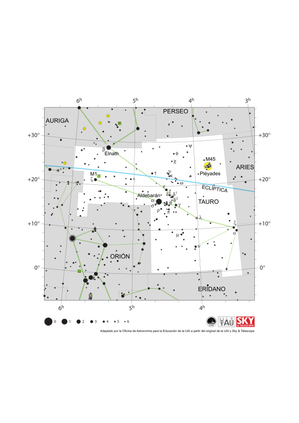
Mapa de la constelación de Tauro
Pie de foto: La constelación de Tauro junto con sus estrellas brillantes y las constelaciones circundantes. Tauro está rodeada por (en el sentido de las agujas del reloj desde arriba) Perseo, Aries, Cetus, Erídano, Orión, Géminis y Auriga. La estrella más brillante de Tauro, Aldebarán, aparece en el centro de la constelación. Tauro se encuentra en la eclíptica (mostrada aquí como una línea azul), que es la trayectoria que el Sol parece seguir a través del cielo en el transcurso de un año. El Sol está en Tauro desde mediados de mayo hasta finales de junio. Los demás planetas del Sistema Solar se encuentran a menudo en Tauro.
Tauro se encuentra principalmente al norte del ecuador celeste, con una pequeña parte en el hemisferio sur celeste. Toda la constelación es visible en algún momento del año para todo el planeta excepto la Antártida y una pequeña región alrededor del Polo Norte. Tauro es más visible por las tardes en invierno en el hemisferio norte y en verano en el hemisferio sur.
En la parte oriental de Tauro podemos encontrar el remanente de supernova M1 (comúnmente conocido como la Nebulosa del Cangrejo), marcado aquí con un cuadrado verde. En el noreste de Tauro se encuentra uno de los cúmulos abiertos de estrellas más famosos del cielo, M45 (las Pléyades), marcado aquí con un círculo amarillo. Muchas de las estrellas cercanas a Aldebarán (pero no Aldebarán) son miembros de otro cúmulo estelar, las Híades. Sin embargo, este cúmulo se encuentra cerca del Sistema Solar, por lo que está demasiado disperso en el cielo como para tener una designación de objeto Messier como la que tienen las Pléyades.
El eje-y de este diagrama está en grados de declinación con el norte hacia arriba y el eje-x está en horas de ascensión recta con el este a la izquierda. El tamaño de las estrellas marcadas aquí está relacionado con la magnitud aparente de la estrella, una medida de su brillo aparente. Los puntos más grandes representan estrellas más brillantes. Las letras griegas indican las estrellas más brillantes de la constelación. Están ordenadas según su brillo: la estrella más brillante se denomina alfa, la segunda más brillante beta, etc., aunque este orden no siempre se sigue con exactitud. Las líneas punteadas marcan los límites de las constelaciones según la UAI y las líneas verdes continuas marcan una de las formas habituales utilizadas para representar las figuras de las constelaciones. Ni los límites de las constelaciones, ni la línea que marca la eclíptica, ni las líneas que unen las estrellas aparecen en el cielo.
Crédito: Adaptado por la Oficina de Astronomía para la Educación de la UAI a partir del original de UAI/Sky & Telescope
License: CC-BY-4.0 Creative Commons Reconocimiento 4.0 Internacional (CC BY 4.0) íconos
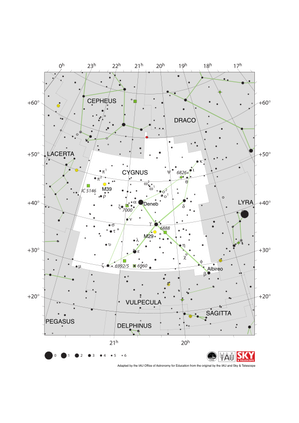
Cygnus Constellation Map
Pie de foto: The constellation Cygnus with its bright stars and surrounding constellations. Cygnus is surrounded by (going clockwise from the top): Cepheus, Draco, Lyra, Vulpecula, Pegasus and Lacerta. Cygnus is notable for its brightest star Deneb. This forms one vertex of the prominent Summer Triangle asterism that is visible in northern hemisphere summer evenings.
Cygnus is a northern constellation and thus the whole of the constellation is visible at some point in the year in the whole northern hemisphere. The whole constellation is also visible from equatorial regions of the southern hemisphere with parts of the constellation visible from temperate southern regions.
The plane of the Milky Way runs through Cygnus and thus the constellation is rich in nebulae and star clusters. These include the North America Nebula (NGC 7000) and the Crescent Nebula (NGC 6888). The Veil Nebula is a huge supernova remnant, parts of which are marked here as NGC 6960 and NGC 6992/5. All of the previously-mentioned nebulae are marked with green squares. The planetary nebula NGC 6826 is marked here with a green circle superimposed on a plus sign. The open star clusters M29 and M39 are marked here with yellow circles.
The y-axis of this diagram is in degrees of declination with north as up and the x-axis is in hours of right ascension with east to the left. The sizes of the stars marked here relate to the star's apparent magnitude, a measure of its apparent brightness. The larger dots represent brighter stars. The Greek letters mark the brightest stars in the constellation. These are ranked by brightness with the brightest star being labeled alpha, the second brightest beta, etc., although this ordering is not always followed exactly. The dotted boundary lines mark the IAU's boundaries of the constellations and the solid green lines mark one of the common forms used to represent the figures of the constellations. Neither the constellation boundaries, nor the lines joining the stars appear on the sky.
Crédito: Adapted by the IAU Office of Astronomy for Education from the original by the IAU and Sky & Telescope
License: CC-BY-4.0 Creative Commons Reconocimiento 4.0 Internacional (CC BY 4.0) íconos