Glossary term: 초신성잔해
Description: 초신성 잔해는 초신성 폭발 후에 남은 구조물을 말합니다. 이 잔해는 초신성의 강력한 충격파로 만들어진 뜨거운 가스와 플라즈마로 이루어진 거대한 구조입니다. 많은 초신성 잔해에는 폭발을 일으킨 별의 중심에 남은 블랙홀이나 중성자별이 함께 존재하지만, 어떤 경우에는 폭발의 힘으로 이들이 주변으로 튕겨 나가기도 합니다.
초신성의 폭발은 엄청난 에너지를 내며, 주변의 성간 가스에 강한 충격파를 일으킵니다. 이 충격은 주변 가스를 백만 켈빈(K)이 넘는 매우 높은 온도로 가열하고 이온화시킵니다. 이렇게 뜨거워진 가스는 여러 파장의 빛을 방출하는데, 그중 일부는 엑스선(X-ray) 형태로 나타나 엑스선의 주요 근원이 됩니다. 또한 충격파는 입자들을 빠른 속도로 가속시켜, 초신성 잔해를 우주선(cosmic rays)의 중요한 원천으로 만듭니다.
천문학자들은 초신성 잔해가 얼마나 빠르게 팽창하는지를 관측함으로써, 그 잔해가 지금의 크기에 이르는 데 걸린 시간을 추정할 수 있습니다. 이를 통해 초신성이 언제 폭발했는지 대략적인 시기를 알 수 있습니다. 우리 은하수(Milky Way) 안에 있는 몇몇 큰 초신성 잔해들은 이런 방법으로 연대가 측정되었으며, 수백 년 전 천문학자들이 실제로 관측했던 초신성 폭발 기록과 연결되었습니다.
Related Terms:
See this term in other languages
Term and definition status: The original definition of this term in English have been approved by a research astronomer and a teacher The translation of this term and its definition is still awaiting approval
The OAE Multilingual Glossary is a project of the IAU Office of Astronomy for Education (OAE) in collaboration with the IAU Office of Astronomy Outreach (OAO). The terms and definitions were chosen, written and reviewed by a collective effort from the OAE, the OAE Centers and Nodes, the OAE National Astronomy Education Coordinators (NAECs) and other volunteers. You can find a full list of credits here. All glossary terms and their definitions are released under a Creative Commons CC BY-4.0 license and should be credited to "IAU OAE".
If you notice a factual or translation error in this glossary term or definition then please get in touch.
In Other Languages
- 아랍어: بقايا المستعر الأعظم
- 독일어: Supernova-Überrest
- 영어: Supernova Remnant
- 스페인어: Remanente de supernova
- 프랑스어: Rémanent de supernova
- 이탈리아어: Resto di Supernova
- 일본어: 超新星残骸 (external link)
- 브라질 포르투갈어: Remanescente de supernova
- 중국어 간체: 超新星遗迹
- 중국어 번체: 超新星遺跡
Related Media

Remnant of SN 1006
Caption: This image shows the remnant of the supernova SN 1006. This was probably the result of a white dwarf that accreted so much material from a binary companion star that the white dwarf exploded (this is called a Type 1a supernova by astronomers). This explosion happened several thousand years ago, however it took time for the light from this event to reach Earth, only arriving in the year 1006. This bright explosion was noticed by observers across the Earth and its appearance was noted in the records of many different societies.
Here we see the effect that supernova has had on its surroundings in the galaxy. The force of the explosion has blown a huge bubble in the surrounding interstellar gas with a hot shockwave at its edge. The image appears to be a simple color picture but it actually represents light far beyond what our eye can see. The blue is X-ray data from NASA's Chandra X-ray Observatory, the yellow and orange are data from optical telescopes and the red is detections in radio waves from the Very Large Array and the Green Bank Telescope. The bright blue of the outer shell shows the gas there is very hot and that the explosion produced energetic shock waves.
Credit: X-ray: NASA/CXC/Rutgers/G.Cassam-Chenai, Hughes et al.; Radio: NRAO/AUI/NSF/GBT/VLA/Dyer, Maddalena & Cornwell; Optical: Middlebury College/F.Winkler, NOAO/AURA/NSF/CTIO Schmidt & DSS
credit link
License: PD Public Domain icons

The Crab Nebula
Caption: The Crab Nebula is situated 6500 light years away in the constellation Taurus. This is remnant of a supernova explosion caused by a massive star at the end of its life. This happened several thousand years ago but the light from this explosion only reached the Earth in the year 1054. This celestial event was viewed by people across the world with many different societies noting it in their records.
The force of the supernova explosion has pushed pushed the outer layers of the star out into the surrounding gas. Here we see this as the bubbly orange structure as the force of the explosions ploughs into the surrounding gas. At its heart lies the Crab Nebula Pulsar, a neutron star that is the remains of the exploded star. This neutron star has a strong magnetic field. Electrons in nebula dance in this magnetic field, emitting the diffuse blue light we see inside the orange bubble.
Credit: NASA, ESA, J. Hester and A. Loll (Arizona State University)
credit link
License: PD Public Domain icons
Related Diagrams
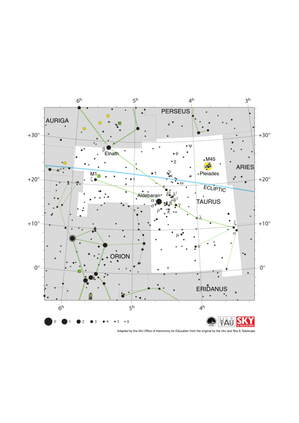
Taurus Constellation Map
Caption: The constellation Taurus along with its bright stars and surrounding constellations. Taurus is surrounded by (going clockwise from the top) Perseus, Aries, Cetus, Eridanus, Orion, Gemini and Auriga. Taurus’s brightest star Aldebaran appears in the middle of the constellation. Taurus lies on the ecliptic (shown here as a blue line), this is the path the Sun appears to take across the sky over the course of a year. The Sun is in Taurus from mid May to late June. The other planets of the Solar System can often be found in Taurus.
Taurus lies mostly north of the celestial equator with a small part in the celestial southern hemisphere. The whole constellation is visible at some point in the year to whole planet except for the Antarctic and a small region around the North Pole. Taurus is most visible in the evenings in the northern hemisphere winter and southern hemisphere summer.
In the eastern part of Taurus we can find the supernova remnant M1 (commonly known as the Crab Nebula), marked here with a green square. In Taurus’s north-east find one of the sky’s most famous open stars clusters M45 (the Pleiades), marked here with a yellow circle. Many of the stars near Aldebaran (but not) Aldebaran are members of another star cluster, the Hyades. However this cluster is close to the solar system so is too dispersed on the sky to have a Messier object designation like the Pleiades has.
The y-axis of this diagram is in degrees of declination with north as up and the x-axis is in hours of right ascension with east to the left. The sizes of the stars marked here relate to the star's apparent magnitude, a measure of its apparent brightness. The larger dots represent brighter stars. The Greek letters mark the brightest stars in the constellation. These are ranked by brightness with the brightest star being labeled alpha, the second brightest beta, etc., although this ordering is not always followed exactly. The dotted boundary lines mark the IAU's boundaries of the constellations and the solid green lines mark one of the common forms used to represent the figures of the constellations. Neither the constellation boundaries, nor the line marking the ecliptic, nor the lines joining the stars appear on the sky.
Credit: Adapted by the IAU Office of Astronomy for Education from the original by IAU/Sky & Telescope
License: CC-BY-4.0 Creative Commons 저작자표시 4.0 국제 (CC BY 4.0) icons
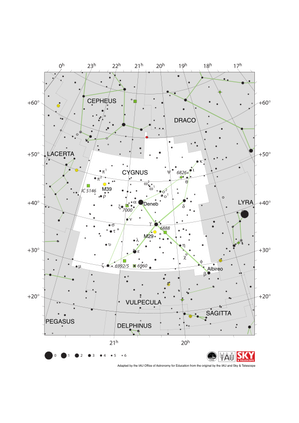
Cygnus Constellation Map
Caption: The constellation Cygnus with its bright stars and surrounding constellations. Cygnus is surrounded by (going clockwise from the top): Cepheus, Draco, Lyra, Vulpecula, Pegasus and Lacerta. Cygnus is notable for its brightest star Deneb. This forms one vertex of the prominent Summer Triangle asterism that is visible in northern hemisphere summer evenings.
Cygnus is a northern constellation and thus the whole of the constellation is visible at some point in the year in the whole northern hemisphere. The whole constellation is also visible from equatorial regions of the southern hemisphere with parts of the constellation visible from temperate southern regions.
The plane of the Milky Way runs through Cygnus and thus the constellation is rich in nebulae and star clusters. These include the North America Nebula (NGC 7000) and the Crescent Nebula (NGC 6888). The Veil Nebula is a huge supernova remnant, parts of which are marked here as NGC 6960 and NGC 6992/5. All of the previously-mentioned nebulae are marked with green squares. The planetary nebula NGC 6826 is marked here with a green circle superimposed on a plus sign. The open star clusters M29 and M39 are marked here with yellow circles.
The y-axis of this diagram is in degrees of declination with north as up and the x-axis is in hours of right ascension with east to the left. The sizes of the stars marked here relate to the star's apparent magnitude, a measure of its apparent brightness. The larger dots represent brighter stars. The Greek letters mark the brightest stars in the constellation. These are ranked by brightness with the brightest star being labeled alpha, the second brightest beta, etc., although this ordering is not always followed exactly. The dotted boundary lines mark the IAU's boundaries of the constellations and the solid green lines mark one of the common forms used to represent the figures of the constellations. Neither the constellation boundaries, nor the lines joining the stars appear on the sky.
Credit: Adapted by the IAU Office of Astronomy for Education from the original by the IAU and Sky & Telescope
License: CC-BY-4.0 Creative Commons 저작자표시 4.0 국제 (CC BY 4.0) icons