Término del glosario: Desplazamiento al rojo
Descripción: Este término puede referirse a tres efectos diferentes: el desplazamiento al rojo Doppler, el cosmológico o el gravitacional. El desplazamiento al rojo Doppler es lo contrario del desplazamiento al azul; en el caso del desplazamiento al rojo, la fuente que emite la radiación electromagnética se aleja del observador, por lo que la longitud de onda de la radiación electromagnética se alarga hacia longitudes de onda más largas (más rojizas). Esto es similar al efecto Doppler en el contexto de las ondas sonoras. El desplazamiento al rojo cosmológico es el resultado de que la radiación electromagnética emitida por una fuente se alarga a longitudes de onda mayores debido a la expansión física del espacio, a diferencia del desplazamiento al rojo Doppler, que se debe al movimiento relativo. El desplazamiento al rojo gravitacional se refiere al efecto por el cual la longitud de onda de la radiación electromagnética emitida por una fuente se alarga a longitudes de onda mayores, o más bien los fotones asociados pierden energía al intentar salir de una región (pozo gravitacional) donde la gravedad es más fuerte.
Términos relacionados:
Ver este término en otros idiomas
Estado del término y la definición: La definición original de este término en inglés ha sido aprobada por unastrónomo o astrónoma investigadora y un docente La traducción de este término y su definición aún están pendientes de aprobación
El Glosario multilingüe de la OAE es un proyecto de la Oficina de Astronomía para la Educación de la UAI (OAE) en colaboración con la Oficina de Divulgación de Astronomía de la UAI (OAO). Los términos y definiciones fueron seleccionados, redactados y revisados gracias al esfuerzo colectivo de la OAE, los Centros y Nodos de la OAE, los Coordinadores Nacionales de Educación Astronómica (NAECs) y otros voluntarios. Puedes encontrar una lista completa de créditos aquí. Todos los términos del glosario y sus definiciones se publican bajo la licencia Creative Commons CC BY-4.0 y deben atribuirse a la "IAU OAE".
Si detectas algún error de contenido o de traducción en este término del glosario o en ladefinición, ponte en contacto con nosotros.
En otros idiomas
- Árabe: الانزياح الأحمر
- Alemán: Rotverschiebung
- Inglés: Redshift
- Francés: Décalage vers le rouge
- Italiano: redshift
- Japonés: 赤方偏移 (enlace externo)
- Portugués de Brasil: Desvio para o vermelho
- Chino simplificado: 红移
- Chino tradicional: 紅移
Contenidos relacionados
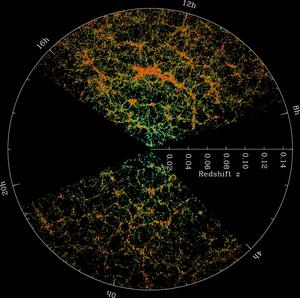
SDSS Redshift Map
Pie de foto: This image shows a map of the distribution of galaxies and is based on redshift data from the Sloan Digital Sky Survey (SDSS). Redshift measurements provides information on the distances, positions and motions of the galaxies.
The Earth is located at the center of the image, and each dot represents a galaxy. The outer circle represents a ""distance"" of about 2 billion light years. The idea of distance in cosmology is complex because the usual measurement of distance is the separation between two points in space at the same time. However, because of the speed of light, the further a distance, the farther back in time we are observing. The numbers on the outer circle are Right Ascension coordinates mapped onto a flat circle, and provides information on the position of the galaxies on the sky. The colours used represent the ages of the stars in the galaxies, the redder, more strongly clustered points represent galaxies comprising of older stars. The dark wedges that do not contain any dots are regions that were not mapped by the SDSS due to dust from the Milky Way galaxy obscuring the view.
Crédito: M. Blanton and Sloan Digital Sky Survey
enlace de crédito
License: CC-BY-4.0 Creative Commons Reconocimiento 4.0 Internacional (CC BY 4.0) íconos