Término del glosario: Meteoroide
Descripción: Un meteoroide es un fragmento de un asteroide o un cometa cuyo tamaño oscila entre unos pocos milímetros y varias decenas de metros. Los meteoroides pueden caer hacia cualquier cuerpo celeste, con o sin atmósfera, a una velocidad muy elevada. Si el cuerpo celeste tiene atmósfera, el meteoroide se frena al chocar con las moléculas atmosféricas. Observamos los meteoroides en la atmósfera terrestre como meteoros. Si el meteoroide no se destruye por completo en la atmósfera (o si el cuerpo celeste carece de atmósfera), cae a la superficie de dicho cuerpo, y entonces se denomina meteorito.
Términos relacionados:
Ver este término en otros idiomas
Estado del término y la definición: La definición original de este término en inglés ha sido aprobada por unastrónomo o astrónoma investigadora y un docente La traducción de este término y su definición aún están pendientes de aprobación
El Glosario multilingüe de la OAE es un proyecto de la Oficina de Astronomía para la Educación de la UAI (OAE) en colaboración con la Oficina de Divulgación de Astronomía de la UAI (OAO). Los términos y definiciones fueron seleccionados, redactados y revisados gracias al esfuerzo colectivo de la OAE, los Centros y Nodos de la OAE, los Coordinadores Nacionales de Educación Astronómica (NAECs) y otros voluntarios. Puedes encontrar una lista completa de créditos aquí. Todos los términos del glosario y sus definiciones se publican bajo la licencia Creative Commons CC BY-4.0 y deben atribuirse a la "IAU OAE".
Si detectas algún error de contenido o de traducción en este término del glosario o en ladefinición, ponte en contacto con nosotros.
En otros idiomas
- Árabe: نيزك
- Alemán: Meteoroid
- Inglés: Meteoroid
- Francés: Météoroïde
- Italiano: Meteoroide
- Japonés: 流星物質 (enlace externo)
- Coreano: 유성체
- Portugués de Brasil: Meteoroide
- Chino simplificado: 流星体
- Chino tradicional: 流星體
Contenidos relacionados
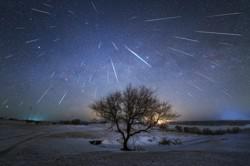
Geminid Meteor Shower from China, by Dai Jianfeng, China
Pie de foto: First place in the 2021 IAU OAE Astrophotography Contest, category Meteor showers.
A meteor shower occurs when the Earth in its orbit around the Sun, passes through a debris trail left previously by a comet on its approach around the Sun. As the Earth enters this debris (small sand grain sized), they enter the atmosphere at high speeds and on parallel trajectories, burning completely leaving beautiful tracks (streaks) in the sky. These streaks can appear and disappear in the blink of an eye, or last much longer. On rare occasions the debris originates from asteroids, as in the case of the Geminid meteor shower, shown in this image, picturing many streaks of debris captured in the sky of China in 2017. Due to relative motions and perspective, the shower appears to come from one single point, known as the radiant point, beautifully pictured in this image. This is similar to driving in a car on a rainy day without any wind, looking out the front window it seems that the rain is coming directly towards the window, when in fact the rain is falling vertically downwards.
Crédito: Dai Jianfeng/IAU OAE
License: CC-BY-4.0 Creative Commons Reconocimiento 4.0 Internacional (CC BY 4.0) íconos
Actividades relacionadas
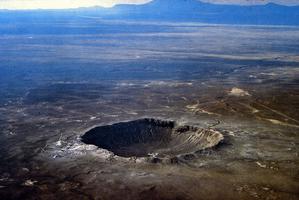
Meteoroids, Meteors and Meteorites
astroEDU educational activity (links to astroEDU website) Description: Unveiling the mystery of "shooting stars": meteors, meteorites and meteroids
License: CC-BY-4.0 Creative Commons Reconocimiento 4.0 Internacional (CC BY 4.0) íconos
Etiquetas:
Geology
Rango de edades:
6-8
, 8-10
, 10-12
, 12-14
Nivel educativo:
Educación secundaria
, Primaria
Áreas de aprendizaje:
Clase interactiva
Costos:
Bajo coste
Duración:
1 hora y 30 minutos
Tamaño del grupo:
Grupo
Competencias:
Analizar e interpretar datos
, Plantear preguntas
, Comunicar información
, Participar en debates basados en pruebas