Glossary term: Meteoroid
Description: A meteoroid is a fragment of an asteroid or comet with a size ranging from a few millimeters to several tens of meters. Meteoroids can fall towards any celestial object, with or without an atmosphere, at very high speed. If the celestial body has an atmosphere the meteoroid is slowed down by collisions with atmospheric molecules. We observe meteoroids in Earth's atmosphere as meteors. If the meteoroid is not completely destroyed in the atmosphere (or if the celestial body has no atmosphere) it falls to the surface of that body, and then it is called a meteorite.
Related Terms:
See this term in other languages
Term and definition status: This term and its definition have been approved by a research astronomer and a teacher
The OAE Multilingual Glossary is a project of the IAU Office of Astronomy for Education (OAE) in collaboration with the IAU Office of Astronomy Outreach (OAO). The terms and definitions were chosen, written and reviewed by a collective effort from the OAE, the OAE Centers and Nodes, the OAE National Astronomy Education Coordinators (NAECs) and other volunteers. You can find a full list of credits here. All glossary terms and their definitions are released under a Creative Commons CC BY-4.0 license and should be credited to "IAU OAE".
If you notice a factual error in this glossary definition then please get in touch.
In Other Languages
- Arabic: نيزك
- German: Meteoroid
- Spanish: Meteoroide
- French: Météoroïde
- Italian: Meteoroide
- Japanese: 流星物質 (external link)
- Korean: 유성체
- Brazilian Portuguese: Meteoroide
- Simplified Chinese: 流星体
- Traditional Chinese: 流星體
Related Media
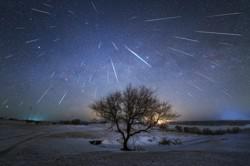
Geminid Meteor Shower from China, by Dai Jianfeng, China
Caption: First place in the 2021 IAU OAE Astrophotography Contest, category Meteor showers.
A meteor shower occurs when the Earth in its orbit around the Sun, passes through a debris trail left previously by a comet on its approach around the Sun. As the Earth enters this debris (small sand grain sized), they enter the atmosphere at high speeds and on parallel trajectories, burning completely leaving beautiful tracks (streaks) in the sky. These streaks can appear and disappear in the blink of an eye, or last much longer. On rare occasions the debris originates from asteroids, as in the case of the Geminid meteor shower, shown in this image, picturing many streaks of debris captured in the sky of China in 2017. Due to relative motions and perspective, the shower appears to come from one single point, known as the radiant point, beautifully pictured in this image. This is similar to driving in a car on a rainy day without any wind, looking out the front window it seems that the rain is coming directly towards the window, when in fact the rain is falling vertically downwards.
Credit: Dai Jianfeng/IAU OAE
License: CC-BY-4.0 Creative Commons Attribution 4.0 International (CC BY 4.0) icons
Related Activities
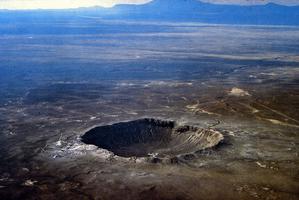
Meteoroids, Meteors and Meteorites
astroEDU educational activity (links to astroEDU website) Description: Unveiling the mystery of "shooting stars": meteors, meteorites and meteroids
License: CC-BY-4.0 Creative Commons Attribution 4.0 International (CC BY 4.0) icons
Tags:
Geology
Age Ranges:
6-8
, 8-10
, 10-12
, 12-14
Education Level:
Middle School
, Primary
Areas of Learning:
Interactive Lecture
Costs:
Low Cost
Duration:
1 hour 30 mins
Group Size:
Group
Skills:
Analysing and interpreting data
, Asking questions
, Communicating information
, Engaging in argument from evidence