This page describes an image Detailansicht von Charon, einem Mond des Pluto
Datei runterladen ( Bild 2.88 MB)
Bildunterschrift:
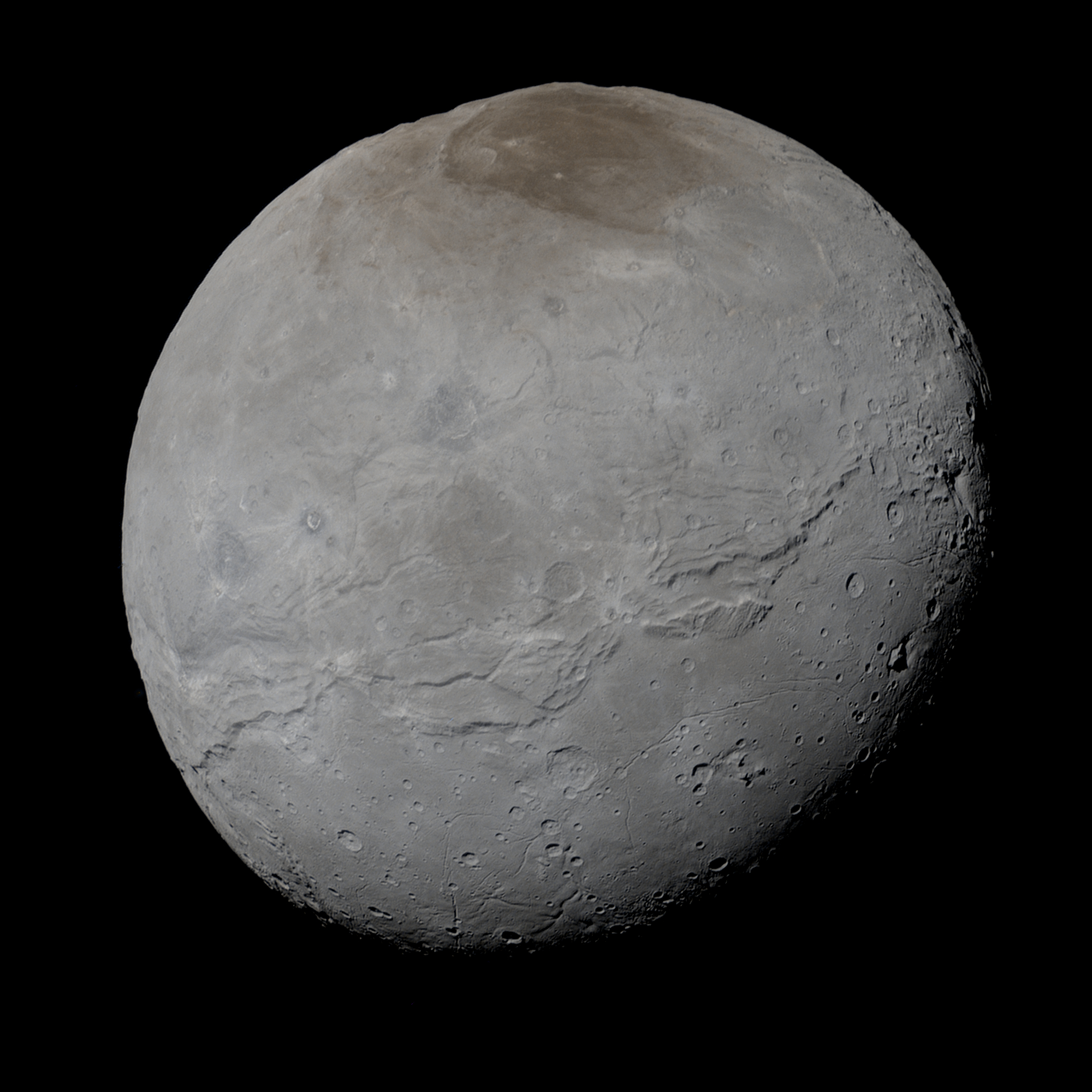
Charon ist der größte natürliche Mond des Zwergplaneten Pluto. Diese detaillierte Aufnahme wurde 2015 von der NASA-Sonde „New Horizons“ während ihrer historischen Mission durch das äußere Sonnensystem aufgenommen. Die Oberfläche von Charon zeigt eine faszinierende Mischung aus hellen und dunklen Regionen, darunter riesige Schluchten, weite Ebenen und Einschlagkrater. Mit einem Durchmesser von etwa 1.200 Kilometern hat Charon mehr als die Hälfte des Durchmessers von Pluto und ist damit im Vergleich zu seinem Mutterkörper ungewöhnlich groß. Die Masse von Charon beträgt etwa 12 % der Masse von Pluto.
Da Pluto und Charon eine so ähnliche Masse haben, liegt der Massenschwerpunkt des Systems (der Punkt, um den sowohl Pluto als auch Charon kreisen) nicht innerhalb von Pluto, sondern zwischen Pluto und Charon. Dies steht im Gegensatz zu Systemen wie der Erde und ihrem Mond, bei denen der Massenschwerpunkt innerhalb des größeren Körpers liegt, in diesem Fall der Erde. Wissenschaftler vermuten, dass sich das Pluto-Charon-System möglicherweise durch eine Kollision zweier Objekte gebildet hat, die sich anschließend trennten und begannen, einander zu umkreisen. Durch die Untersuchung von Charon und den kleineren Monden, die Pluto umkreisen, gewinnen Astronomen Einblicke in die Entstehung von Monden und die Entwicklung weit entfernte Eiskörper über Milliarden von Jahren hinweg.
Scroll zu Unterschriften auf anderen Sprachen
Bildquelle:
NASA/Labor für Angewandte Physik der Johns-Hopkins-Universität/Southwest Research Institute/Alex Parker Link zur Quelle
Unterschrift Übersetzungsstatus: Noch nicht bestätigt von einem Rezensenten
Unterschrift-Übersetzer: Simon Kraus
Ähnliche Glossarbegriffe:
Monde
, Pluto
Bildlizenz: Gemeinfrei Gemeinfrei Symbole
The media file captions presented on the OAE website were written, translated and reviewed by a collective effort from the OAE, the OAE Centers and Nodes, the OAE National Astronomy Education Coordinators (NAECs) and other volunteers. You can find a full list of credits for our translation project here. All media file captions are released under a Creative Commons CC BY-4.0 license and should be credited to "IAU OAE". The media files themselves may have different licenses (see above) and should be credited as listed above under "credit".
Falls dir ein inhaltlicher Fehler in dieser Unterschrift oder ein Fehler in einer der Übersetzungen auffällt, bitte kontaktiere uns.
Unterschriften auf verschiedenen Sprachen:
Bildunterschrift: Charon is the largest natural moon of the dwarf planet Pluto. This detailed image was taken by NASA’s New Horizons spacecraft in 2015 during its historic mission through the outer Solar System. Charon’s surface shows a fascinating mix of light and dark regions, including vast canyons, broad plains, and impact crater. With a diameter of about 1,200 kilometers, Charon is more than half the diameter of Pluto, making it unusually large compared to its parent body. Charon's mass is roughly 12% of that of Pluto.
Because Pluto and Charon are so close in mass, the center of mass of the system (the point both Pluto and Charon orbit) is not within Pluto but between Pluto and Charon. This is in contrast to systems like the Earth and its Moon where the center of mass lies within the larger body, the Earth in this case. Scientists think the Pluto-Charon system may have formed by a collision of two objects that then separated and began to orbit each other. By studying Charon and the smaller moons that circle Pluto, astronomers gain insight into how moons form and how distant icy bodies evolve over billions of years.
Bildquelle: NASA/Johns Hopkins University Applied Physics Laboratory/Southwest Research Institute/Alex Parker
Ähnliche Glossarbegriffe: Moons , Pluto
Bildunterschrift: Caronte è il satellite naturale più grande del pianeta nano Plutone. Questa immagine dettagliata è stata scattata dalla sonda New Horizons della NASA nel 2015 durante la sua storica missione nel Sistema Solare esterno. La superficie di Caronte presenta un affascinante alternarsi di regioni chiare e scure, tra cui vasti canyon, ampie pianure e crateri da impatto. Con un diametro di circa 1.200 chilometri, Caronte misura più della metà del diametro di Plutone, il che lo rende insolitamente grande rispetto al pianeta. La massa di Caronte è pari a circa il 12% di quella di Plutone.
Poiché Plutone e Caronte hanno masse molto simili, il centro di massa del sistema (il punto attorno al quale orbitano sia Plutone che Caronte) non si trova all'interno di Plutone, ma tra Plutone e Caronte. Ciò è in contrasto con sistemi come quello della Terra e della Luna, dove il centro di massa si trova all'interno del corpo più grande, in questo caso la Terra. Gli scienziati ritengono che il sistema Plutone-Caronte possa essersi formato dalla collisione di due oggetti che poi si sono separati e hanno iniziato a orbitare l'uno attorno all'altro. Studiando Caronte e le lune più piccole che orbitano attorno a Plutone, gli astronomi acquisiscono informazioni su come si formano le lune e su come i corpi ghiacciati lontani si evolvono nel corso di miliardi di anni.
Bildquelle: NASA/Laboratorio di Fisica Applicata dell'Università Johns Hopkins/Southwest Research Institute/Alex Parker
Ähnliche Glossarbegriffe: Lune , Plutone Unterschrift Übersetzungsstatus: Noch nicht bestätigt von einem Rezensenten
Unterschrift-Übersetzer: Giuliana Giobbi
Bildunterschrift: Caronte é a maior lua natural do planeta anão Plutão. Esta imagem detalhada foi obtida pela sonda New Horizons da NASA em 2015, durante sua histórica missão pelo Sistema Solar exterior. A superfície de Caronte apresenta uma mistura fascinante de regiões claras e escuras, incluindo vastos cânions, amplas planícies e crateras de impacto. Com um diâmetro de cerca de 1.200 quilômetros, Caronte tem mais da metade do diâmetro de Plutão, o que o torna excepcionalmente grande em comparação com seu corpo principal. A massa de Caronte é de aproximadamente 12% da massa de Plutão. Como Plutão e Caronte têm massas relativamente próximas, o centro de massa do sistema (o ponto em torno do qual tanto Plutão quanto Caronte orbitam) não está dentro de Plutão, mas entre Plutão e Caronte. Isso contrasta com sistemas como o da Terra e sua Lua, onde o centro de massa fica dentro do corpo maior, a Terra, neste caso. Os cientistas acreditam que o sistema Plutão-Caronte pode ter se formado por uma colisão de dois objetos que depois se separaram e começaram a orbitar um ao outro. Ao estudar Caronte e as luas menores que orbitam Plutão, astrônomos obtêm pistas sobre como as luas se formam e como corpos gelados distantes evoluem ao longo de bilhões de anos.
Bildquelle: NASA/Laboratório de Física Aplicada da Universidade Johns Hopkins/Instituto de Pesquisa Southwest/Alex Parker
Ähnliche Glossarbegriffe: Luas , Plutão Unterschrift Übersetzungsstatus: Noch nicht bestätigt von einem Rezensenten
Unterschrift-Übersetzer: Eduardo Monfardini Penteado