Glossar-Begriff: Rover
Beschreibung: Ein Rover ist ein Landfahrzeug, das mit einem Raumschiff zur Oberfläche eines anderen Himmelskörpers geschickt wird, um diesen zu erkunden.
Die meisten Rover können von der Erde aus ferngesteuert werden, um sich über die Oberfläche des Himmelskörpers zu bewegen. Im Rahmen der Apollo-Missionen sind auch Menschen mit Rovern über die Mondoberfläche gefahren.
Rover können viele wissenschaftliche Instrumente wie kleine Bohrer, Werkzeuge zum Sammeln von Proben, Kameras und sogar ein kleines Labor zur Analyse von Luft- und Bodenproben mit sich führen und die Ergebnisse zurück zur Erde senden.
Ähnliche Begriffe:
Dieser Begriff in anderen Sprachen
Begriffs- und Definitionsstatus Die Originaldefinition dieses Begriffes auf Englisch wurden von einem forschenden Astronom und einer Lehrkraft bestätigt Die Übersetzung dieses Begriffs und seiner Definition warten auf Prüfung und Bestätigung
The OAE Multilingual Glossary is a project of the IAU Office of Astronomy for Education (OAE) in collaboration with the IAU Office of Astronomy Outreach (OAO). The terms and definitions were chosen, written and reviewed by a collective effort from the OAE, the OAE Centers and Nodes, the OAE National Astronomy Education Coordinators (NAECs) and other volunteers. You can find a full list of credits here. All glossary terms and their definitions are released under a Creative Commons CC BY-4.0 license and should be credited to "IAU OAE".
Wenn dir ein inhaltlicher oder Übersetzungsfehler in diesem Glossarbegriff oder dieser Definition auffallen, bitte kontaktiere uns.
Auf anderen Sprachen
- Arabisch: المركبة الجوالة
- Englisch: Rover
- Spanisch: Rover
- Französisch: Rover
- Italienisch: Rover
- Brasilianisches Portugiesisch: Veículo Explorador (Rover)
- Vereinfachtes Chinesisch: 漫游车
- Traditionelles Chinesisch: 漫遊車
Ähnliche Medien
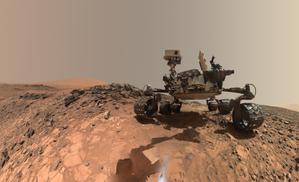
Mars-Rover Curiosity
Unterschrift: Dieses Selbstporträt des NASA-Marsrovers Curiosity zeigt das Fahrzeug an der Stelle, von der aus es nach unten griff, um ein Felsziel namens "Buckskin" am unteren Mount Sharp anzubohren. Das Selfie kombiniert mehrere Bilder, die von Curiositys Mars Hand Lens Imager (MAHLI) am 5. August 2015 aufgenommen wurden, während des 1.065. Marstages, auch Sol genannt, den der Rover auf dem Mars gearbeitet hat.
Bild: NASA/JPL-Caltech/MSSS
Quellenlink
License: PD Gemeinfrei Symbole

Record-Breaking Off-Earth Driving: Rovers on Mars & the Moon
Unterschrift: Part of the Simplifying Astronomy for Arabic Speakers project, this infographic highlights the longest distances traveled by rovers on Mars and the Moon, showcasing space exploration’s progress.
Top Rovers & Their Achievements
Mars: NASA’s Opportunity holds the record, covering 45.16 km between 2004–2018.
Moon: The Soviet Lunokhod 2 leads with 39 km, followed by Apollo rovers:
Apollo 17: 35.74 km
Apollo 15: 27.8 km
Apollo 16: 27.1 km
Mars vs. Moon: Different Challenges
1. Martian Terrain – Mars has a thin atmosphere, dust storms, and rugged landscapes, requiring durable, long-term rovers.
2. Lunar Terrain – The Moon’s cratered surface lacks an atmosphere, allowing easier movement but with shorter mission durations.
3. Mission Longevity – Mars rovers operate for years, while Apollo lunar rovers were used briefly.
Future Rovers & Expectations
Curiosity may reach 42.195 km, making it one of Mars' most traveled rovers.
Yutu-2 (China) continues exploring the Moon since 2019.
Conclusion
These record-breaking distances showcase technological advancements in planetary exploration. With continued innovation, future rovers will go even further, paving the way for ambitious human missions beyond Earth!
Bild: Ali Al-Edhari ; adapted from the original by NASA/JPL-Caltech
License: CC-BY-4.0 Creative Commons Namensnennung 4.0 International (CC BY 4.0) Symbole
Ähnliche Aktivitäten
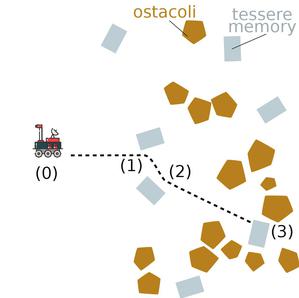
Driving on Mars
astroEDU educational activity (links to astroEDU website) Description: An educational interdisciplinary game to drive a rover on Mars
License: CC-BY-4.0 Creative Commons Namensnennung 4.0 International (CC BY 4.0) Symbole
Schlagworte
Game
, robot
, robotics
, simulation
, telecommunications
Altersgruppen:
14-16
, 16-19
Bildungsniveau:
Middle School
, Secundaria
Lernbereiche:
Guided-discovery learning
Kosten:
Low Cost
Dauer:
2 hours
Gruppengröße:
Group
Fähigkeiten:
Communicating information
, Developing and using models
, Using mathematics and computational thinking