词条 月相
描述: 月相是指月球在围绕地球运行的轨道上的位置。月球位置的不断变化导致从地球上看到的月球被照亮部分的形状在一个朔望月中不断变化。除了月食期间,月球总有一半被太阳照亮。随着月球在围绕地球的轨道上移动,地球上的我们会先后看到月球的不同部分被照亮。0度的相位既是上一个朔望月的终点,又是下一个朔望月的起点,称为新月,月球在这里达到整个轨道上与太阳距离最近的位置。在这个相位处,月球被照亮的是远离地球的那一面,因此看起来是黑暗的。之后,月球被照亮的部分逐渐增大(称为盈月期),变为蛾眉月。上弦月(月亮的一半被照亮,俗称半月)出现在距离起点90度的相位。之后,月球被照亮的部分继续增大,变为渐盈凸月(呈凸形或鼓形)。满月出现在距离起点180度处。此后,月球被照亮的部分开始逐渐减小(称为亏月期),先变为渐亏凸月,再在距起点270度处变为下弦月(月亮的一半被照亮,俗称半月),又变为残月,最后在360度处变为新月并到达终点。尽管在90度和270度相位处,月球靠近地球的那一面都是一半被照亮,但被照亮的部分却是相反的。
相关词条
用其他语言查看该词条
词条和定义状态: 该术语的英文原始定义已通过天文研究人员和教师的审核 该术语及其定义的译文仍待审核
OAE多语言词汇表是由国际天文学联合会(IAU) 天文教育办公室(OAE) 和 国际天文学联合会(IAU) 天文推广办公室(OAO)合作的项目。. 术语和定义由 OAE中心, OAE 国家天文教育协调员(NAECs) 以及其他志愿者共同选择、撰写和审阅。您可以在 找到完整的致谢列表。所有词汇表术语及其定义均根据 Creative Commons CC BY-4.0许可证发布 且版权归属于 “IAU OAE”。
如果您发现此词汇术语或定义中的事实或翻译错误, 请向 发邮件 联系.
其他语言版本
- 阿拉伯语: الطور القمري
- 德语: Mondphase
- 英语: Lunar Phase
- 西班牙语: Fase lunar
- 法语: Phase lunaire
- 意大利语: Fase lunare
- 日语: 月の位相 (外部链接)
- 马拉地语: चंद्राच्या कला
- 巴西葡萄牙语: Fase lunar
- 繁体中文: 月相
相关媒体
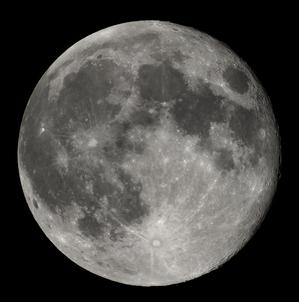
满月
图注: 这张图像展示了用小型望远镜和单反相机观察到的接近满月的月亮。
来源: 卢克 维亚图尔
来源链接
License: CC-BY-SA-3.0 知识共享许可协议 Attribution-ShareAlike 3.0 Unported 图标

满月
图注: 在南半球(新西兰)拍摄的满月。在这一阶段,从地球上完全可以看到月亮被照亮的一半。
来源: Dave Young / dcysurfer
来源链接

First quarter moon
图注: The first quarter moon photographed from New Zealand. As half of the moon's illuminated half is visible, this is phase is popularly know as half moon.
来源: Dave Young / dcysurfer
来源链接

First quarter moon
图注: The first quarter moon photographed from the Northern Hemisphere (USA). At this phase half of the moon's illuminated half is visible. This phase is popularly known as half moon.
来源: Stephen Rahn
来源链接
License: CC0 CC0 1.0 通用 (CC0 1.0) 公共领域贡献 图标

Last quarter moon
图注: This shows the last quarter moon photographed from the Northern Hemisphere (USA). During this phase half of the moon's illuminated half is visible. This phase is popularly known as half moon.
来源: Stephen Rahn
来源链接
License: CC0 CC0 1.0 通用 (CC0 1.0) 公共领域贡献 图标
相关图表

Lunar Phase Northern Hemisphere
图注: The phases of the Moon when viewed from the Northern Hemisphere. Here north is up and east is left. The Moon orbits the Earth every 29.5 days. It is tidally locked to the Earth meaning its rotation period is the same as its orbital period and the same side of the Moon always faces the Earth. At any particular time, half of the Moon is illuminated by the Sun and half is in shadow. Over the course of the Moon’s orbit around the Earth every part of the Moon is illuminated for half of the orbit and is in shadow for the other half of the orbit.
When the Moon sits between the Earth and the Sun its illuminated half faces away from the Earth and we only see the half that is in shadow. This phase of the Moon is known as new moon. As the Moon moves in its orbit, a small but growing sliver of the illuminated half of the Moon begins to be seen from the Earth. This illuminated sliver appears on the western side of the Moon’s face when viewed from Earth. This phase is known as waxing crescent moon. By a quarter of the way through the Moon’s orbit around the Earth the Moon appears 90° away from the Sun and half of the Moon’s illuminated half points toward the Earth. This phase is known as first quarter moon. As the orbit continues more than half of the Moon seen from Earth is now illuminated with a dark crescent. This phase is known as waxing gibbous moon. Once we reach the halfway point in the Moon’s orbit round the Earth the Moon is now on the opposite side of the Earth from the Sun and we see all of the Moon’s illuminated half. As the whole of the side of the Moon that faces the Earth is now illuminated this is referred to as full moon.
For the remaining half of the Moon’s orbit the half of the moon that faces the Earth begins to move into shadow. Hence the illuminated portion of the Moon that we see from Earth begins to shrink or wane. The western edge of the face of the Moon when viewed from Earth begins to appear dark and this grows through subsequent phases. The phases are repeated in reverse order: waning gibbous, third quarter, waning crescent and finally back to new moon.
Note the surface features of the Moon are illustrative and do not accurately represent the Moon’s true surface.
来源: Aneta Margraf/IAU OAE
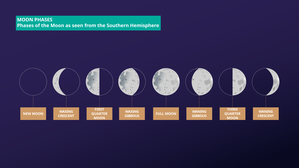
Lunar Phase Southern Hemisphere
图注: The phases of the Moon when viewed from the Southern Hemisphere. Here north is up and west is left The Moon orbits the Earth every 29.5 days. It is tidally locked to the Earth meaning its rotation period is the same as its orbital period and the same side of the Moon always faces the Earth. At any particular time, half of the Moon is illuminated by the Sun and half is in shadow. Over the course of the Moon’s orbit around the Earth every part of the Moon is illuminated for half of the orbit and is in shadow for the other half of the orbit.
When the Moon sits between the Earth and the Sun its illuminated half faces away from the Earth and we only see the half that is in shadow. This phase of the Moon is known as new moon. As the Moon moves in its orbit, a small but growing sliver of the illuminated half of the Moon begins to be seen from the Earth. This illuminated sliver appears on the western side of the Moon’s face when viewed from Earth. This phase is known as waxing crescent moon. By a quarter of the way through the Moon’s orbit around the Earth the Moon appears 90° away from the Sun and half of the Moon’s illuminated half points toward the Earth. This phase is known as first quarter moon. As the orbit continues more than half of the Moon seen from Earth is now illuminated with a dark crescent. This phase is known as waxing gibbous moon. Once we reach the halfway point in the Moon’s orbit round the Earth the Moon is now on the opposite side of the Earth from the Sun and we see all of the Moon’s illuminated half. As the whole of the side of the Moon that faces the Earth is now illuminated this is referred to as full moon.
For the remaining half of the Moon’s orbit the half of the moon that faces the Earth begins to move into shadow. Hence the illuminated portion of the Moon that we see from Earth begins to shrink or wane. The western edge of the face of the Moon when viewed from Earth begins to appear dark and this grows through subsequent phases. The phases are repeated in reverse order: waning gibbous, third quarter, waning crescent and finally back to new moon.
Note the surface features of the Moon are illustrative and do not accurately represent the Moon’s true surface.
来源: Aneta Margraf/IAU OAE

Lunar Phase Equator
图注: The phases of the Moon when viewed from the Equator. Here west is up, north is left and east is down. The Moon orbits the Earth every 29.5 days. It is tidally locked to the Earth meaning its rotation period is the same as its orbital period and the same side of the Moon always faces the Earth. At any particular time, half of the Moon is illuminated by the Sun and half is in shadow. Over the course of the Moon’s orbit around the Earth every part of the Moon is illuminated for half of the orbit and is in shadow for the other half of the orbit.
When the Moon sits between the Earth and the Sun its illuminated half faces away from the Earth and we only see the half that is in shadow. This phase of the Moon is known as new moon. As the Moon moves in its orbit, a small but growing sliver of the illuminated half of the Moon begins to be seen from the Earth. This illuminated sliver appears on the western side of the Moon’s face when viewed from Earth. This phase is known as waxing crescent moon. By a quarter of the way through the Moon’s orbit around the Earth the Moon appears 90° away from the Sun and half of the Moon’s illuminated half points toward the Earth. This phase is known as first quarter moon. As the orbit continues more than half of the Moon seen from Earth is now illuminated with a dark crescent. This phase is known as waxing gibbous moon. Once we reach the halfway point in the Moon’s orbit round the Earth the Moon is now on the opposite side of the Earth from the Sun and we see all of the Moon’s illuminated half. As the whole of the side of the Moon that faces the Earth is now illuminated this is referred to as full moon.
For the remaining half of the Moon’s orbit the half of the moon that faces the Earth begins to move into shadow. Hence the illuminated portion of the Moon that we see from Earth begins to shrink or wane. The western edge of the face of the Moon when viewed from Earth begins to appear dark and this grows through subsequent phases. The phases are repeated in reverse order: waning gibbous, third quarter, waning crescent and finally back to new moon.
The perspective for this diagram is with west up, north left and east down. When the moon is viewed looking west, for example viewing the waxing crescent just after sunset, the view of the Moon would be rotated by 180°.
Note the surface features of the Moon are illustrative and do not accurately represent the Moon’s true surface.
来源: Aneta Margraf/IAU OAE

Total Solar Eclipse
图注: This not to scale diagram shows what happens during a total solar eclipse. The Moon orbits the Earth, but its orbit is slightly tilted with respect to the Earth’s orbit around the Sun. During the new moon lunar phase, the Moon lies between the Earth and the Sun, but due to the Moon’s tilted orbit around the Earth, the Moon normally lies above or below the Sun at this point. However twice a year the Moon’s orbit lines up in such a way that the Moon can lie in a direct line between the Earth and Sun. During each of these periods (each of which last roughly a month) solar (and lunar) eclipses can occur. The Moon is about 400 times smaller than the Sun, but is 400 times closer to the Earth than the Sun. Hence the Sun and Moon have approximately the same angular size when viewed from the Earth. This means that it is possible for the Moon to completely cover the Sun when viewed from Earth. This is known as a total solar eclipse.
Here we see a schematic of such and eclipse. The Moon casts a shadow on the Earth known as the umbra. This is a roughly circular shadow a few hundred kilometres across although its shape can be severely distorted when the eclipse is at the edge of the illuminated part of the Earth. Any region within the umbra will see the Moon completely cover the Sun and thus will experience a total solar eclipse. Outside of the umbra there are regions where the Moon will cover part of the Sun. This partial shadow is known as the penumbra. Regions in the penumbra will experience a partial solar eclipse.
An eclipse is a dynamic event with the Moon moving in its orbit and the Earth rotating. Hence the umbra and penumbra move across the Earth’s surface together. The path the umbra takes across the Earth is known as the path of totality. Let’s consider one particular region that lies in the path of totality: except in rare cases where an eclipse begins at sunrise, a region that experiences totality will first see the Moon cover part of the Sun and gradually move across Sun until it is totally covered. From outside the Earth this would appear as the penumbra moving over this particular region followed by the umbra moving over this region. Once the Moon moves so that it no longer completely covers the Sun, totality ends and the umbra moves away from this particular region. The Moon will continue to uncover the Sun until (unless the Sun sets before the end of the eclipse) the Sun is completely uncovered. From outside the Earth this would appear as the umbra moving away from our particular region and the edge of the penumbra approaching and eventually passing over the region.
Outside of the path or totality there is a much broader region that will lie in the penumbra but will be missed by the umbra. Such regions will not experience a total solar eclipse during this event, only a partial solar eclipse.
来源: Aneta Margraf/IAU OAE