词条 红外望远镜
描述: 红外望远镜观测红外波段的光,用于红外天文学。红外望远镜可以安装在地面上,也可以安装在太空中。位于地球上的观测站由于受到大气吸收和地球大气层、望远镜本身及其周围环境发出的红外辐射的影响,其观测范围受到限制。空间红外望远镜不需要处理大气吸收或其周围环境的红外辐射,并且可以屏蔽太阳和冷却,从而减少望远镜发出的红外辐射。
相关词条
用其他语言查看该词条
词条和定义状态: 该术语的英文原始定义已通过天文研究人员和教师的审核 该术语及其定义的译文仍待审核
OAE多语言词汇表是由国际天文学联合会(IAU) 天文教育办公室(OAE) 和 国际天文学联合会(IAU) 天文推广办公室(OAO)合作的项目。. 术语和定义由 OAE中心, OAE 国家天文教育协调员(NAECs) 以及其他志愿者共同选择、撰写和审阅。您可以在 找到完整的致谢列表。所有词汇表术语及其定义均根据 Creative Commons CC BY-4.0许可证发布 且版权归属于 “IAU OAE”。
如果您发现此词汇术语或定义中的事实或翻译错误, 请向 发邮件 联系.
其他语言版本
- 阿拉伯语: تلسكوب الأشعة تحت الحمراء
- 德语: Infrarotteleskop
- 英语: Infrared Telescope
- 西班牙语: Telescopio infrarrojo
- 法语: Télescope infrarouge
- 意大利语: Telescopio a infrarossi
- 巴西葡萄牙语: Telescópio infravermelho
- 繁体中文: 紅外望遠鏡
相关媒体

The Pillars of Creation in comparison
图注: The 'Pillars of Creation' are a renowned astronomical feature situated within the Eagle Nebula in the Serpens constellation. The illustration provides a direct comparison between images captured by the Hubble Space Telescope (HST) and the James Webb Space Telescope (JWST), showcasing the pillars, which span several light years in diameter, in both visible light (also known as optical light) and infrared light. On the left are the pillars as seen by Hubble in visual light, taken in 2014. It displays dark pillars against an opaque background, with only a handful of visible stars. Conversely, the counterpart on the right is Webb’s near-infrared view published in 2022, penetrating the dust and revealing numerous stars of varying sizes.
Their distance from Earth is approximately 6,500 to 7,000 light years. Within these pillars, new stars are constantly forming, making them a subject of extensive study by astronomers. Composed mostly of cool molecular hydrogen and small amounts of interstellar dust, they are subject to erosion by the intense ultraviolet radiation emitted by nearby massive and newborn stars, a process known as photoevaporation.
来源: NASA, ESA, CSA, STScI
来源链接
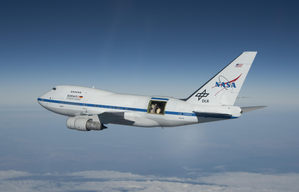
SOFIA: Unveiling the Infrared Universe from the Skies
图注: This image shows the Stratospheric Observatory for Infrared Astronomy (SOFIA) telescope. This telescope which operated from 2010 to 2022 was mounted in a modified Boeing 747 aircraft with a section of the rear fuselage removed to allow the telescope to observe the sky and with other modifications that allow it to fly at a higher altitude than a standard 747.
Many molecules which are common in the Earth's atmosphere (such as water, carbon dioxide and methane) absorb radiation at infrared wavelengths. This interferes with infrared observations made from the ground. SOFIA flew at an altitude that puts it above most of the water vapour in the Earth's atmosphere, greatly reducing the impact of absorption by water molecules on its observations.
来源: NASA photo / Jim Ross
来源链接
License: PD 公共领域 图标







.png)
