Glossary term: Gravitational Lens
Description: Objects with mass can bend the path followed by light that passes nearby their gravitational influence. This effect, predicted by Einstein's theory of general relativity, was first observed during the solar eclipse of 1919 when the bending of starlight from several stars near the Sun was measured. Gravitational lensing is most apparent for very massive objects such as galaxies or galaxy clusters. If observers on Earth are looking at a distant object whose light is thus bent (by "the lens"), the object will appear distorted. This distortion always implies light (de)magnification, typically allowing us to better see otherwise faint background objects. When the lens has enough mass concentrated in a small angular area, multiple images of the same background object are produced, each having its light reaching the observer at different times. Measuring these so-called "time delays" is one of the best ways to determine the value of the Hubble Constant on extragalactic scales. Multiple images from a lens, on the other hand, allow us to precisely determine its mass (using modelling); this is a very useful method for finding the mass of galaxies and, especially, galaxy clusters.
Related Terms:
See this term in other languages
Term and definition status: This term and its definition have been approved by a research astronomer and a teacher
The OAE Multilingual Glossary is a project of the IAU Office of Astronomy for Education (OAE) in collaboration with the IAU Office of Astronomy Outreach (OAO). The terms and definitions were chosen, written and reviewed by a collective effort from the OAE, the OAE Centers and Nodes, the OAE National Astronomy Education Coordinators (NAECs) and other volunteers. You can find a full list of credits here. All glossary terms and their definitions are released under a Creative Commons CC BY-4.0 license and should be credited to "IAU OAE".
If you notice a factual error in this glossary definition then please get in touch.
In Other Languages
- Arabic: عدسة الجاذبية
- German: Gravitationslinse
- Spanish: Lente gravitacional
- French: Lentille gravitationnelle
- Hindi: गुरुत्वाकर्षण लेंस
- Italian: Lente gravitazionale
- Japanese: 重力レンズ (external link)
- Marathi: गुरुत्वीय भिंग (ग्रॅव्हिटेशनल लेन्सिंग)
- Brazilian Portuguese: Lente gravitacional
- Simplified Chinese: 引力透镜
- Traditional Chinese: 引力透鏡
Related Media
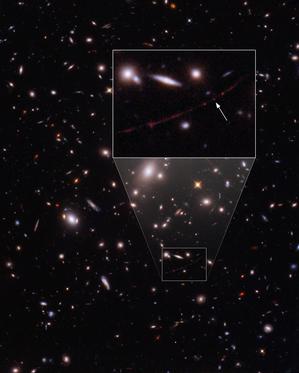
A gravitational lens magnifies one of the first stars
Caption: This image zooms in on a star formed within the first billion years after the birth of the Universe (at a redshift of 6.2). The Hubble Space Telescope detected this light using a technique called gravitational lensing. A massive galaxy cluster between the observer and the imaged star creates a distorted and warped image of the parent galaxy and reveals its features.
Credit: NASA, ESA, B. Welch (JHU), D. Coe (STScI), A. Pagan (STScI)
credit link
License: CC-BY-4.0 Creative Commons Attribution 4.0 International (CC BY 4.0) icons

The Happy Face of Gravitational Lensing
Caption: Captured by the NASA/ESA Hubble Space Telescope, this image showcases the galaxy cluster SDSS J1038+4849, affectionately dubbed the "happy face" cluster due to its striking resemblance to a smiling face. The two bright galaxies at the center resemble orange eyes, while the arcs surrounding them form the illusion of a smile. These arcs are actually a result of strong gravitational lensing, a phenomenon where the cluster's immense gravitational pull distorts and magnifies light from background objects. This particular case of gravitational lensing has produced an Einstein Ring, a ring-like structure formed by the precise alignment of the source, lens, and observer. By studying these gravitational lenses, astronomers gain insights into the properties of massive galaxies, allowing for a deeper understanding of the early Universe.
Credit: NASA/ESA
credit link
License: PD Public Domain icons
Related Activities

Dark matter & dark energy (Part 2) – Understanding the nature of dark matter and dark energy
astroEDU educational activity (links to astroEDU website) Description: Let's investigate the nature of dark matter and energy with gravitational lensing!
License: CC-BY-4.0 Creative Commons Attribution 4.0 International (CC BY 4.0) icons
Tags:
Experiment
, Invisible
Age Ranges:
12-14
, 14-16
, 16-19
, 19+
Education Level:
Informal
, Middle School
Areas of Learning:
Guided-discovery learning
, Interactive Lecture
, Modelling
, Problem-solving
Costs:
Medium Cost
Duration:
45 mins
Group Size:
Group
Skills:
Constructing explanations
, Developing and using models
, Engaging in argument from evidence